
Our Approach · The Legends · Era II
Era II · 1898 to 1978
Clarence Gonstead
The Engineer
Clarence Gonstead (1898 to 1978) was the Wisconsin chiropractor who built the most demanding spinal analysis in the profession. He placed the subluxation at the intervertebral disc, required five separate examinations to agree on one segment before adjusting it, and practiced fifty-one years in Mount Horeb. The Unified Model of Tone reads those five criteria as convergence: several partial windows onto one regulatory state, layered until they name the one segment worth adjusting.
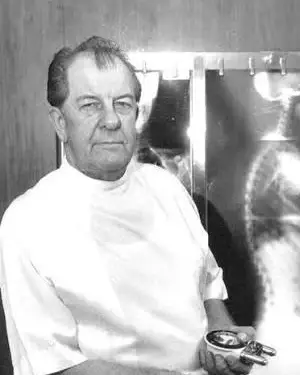
Born
July 23, 1898 · Willow Lake, South Dakota
Died
October 2, 1978 · Mount Horeb, Wisconsin
Practiced
Fifty-one years · 1923 to 1974
Clinic
Gonstead Clinic of Chiropractic · 29,000 sq ft, 1964
Engineering, then chiropractic
Gonstead trained as an engineer before he trained as a chiropractor
Clarence Selmer Gonstead worked as an automotive engineer before he enrolled in chiropractic school, and the order of those two trainings shaped everything that followed. He was born in 1898 at Willow Lake, South Dakota, the son of Carl and Sarah Gonstead. His father moved the family a few years later to a dairy farm at Primrose, Wisconsin, where tractors and the first generation of automobiles were the machines the boy learned on. He graduated from the Palmer School of Chiropractic in 1923 and practiced for the next fifty-one years.
The engineer's question is where the load goes, not what hurts
An engineer looking at a tilted beam examines the footing under it. Gonstead applied that habit to the human frame and read the spine as a weight-bearing structure standing on a pelvis. Every finding above the pelvis was assessed for whether it caused the problem or answered it. Robert Cooperstein's technique review in the Journal of Chiropractic Medicine in 2003 remains the standard peer-reviewed description of the system that grew out of that habit (Cooperstein, 2003).
Rheumatoid arthritis at nineteen put Gonstead in a chiropractor's hands
Gonstead was in trade school when acute rheumatoid arthritis took him out of it for four weeks. By his own account the pain began in a toe, swelled the whole foot within three days, then moved to the left knee and the right. University physicians attended him at his aunt's house on the east side of Madison for two weeks without progress. His aunt then called her own doctor, a chiropractor named J.B. Olson, who came to the house. After a course of adjustments and rest, Gonstead walked again, and he began saving engineering wages for tuition.
I couldn't even stand having the covers over my knee. I had a box over it. The knee was that sore.
Clarence Gonstead, recalling the illness that sent him to chiropractic, Gonstead Clinical Studies SocietyThe disc concept
Gonstead moved the subluxation from the bone to the intervertebral disc
The single claim that separates Clarence Gonstead from his contemporaries is where he located the lesion. Working with his younger brother Merton, who joined the Mount Horeb practice in 1929, Gonstead concluded that the intervertebral disc governs the segment above it. The Gonstead Disc Concept came out of that partnership. Decades later the profession recognized it as an early model of what medicine now calls discogenic pain.
What the profession held when Gonstead started practicing
The dominant account in the 1920s came from B.J. Palmer and put the subluxation at the bone. A vertebra sat out of position and pressed on a nerve, and the upper cervical spine was the place worth correcting. Gonstead accepted the consequence and rejected the location. Simon Senzon's 2018 history of subluxation models names Gonstead among the technique developers who took the profession from upper cervical models back to the full spine (Senzon, J Chiropr Humanit 2018).
The mechanical argument behind the disc concept
A disc under uneven load wedges, and the vertebra above tips into the wedge. Disc height falls on the loaded side, the intervertebral foramen narrows, and the nerve root loses room. The disc carries almost no blood supply and depends on movement to exchange fluid, which a wedged segment cannot do. Gonstead read that sequence as self-sustaining, which is why he wanted the segment restored to a position gravity would hold rather than moved once.
Locating the lesion at the disc removed rotation from the adjustment
A rotatory thrust loads a disc in torsion, so Gonstead would not use one. He engineered the setups instead, modifying the Zenith Hy-Lo into the table sold today as the Zenith 210 and designing the thoracic break-away piece still in use. Every table in the system holds a patient where a specific line of drive is available without twisting the column. The Gonstead technique page carries the contacts, the tables, and the listing notation in full.
The level foundation
Gonstead read every spine upward from the pelvis
Gonstead treated the sacral base as the floor the whole column stands on. Tilt that floor and the spine compensates: a lumbar curve appears to keep the head over the feet, a thoracic curve answers it, and the cervical spine finishes the job. Gregory Plaugher set the premise out in five terms in the 1993 Textbook of Clinical Chiropractic. Level foundation, intervertebral disc, compensation, fixation, and listing.
The loudest region is often the compensation
Gonstead taught that the tight, tender, guarded area is frequently the spine answering a problem set somewhere else, and that the segment which set it is often silent. Patients arrive with upper neck pain and the neck turns out to be compensating for a tilted pelvis. That distinction between a primary site and a downstream answer is the reason the Gonstead analysis starts at the bottom of the film and works up.
The pelvic marking system was tested and held
Gonstead's pelvic analysis reads the relative positions of the two innominate bones and the sacrum, and measures leg length inequality from femur head height. Two examiners marked 71 full spine radiographs twice each, giving 284 analyses, and concordance was high both within and between examiners (Plaugher and Hendricks, JMPT 1991). Intraexaminer agreement beat interexaminer agreement in every comparison, which is the expected pattern for a skilled measurement.
Gonstead's line drawings survived a distortion test, and his positioning rules explain why
Frank Zengel and B.P. Davis mounted two vertebrae on supports, flexed the upper one by known amounts, and varied off-centering, z-axis rotation, and object-film distance. Gonstead endplate lines reported the structural relationship accurately in every trial (Zengel and Davis, JMPT 1988). Patient positioning is the vulnerable step. A phantom pelvis was imaged one degree at a time through ten degrees of axial rotation (Weinert, JMPT 2005). A few degrees produced apparent misalignments of several millimeters. The system spends much of its protocol on how the patient is placed.
The five criteria
Gonstead required five separate examinations to agree before he would adjust
No segment was adjusted in Gonstead's clinic unless five findings pointed at it. Visualization, instrumentation with a dual probe temperature instrument, static palpation, motion palpation, and full spine radiography each had to name the same level. Analysis took more of the visit than the adjustment did, and the intended output was small: one segment, corrected once.
Five windows that fail in different ways
The five criteria are not five confirmations of the same measurement. Visualization reads posture and gait, and names no segment at all. Static palpation reads tissue at rest. Motion palpation reads how a joint travels through three planes and supplies the direction a listing needs. The nervoscope reads temperature. The film records structure and rules out pathology. Each carries its own characteristic error, so agreement between them is worth more than any one reading alone.
The nervoscope reads an autonomic variable
Gonstead's claim for the instrument was direct. A side to side temperature difference marks inflammation around a compromised nerve, and it tells the doctor when the subluxation is present. The physiology underneath is vasomotor. Skin temperature is set by cutaneous blood flow, and cutaneous blood flow is under sympathetic control. An active vasodilator system accounts for 80 to 90 percent of cutaneous vasodilation during whole body heat stress (Charkoudian, Mayo Clin Proc 2003). A paraspinal differential therefore reports asymmetric sympathetic outflow at that level, which makes it a reading of the autonomic nervous system rather than of structure.
One segment per visit, with the next visit as the test
Across five decades Gonstead concluded that correcting one bone at a time gave his best results, and he treated the response as data. If the analysis was right, the findings change and the next visit says so. If they do not change, the analysis was wrong, and the doctor returns to the five criteria instead of adding segments. That rule turns every adjustment into a question the following visit answers.
Chiropractic always works. When it seems as though it is not working, question the application, not the principle.
Clarence Gonstead, recorded in the case management material taught in the Gonstead curriculumMount Horeb
Gonstead's practice turned a Wisconsin village into a destination
Gonstead bought his own practice in Mount Horeb, Wisconsin, after a short period working alongside J.B. Olson, the chiropractor who had treated him. The first office sat above the bank building on Main Street with a small reception area, and patients regularly overflowed into the street. He was the first chiropractor in Wisconsin to keep an office separate from his home, and the first in the state to take radiographs.
The 1939 building, and a practice that outgrew it anyway
In 1939 Gonstead built a new office at the corner of Main Street and Second Street in Mount Horeb. Demand kept climbing. Gonstead worked six and a half days a week and saw as many as 250 people a day. He met a fuller schedule by adding hours rather than turning people away, at times adjusting his last patient at 2:30 in the morning. Patients traveled in from Iowa, South Dakota, Illinois, and Michigan.
The 29,000 square foot clinic of 1964
The Gonstead Clinic of Chiropractic opened east of Mount Horeb in 1964. The two-level building ran 29,000 square feet and held eleven adjusting rooms, a chemistry laboratory, research facilities, and seminar rooms. A full-service motel went up beside it in 1965, because out of town patients had until then boarded in local houses. Limousines ran from the Madison airport, and patients with their own aircraft landed at the airstrip beside Gonstead's home.
Fifty-one years, and the sale in 1974
Gonstead sold the clinic and the seminar business to Alex and Doug Cox in 1974, after fifty-one years in practice. He died on October 2, 1978, at the age of eighty. The building is now held by the non-profit C.S. Gonstead Chiropractic Foundation, and the seminars continue in their original format. The Gonstead Clinical Studies Society keeps the biographical record.
Teaching the Gonstead system
Gonstead taught reluctantly and never wrote his own textbook
For the first three decades of his career Gonstead was a clinician rather than a teacher of his method. Chiropractors elsewhere in the Midwest wanted to know why their own patients were driving to a Wisconsin village to be adjusted. The answer arrived as a teaching system only because other people built one around him.
Ted and Phyllis Markham organized the first formal class in 1954
Gonstead consented with reluctance, citing the demands of his own practice, and the Markhams organized the first structured class for field doctors in 1954. Over the following years the Markhams, working with Lee Vogel, assembled the lexicon, the symbols, and the tools that make the method teachable. What had been informal instruction became the Gonstead seminars, and Gonstead began traveling to teach.
Roger Herbst set the system down in print in 1968
The standard reference for Gonstead scoping protocol and listing notation was written by a student rather than by Gonstead. Roger Herbst published Gonstead Chiropractic Science and Art in 1968, and it remains the primary text more than fifty years later. The account preserved in the teaching tradition is that students followed Gonstead for years, wrote the manual themselves, then presented it to him.
Palmer rebuilt its technique curriculum around the Gonstead system
B.J. Palmer died in 1961, and the Palmer School of Chiropractic rewrote its technique curriculum under new leadership. Within a few years the Gonstead system was the cornerstone of the technique department, and other colleges followed. The adoption is measurable in practice decades later. A survey of 197 licensed graduates of two Texas colleges compared what each school taught against what its graduates used (Leone, JMPT 1999). The curriculum predicted the practice. Gonstead was one of four techniques showing a significant difference between the two colleges.
You got about half of it.
Clarence Gonstead, on the manual his students wrote for him, as preserved in the Gonstead teaching traditionGonstead research since 1978
What has been measured about the Gonstead system since Gonstead died
Gonstead ran an empirical practice and left no published research of his own. The measurement came afterward, much of it from the Gonstead Clinical Studies Society and from chiropractic college laboratories, and it is unusually concrete for a named technique.
The instrument and the pelvic analysis were both tested for reliability
The dual probe contact thermocouple used in Gonstead instrumentation was examined across 19 subjects and three spinal regions in 1991. Agreement between examiners was substantial in the T4 to T8 region and reached an intraclass correlation of 0.8588 within one examiner (Plaugher, Lopes, Melch and Cremata, JMPT 1991). Paired with the pelvic marking study of the same year, the two analyses that carry the most weight in the system both have published reliability figures.
A Gonstead thrust has a measured force profile
Gary Kawchuk and Walter Herzog fingerprinted five methods of cervical manipulation in 1993 (Kawchuk and Herzog, JMPT 1993). The Gonstead thrust recorded a normalized mean peak force of 109.8 N over 91.9 milliseconds. An instrument adjustment recorded 40.9 N over 31.8 milliseconds in the same laboratory. Side posture work has been measured with force plates since. Seven diplomates of the Gonstead Clinical Studies Society delivered 24 thrusts averaging 69.7 N of preload, 167 milliseconds of loading, and 1010.9 N of peak load (Russell et al, J Chiropr Educ 2023).
The clinical literature carrying the technique's name
Gregory Plaugher and colleagues measured a reduction of roughly 34 percent in lumbar retrolisthesis on comparative radiographs after adjusting, with no reduction in a control group (Plaugher, Cremata and Phillips, JMPT 1990). A three-arm randomized pilot trial of 23 people with essential hypertension compared Gonstead care, brief massage, and no treatment in a private practice (Plaugher et al, JMPT 2002). Its stated purpose was feasibility, and it demonstrated that a controlled trial can be run inside a working chiropractic office.
The dated record
Eight dated facts about Clarence Gonstead, with the source for each
1898. Gonstead was born at Willow Lake, South Dakota, to Carl and Sarah Gonstead, and the family moved to a dairy farm at Primrose, Wisconsin, a few years later.
1923. Gonstead graduated from the Palmer School of Chiropractic and began practice alongside J.B. Olson, the chiropractor who had treated his arthritis, before buying his own practice in Mount Horeb.
1929. Merton Gonstead joined his older brother's practice. The Gonstead Disc Concept came out of the collaboration that followed.
1939. Gonstead built a new office at Main and Second in Mount Horeb, having outgrown the rooms above the bank building where patients queued into the street.
1954. Ted and Phyllis Markham organized the first formal class in Gonstead's method, thirty-one years into his practice. The lexicon and symbols that make the system teachable date from the years that followed.
1964. The Gonstead Clinic of Chiropractic opened east of Mount Horeb with 29,000 square feet and eleven adjusting rooms. A motel followed in 1965.
1968. Roger Herbst published Gonstead Chiropractic Science and Art, the reference that still governs scoping protocol and listing notation.
1974. Gonstead sold the clinic and the seminars to Alex and Doug Cox after fifty-one years in practice. He died on October 2, 1978, at eighty.
Gonstead's contribution to the model
Gonstead's contribution is convergence, and the Unified Model of Tone builds on it
Gonstead described a mechanical system of wedged discs and narrowed openings. The Unified Model of Tone reads the same clinic as a regulatory one, and the reading explains several of his rules that the mechanical account leaves unexplained. Gonstead built a method for finding the single most consequential segment without letting any one instrument name it alone.
Triangulation across windows that fail differently
Every window onto the body's state is partial and carries its own error, so accuracy comes from layering several rather than trusting one. Gonstead's five criteria are that discipline in its strictest published form. He also assigned each window a job it may not exceed. The film rules out pathology and generates the vector. The instrument locates. Palpation confirms. Motion supplies direction. The highest resolution window has no vote of its own, which is the part worth copying.
Each window passes an error check before the windows are compared
Before the five criteria are weighed against each other, each is tested against itself. The rescope rule is the plain case. A break in the nervoscope reading is marked on the first glide, scoped three more times, and counted only if it sharpens. Gonstead ran error control inside a channel, then triangulated across channels. The first stage removes noise. The second removes the error that a clean reading still carries, because one window sees one thing.
Everything the analysis does not name is left alone
The one-segment rule is a statement about dose. Response in living systems is not linear. Input below the threshold of registration does nothing, input inside the integration window reorganizes, and input past the tolerance threshold provokes defense. Correcting five segments does not deliver five times the information. It delivers a larger load into a system that then has to sort out which part mattered, and it destroys the doctor's ability to read the response. The quality of the input is what the nervous system answers.
Where the model goes past what Gonstead held
Gonstead held that the disc is the seat of the subluxation and that the pelvis is the foundation the column answers to. He practiced that way for fifty-one years. The model holds that there is no single seat, and that a matched input can reach the whole system from more than one address. Tone is the organizing state the nervous system holds, expressed at several scales and deviating in two directions. Tone held within its healthy range is health, because the range preserves the ability to adapt to load. Tone that drifts or distorts outside that range is what shows up as illness. Gonstead's convergence method is how a clinician finds where that state can be reached today.
Where Gonstead sits in this library
The Gonstead technique page carries the five criteria, the listings, and the tables in working detail. D.D. Palmer named tone as the variable Gonstead spent his career locating. Diversified absorbed Gonstead's listing discipline and kept the rotatory moves he removed. Motion palpation took one of his five criteria and built a school of analysis on it. Coupling is the property that lets findings in five separate channels report on one state, and the autonomic nervous system is the physiology behind the nervoscope reading.
Questions people ask
Common questions about Clarence Gonstead
What did Clarence Gonstead contribute to the understanding of tone?
Gonstead contributed convergence. He required five separate examinations to agree on one segment before adjusting it, gave each examination a job it could not exceed, and left every level the analysis did not name alone. The Unified Model of Tone treats tone as one organizing state readable through several partial windows, each with its own error. Gonstead worked out the clinical discipline for that from the table, fifty years before the model named the variable.
Who was Clarence Gonstead?
Clarence Selmer Gonstead was an American chiropractor, born at Willow Lake, South Dakota, in 1898 and died at Mount Horeb, Wisconsin, in 1978. He trained as an automotive engineer, graduated from the Palmer School of Chiropractic in 1923, and practiced fifty-one years in Mount Horeb. He built the Gonstead system, opened a 29,000 square foot clinic in 1964, and saw as many as 250 patients a day.
What is the Gonstead Disc Concept?
The Gonstead Disc Concept places the subluxation at the intervertebral disc rather than at the bone alone. A disc under uneven load wedges, the vertebra above tips into the wedge, disc height falls, and the intervertebral foramen narrows on that side. Gonstead developed the idea with his brother Merton after 1929. It also removed rotation from the adjustment, since a rotatory thrust loads a disc in torsion.
Why did Gonstead adjust only one segment per visit?
Gonstead concluded across five decades of practice that correcting one bone at a time produced his best results, and he read the response as data. If the analysis was right, the findings change by the next visit. If they do not change, the analysis was wrong. Adjusting several levels at once removes that test, because the doctor can no longer tell which input the body answered.
Did Clarence Gonstead write the Gonstead textbook?
No. Gonstead taught from the table and never wrote his own text. Ted and Phyllis Markham organized the first formal class in 1954, and Roger Herbst published Gonstead Chiropractic Science and Art in 1968, which remains the primary reference for scoping protocol and listing notation. The account preserved in the teaching tradition is that students followed him for years, wrote the manual, and presented it to him.
Has the Gonstead system been studied in the research literature?
Yes. The Gonstead pelvic marking system was tested across 71 radiographs and 284 analyses in 1991 with high concordance, and the dual probe temperature instrument was tested across 19 subjects the same year. Cervical thrust force was measured at 109.8 N over 91.9 milliseconds in 1993. Robert Cooperstein's 2003 review in the Journal of Chiropractic Medicine remains the standard peer-reviewed description of the system.
Sources
Sources for this page
- Cooperstein R. Gonstead Chiropractic Technique (GCT). J Chiropr Med. 2003;2(1):16-24. PMID 19674591. The standard peer-reviewed description of the system.
- Plaugher G, Hendricks AH. The inter- and intraexaminer reliability of the Gonstead pelvic marking system. J Manipulative Physiol Ther. 1991;14(9):503-8. PMID 1761961. 71 radiographs, 284 analyses, high concordance.
- Plaugher G, Lopes MA, Melch PE, Cremata EE. The inter- and intraexaminer reliability of a paraspinal skin temperature differential instrument. J Manipulative Physiol Ther. 1991;14(6):361-7. PMID 1919373. 19 subjects, three spinal regions.
- Zengel F, Davis BP. Biomechanical analysis by chiropractic radiography: Part III. Lack of effect of projectional distortion on Gonstead vertebral endplate lines. J Manipulative Physiol Ther. 1988;11(6):469-73. PMID 3075648.
- Weinert DJ. Influence of axial rotation on chiropractic pelvic radiographic analysis. J Manipulative Physiol Ther. 2005;28(2):117-21. PMID 15800511. Ten degrees of axial rotation, measured one degree at a time.
- Kawchuk GN, Herzog W. Biomechanical characterization (fingerprinting) of five novel methods of cervical spine manipulation. J Manipulative Physiol Ther. 1993;16(9):573-7. PMID 8133191. Gonstead thrust at 109.8 N over 91.9 milliseconds.
- Russell BS, Owens EF Jr, Hosek RS, Dever LL, Weiner MT. Assessment of forces during side-posture adjustment with the use of a table-embedded force plate. J Chiropr Educ. 2023;37(2):73-81. PMID 37721390. Seven Gonstead diplomates, 24 thrusts.
- Plaugher G, Cremata EE, Phillips RB. A retrospective consecutive case analysis of pretreatment and comparative static radiological parameters following chiropractic adjustments. J Manipulative Physiol Ther. 1990;13(9):498-506. PMID 2273331. Retrolisthesis reduced about 34 percent.
- Plaugher G, Long CR, Alcantara J, et al. Practice-based randomized controlled-comparison clinical trial of chiropractic adjustments and brief massage treatment at sites of subluxation in subjects with essential hypertension: pilot study. J Manipulative Physiol Ther. 2002;25(4):221-39. PMID 12021741. 23 subjects, three arms, feasibility.
- Senzon SA. The Chiropractic Vertebral Subluxation Part 7: Technics and Models From 1962 to 1980. J Chiropr Humanit. 2018;25:99-113. PMID 31019423. Places Gonstead in the shift from upper cervical to full spine models.
- Leone A. Relationship between techniques taught and practice behavior. J Manipulative Physiol Ther. 1999;22(1):29-31. PMID 10029947. 197 graduates of two colleges.
- Charkoudian N. Skin blood flow in adult human thermoregulation: how it works, when it does not, and why. Mayo Clin Proc. 2003;78(5):603-12. PMID 12744548. The physiology behind a paraspinal temperature differential.
- Herbst RW. Gonstead Chiropractic Science and Art. Sci-Chi Publications; 1968. The reference for scoping protocol and listing notation.
- Plaugher G, ed. Textbook of Clinical Chiropractic: A Specific Biomechanical Approach. Williams and Wilkins; 1993. Sets out the level foundation, disc, compensation, fixation, and listing.
- Gonstead Clinical Studies Society, Who was Dr. Gonstead? Biography, the arthritis account in Gonstead's own words, the 1939 office, the 1954 Markham class, the 1964 clinic, and the 1974 sale.
This page is history and education. It is not medical advice, and nothing here is a promise of outcome. Consult a licensed practitioner about your own condition.