
Our Approach · The Legends · Era III
Era III · partnership forged 1941
Gregory & Grostic
The Precisionists
Ralph R. Gregory and John F. Grostic were the Michigan chiropractors who turned the atlas adjustment into a measured procedure. Working together from 1941, they built aligned radiographic equipment and a skull measuring device, reduced the misalignment to angles a doctor could calculate, and replaced the recoil thrust with one low force vector. Gregory incorporated NUCCA on April 16, 1966. The Unified Model of Tone reads their vector as correspondence written down before it is delivered.
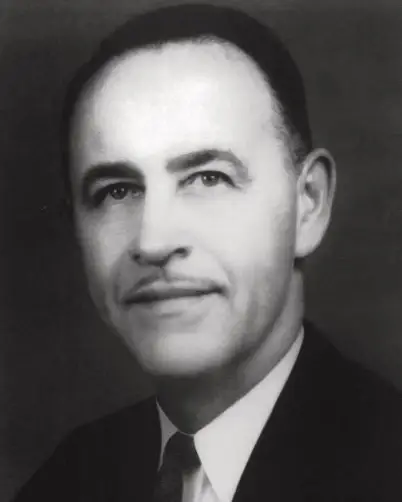
Partnership
Forged 1941 · Michigan
John F. Grostic
1907 to 1964 · Palmer School of Chiropractic, 1933
Ralph R. Gregory
Died 1990 · Monroe, Michigan
Founded
The Grostic procedure · NUCCA, April 16, 1966
Monroe, 1941
John F. Grostic went to Ralph Gregory for an atlas adjustment in 1941, and the visit started a 23 year collaboration
John Francis Grostic was born on October 9, 1907 in Genoa Township, Michigan. He graduated from the Palmer School of Chiropractic in 1933 and practiced in Ann Arbor from that year until his death. He carried Hodgkin's disease, and before 1941 he had been going to B.J. Palmer's clinic in Davenport, Iowa for his own care. In 1941 he walked into Ralph R. Gregory's office in Monroe, Michigan for an atlas adjustment. The two men worked together from that day until Grostic died.
Grostic came out of the Palmer Standardized Chiropractic Council
Grostic did not begin alone. He belonged to the Palmer Standardized Chiropractic Council, a body founded by Roy G. Labachotte under B.J. Palmer's direction to give research and new ideas a forum. Grostic presented his measurement work at the Council's annual meeting and in the monthly Bulletin it published. The Grostic procedure descends directly from the Palmer specific upper cervical technique, and it was one of several methods that grew from the drive to standardize chiropractic analysis.
Gregory's Monroe office is still the longest running NUCCA practice
Gregory practiced at 217 West Second Street in Monroe, Michigan, and that address has never stopped delivering the work. It is the original NUCCA practice and the longest continuing provider of NUCCA care, still run by doctors who began in private practice with Gregory himself. Monroe is also where he held the first NUCCA seminar in 1966, at a Howard Johnson motel a short distance from the office.
Both men were working an argument the profession had already made
The claim that the first cervical vertebra deserves primary focus was not theirs. W.G. Wernsing had argued it in 1934, and B.J. Palmer's Hole In One work had staked a whole method on the atlas and axis. What Gregory and Grostic added was measurement. Their contribution begins where the earlier upper cervical work stopped, at the question of how a doctor knows the size and direction of the misalignment before touching the patient.
The measurement
The Grostic procedure is a measurement system before it is an adjustment
Grostic held that the atlas misalignment is a geometric object, a displacement in space with a size and a direction, and that anything geometric can be drawn and calculated. He built the tools to see it. He and Gregory engineered radiographic equipment aligned tightly enough that the film itself would not introduce error, then reduced the three dimensional misalignment to a set of angles. His son later wrote that the x-ray analysis is the real core of the procedure and the one part that stayed constant across 30 years.
The cephalometer arrived in early 1943 and gave the skull a central line
A measurement needs a reference. In early 1943 Grostic built the prototype of the instrument that became the cephalometer, a skull divider that establishes a central skull line on a radiograph. Atlas position could then be measured against something fixed. The procedure treats the skull on a nasium view as an incomplete ellipsoid. Its major axis is the vertical central skull line, and that line should sit close to vertical in a person free of subluxation.
Grostic averaged the whole side of the skull instead of picking one landmark
Earlier upper cervical methods measured from a single point: the tops of the ocular orbits, the tips of the mastoids, the jugular processes, or the inferior tips of the condyles. Grostic used the skull itself. The method takes a statistical average across the many points that make up the side of the skull rather than trusting any one of them. A single landmark that is malformed or badly projected corrupts the whole reading, and averaging removes that failure mode.
Four assumptions turn the films into a set of angles
The procedure rests on four stated assumptions. The vertical central skull line should be near vertical in the upright patient. A line through the inferior lateral attachment points of the atlas represents the plane of the atlas and should be near perpendicular to that skull line. On the vertex view, a line through the centers of the foramen transversarium should be near perpendicular to a line bisecting the skull. The odontoid and the spinous process of the axis should sit at the center of the atlas.
Grostic recorded where the measurement fails
In roughly 20 percent of cases the odontoid is laterally displaced, so the center of the odontoid is not the center of the axis. The procedure names that exception and gives the workaround, which is to find the true center by bisecting the superior surface of the axis. A measurement system that publishes its own exception rate is doing the thing that makes a measurement trustworthy.
This procedure no more dictates the normal position of atlas than physiology texts dictate the normal oral temperature to be 98.6 degrees.
John D. Grostic, The Origins of the Grostic Procedure, International Review of Chiropractic, March 1978The 1946 seminar
Grostic taught the assembled research for the first time in the fall of 1946
The seminar happened because the field asked for it. Grostic had been showing the work piece by piece as he developed it, at Council meetings and in the Bulletin, and the presentations lacked continuity. Several chiropractors asked him to assemble the research into one package they could take at a sitting. In the fall of 1946 he presented it in Ann Arbor. The seminar was capped at eighteen places, and the Grostic Procedure Society records 14 doctors in the room.
The seminar became annual and the procedure spread through it
One room in Ann Arbor became a yearly event, and the Grostic procedure moved doctor by doctor from there. Grostic was teaching a discipline rather than a move: train the eye, trust the film, respect the geometry. Most of the upper cervical methods that followed were built either on his measurement system or as modifications of it. The procedure is still taught, and Palmer College carried it as an elective for senior students and through its postgraduate seminars.
Grostic died of Hodgkin's disease on October 31, 1964
Grostic died in Ann Arbor on October 31, 1964, at 57, in the city where he had practiced since 1933. He had carried the disease for years and built the measurement system while living with it. Gregory declined to teach in the two years that followed. He resumed in 1966, and what he resumed with was an organization rather than a seminar series.
The delivery
Gregory and Grostic took the recoil out of the upper cervical adjustment
The analysis stayed fixed and the adjustment kept changing. Since 1946 the delivery moved from the Palmer toggle to a much shorter and lighter thrust, and the pisiform contact travels less than one quarter of an inch. John D. Grostic recorded two results from the shortened thrust. Patient discomfort was largely eliminated, and the atlas misalignment could be reduced more consistently and predictably. The measurement system is what made that comparison possible, because it can grade one adjusting method against another.
NUCCA removed the thrust entirely and kept the aim
NUCCA carried the direction of travel to its end. The patient lies in side posture with the head on a rigid mastoid support. The doctor sets the pisiform on the transverse process of the atlas, locks his whole body on the vector taken from the films, and straightens his arms with the long head of the triceps. Nothing twists, no joint is loaded to end range, and no cavitation is sought. The correction is specific in direction, depth, velocity, and amplitude.
The upper cervical joints move under almost no force
There are no interlocking facets at the top of the neck. Stability comes from the weight of the head, the shape of the articular surfaces, and the surrounding muscle and ligament. The atlas carries roughly 10 to 12 pounds of skull on joints whose coefficient of friction runs near 0.005, close to ice on ice. The tangential force needed to start a slide is about 1 percent of the compressive load. The displacement in a correction runs from about one sixteenth to one quarter of an inch.
Excess depth degrades the correction rather than deepening it
Roy Sweat argued the case in print in February 1988 under the title Minimum Force versus Moderate Force in the Occipital-Atlanto-Axial Subluxation Complex. He concluded for minimal depth, low force, and specific angles. Kirk Eriksen supplies the mechanism. Excess depth locks the joint or produces an asymmetric correction, and a deep contact can make the suboccipital muscles splint in defense. The field instruction to a doctor struggling with a correction runs the other way from force, which is to lighten up.
April 16, 1966
Gregory incorporated NUCCA and named it for the work rather than for himself
Ralph R. Gregory incorporated the National Upper Cervical Chiropractic Association in Michigan on April 16, 1966, and held the first seminar that year at a Howard Johnson motel in Monroe. Earlier upper cervical methods carried a founder's name or initials. Gregory chose an organizational name and an officer structure that put him third on the masthead. Irvin Mathias of Indiana was president, Albert Dick of Michigan vice president, Robert Kemp of Michigan secretary, and Marshall Dickholtz of Illinois treasurer. Gregory took a seat as one of three directors.
The policy statement adopted in 1966 is still the enforceable rule
Because the standard lives in an organization rather than in a man, it lives in documents. The policy statement NUCCA adopted in 1966 names the Restoration Principle, the reduction to normal of the misalignment factors of the complex, and calls it a pre-determined and pre-directed process of correction. The doctor decides where the atlas has to go before touching the patient. That sentence, written in 1966, is the rule the association still enforces through its certification board.
The research arm followed on October 6, 1971
Gregory incorporated the National Upper Cervical Chiropractic Research Association on October 6, 1971, and it later became the Upper Cervical Research Foundation. He also edited the association's publication from its first issue in December 1966, which was renamed The Monograph as its content turned more technical. He kept refining the analysis and the procedure for another twenty four years, until his death in 1990.
The Atlas Subluxation Complex was coined to cover the whole organism
Gregory needed a term for something wider than a bone out of place, so he built one. The NUCCA Standards present the Atlas Subluxation Complex as a deliberate coinage for the effects that a subluxated occipital-atlanto-axial area produces throughout the organism. Four things fall inside it: the atlas in all its planes of misalignment, its relationship to the occiput, its relationship to the vertebrae and pelvis below, and the neurological consequence of the whole arrangement. Gregory described that consequence as deformation by traction, enfoldment, and compression.
The distant measurement
Gregory built an instrument that measures everything except the bone he adjusts
Gregory co-invented the Anatometer with Peter Benesh of Monroe, Michigan. They filed for United States patents in April 1976 after roughly seven years of development, funded largely by Benesh at a cost above $100,000. The instrument records the presence, the location, and the severity of distortion in the orientation planes of the body. In practice it reports pelvic tilt, shoulder and hip leveling, weight distribution, and the deviation of the seventh cervical vertebra from center.
Not one Anatometer reading describes the atlas
The instrument reads the standing body from the shoulders down. A doctor who moves the atlas and then measures the hips has committed to the claim that the effect travels, and has accepted a measurement that can contradict him inside the same visit. NUCCA made the supine leg check and the postural measurement mandatory at every visit, and requires a minimum of three analytical procedures for an initial assessment. The method spends its verification on a distant measure rather than on the site of the contact.
A short leg that lengthens is muscle rather than bone
In one recorded NUCCA examination the readings ran to a left shoulder 2.75 degrees low, a left hip 4.9 degrees low, and a left leg contracted by about a quarter inch. After the correction the legs measured even. The bones of that leg are the same length as the other. Muscles on one side were holding it up, and they let go when the atlas moved. Gregory read his postural instrument as a report on nervous system output.
Certification writes the standard as a number a candidate has to hit
NUCCA certification runs four levels. Level I covers radiographic positioning and requires an 80 percent exam score. Level II adds analysis and interpretation. Level III requires the candidate to demonstrate 80 percent or better reduction of the atlas subluxation complex, across four progressive submission stages, and to show all four misalignment types. Board certification requires 10 consecutive pre and post film sets reviewed by designated board doctors.
The record since
The NUCCA reading has been measured for agreement across 254 film sets
Landholm-Duvall and colleagues published an inter-examiner study of the NUCCA analysis in the Journal of Chiropractic Medicine in 2023. Two board certified NUCCA doctors independently marked 254 three view radiographic series. Agreement on atlas laterality returned an intraclass correlation of 0.95, and agreement on atlas rotation returned 0.92. The films are the input to everything downstream, so the reproducibility of the marking sets the reproducibility of the method.
John D. Grostic carried the research forward and named the mechanism
John D. Grostic, born April 23, 1943, graduated from Palmer College in 1969 and practiced in his father's town of Ann Arbor until 1977. He measured atlas laterality and rotation before and after adjustment in a retrospective study published in 1982. He then joined the Palmer faculty for a computer assisted x-ray analysis project, and in 1988 he published the dentate ligament cord distortion hypothesis. He served on the faculty of Life College of Chiropractic in Marietta, Georgia from 1986 until his death on June 27, 1995.
The dentate ligament argument was in the family's work from the start
The 1978 account of the procedure already lists direct traction on the cord by the denticulate ligaments as one of four mechanisms by which an upper cervical misalignment produces nerve interference. It cites Kahn's 1947 paper in the Journal of Neurosurgery on the role of the dentate ligaments in cord compression. The 1988 hypothesis narrowed that to two components, mechanical irritation of the cord through the dentate ligaments and ischemia from the traction those ligaments transmit.
Two pilots carried the method into indexed medicine
Bakris and colleagues ran a 50 patient double blind placebo controlled pilot in stage 1 hypertension at the Rush University Hypertension Center, with Marshall Dickholtz Sr delivering the corrections. It appeared in the Journal of Human Hypertension in 2007. Woodfield and colleagues ran an 11 subject observational pilot in migraine with the University of Calgary, published in 2015. It used phase contrast MRI to measure arterial inflow, venous outflow, and cerebrospinal fluid flow.
Three living methods read the same three films
NUCCA, Atlas Orthogonal, and Orthospinology all descend from Grostic and inherit his measurement discipline, and they split at the moment of contact. NUCCA adjusts by hand and only by hand. Atlas Orthogonal adjusts only with a table mounted percussion instrument, a program Roy Sweat established in 1981 after founding the Orthospinology society in 1977. Orthospinology teaches the hand adjustment, a handheld solenoid instrument, and a multivector table instrument. Blair Upper Cervical drops the orthogonal standard entirely and images each patient's own joint planes.
A vector is correspondence
What Gregory and Grostic contributed to the understanding of tone
Gregory and Grostic established that a correction can be specified in advance, in numbers, for one particular body. That is the strongest early statement of a claim the Unified Model of Tone makes generally. The active ingredient in an input is correspondence between the input and the pattern the body is holding, and correspondence is a property of the analysis before it is a property of the hands. A vector calculated from a person's own films is correspondence written down.
Specificity belongs to the reading that precedes the input
An input can only correspond to a pattern somebody has already found, so accuracy is decided before the contact. NUCCA stakes everything there. The Standards require a minimum of three analytical procedures before care begins, a three view radiographic series, and a leg check plus postural measurement at every visit. The 2023 reliability study graded the analysis rather than the adjustment, which is where the model holds that reliability research belongs (input quality).
A fraction of a degree at the atlas is readable in the whole posture
A local input reaches a whole system because the system is coupled, and the test of a local input is therefore a distant measurement. A recorded NUCCA case reports atlas laterality of 2.49 degrees, head tilt of 1.98 degrees, a lower angle of 5.8 degrees, and angular rotation of 1.35 degrees. Those are fractions of a degree at one small bone, and the Anatometer reads their consequence at the shoulders, the hips, and the standing weight distribution (coupling).
The dentate ligament reading is the tension argument arriving early
Grostic's mechanism was tension rather than pinching. The dentate ligaments run from the pia mater to the dura and suspend the cord inside its sleeve, and the first pair sits at the foramen magnum, often the largest of them all. Alf Breig established in 1978 that raised tension rather than compression carries the primary neurophysiological consequence, since even compressive lesions generate axial tension. The Grostic account of cord traction through the dentate ligaments reached that position from a chiropractic office three decades earlier.
The model parts with Gregory on where the atlas sits in the causal order
Gregory held that the skull, spinal column, and pelvis deviate from the vertical axis together, and that the atlas is where that deviation is won or lost. He never widened the claim. The model holds that a body ordinarily carries several points of critical tension at once, each with a different capacity to reorganize the whole. That capacity shifts with the system's state from week to week. The atlas NUCCA works is one of them and a real one (tone).
Several live access sites let every upper cervical method be right at once
A framework with one governing segment has to explain away every technique that contacts something else. A framework with several live leverage points, places where a small input moves the whole system, does not. Gregory's atlas, the sacrum Logan Basic contacts, and the atlas and axis of H.I.O. Knee Chest are all genuine ways of reaching the same nervous system. Techniques differ by where they reach the nervous system rather than by kind. That position lets the 33 methods in this library all be doing real work.
What the model predicts
Two predictions follow from the Gregory and Grostic method, and both can be run with equipment NUCCA practices own
The measurement discipline these two men built is what makes the model's predictions testable here rather than rhetorical. Every quantity is recorded before the outcome is known, which is the condition a prediction needs. The films fix the vector, the leg check and the Anatometer read the body, and the certification standard already defines what counts as a correction at 80 percent reduction.
A matched correction should move people toward the middle from both directions
Recruit two groups on one autonomic variable, one running high and one running low. Fix each vector from the films before any outcome is known, and give half of each group a sham matched for positioning and contact time. The model predicts that the treated groups converge toward the middle and their spread narrows, while the sham groups do not. Blood pressure is the obvious measure, and the 2007 pilot already ran a 50 patient double blind design on it (blood pressure).
Agreement among the readings should predict the size of the change
NUCCA already requires three readings to point the same way: the films, the supine leg check, and the postural measurement. Score that agreement in advance and blind to outcome, then measure what follows the correction. If accuracy lived in the delivery, the prior agreement would carry no information about the result. The model predicts it carries most of it, which is a claim about analysis that a study of hands would miss entirely (prediction).
The library web
How Gregory and Grostic relate to the rest of the library
Each neighbor below carries a piece of the same argument.
NUCCA is the method itself, with the three view series, the double pivot point analysis, and the triceps pull.
Atlas Orthogonal reads the same three films and answers them with a machine, which makes the instrument the only real variable between the two methods.
Roy Sweat trained in the Grostic procedure and built both Orthospinology and Atlas Orthogonal out of it.
B.J. Palmer made the single lynchpin argument first and hardest, and his toggle recoil is the delivery Gregory replaced.
H.I.O. Knee Chest is the ancestor of every upper cervical method here and the one Grostic was going to Davenport for.
William Blair answered the same problem by imaging each patient's own joint planes rather than measuring against an orthogonal standard.
The autonomic nervous system covers the brainstem regulation an upper cervical correction is aimed at, and migraine covers the condition of the 2015 imaging pilot.
One Mechanism, Many Types of Healing supplies the general form of the claim a calculated vector makes.
Questions people ask
Common questions about Gregory and Grostic
What did Gregory and Grostic contribute to the understanding of tone?
They established that a correction can be specified in advance, in numbers, for one particular body. A vector calculated from a patient's own radiographs is correspondence written down before anything is delivered. The Unified Model of Tone holds that the active ingredient in any input is correspondence between that input and the pattern the body is holding. Correspondence belongs to the analysis before it belongs to the hands. Gregory and Grostic proved that claim was workable in 1943.
Who founded NUCCA?
Ralph R. Gregory incorporated the National Upper Cervical Chiropractic Association in Michigan on April 16, 1966, two years after the death of his collaborator John F. Grostic. He held the first seminar that year at a Howard Johnson motel in Monroe, Michigan. Gregory named the association for the work rather than for himself and took a seat as one of three directors, with Irvin Mathias of Indiana serving as the first president. Gregory kept refining the procedure until his death in 1990.
What is the difference between the Grostic procedure and NUCCA?
The Grostic procedure is the parent method, a radiographic measurement system John F. Grostic assembled through the 1940s and first taught as a seminar in the fall of 1946. NUCCA is the association Ralph Gregory incorporated in 1966 to carry that work forward under a written standard, a certification board, and a research arm. The analysis is largely shared. NUCCA added the mandatory postural measurement, the triceps pull as the only delivery, and the four level certification sequence.
Which Grostic was which?
John F. Grostic, born October 9, 1907 and died October 31, 1964, is the father and the originator of the procedure. He graduated from the Palmer School of Chiropractic in 1933 and practiced in Ann Arbor, Michigan. His son John D. Grostic was born April 23, 1943 and died June 27, 1995. The son graduated from Palmer College in 1969 and continued the research, publishing the 1982 pre and post measurement study and the 1988 dentate ligament cord distortion hypothesis.
How much force does a Grostic or NUCCA adjustment use?
Very little, and the number that matters is displacement rather than pounds. Since 1946 the delivery moved from the Palmer toggle to a much shorter, lighter thrust in which the pisiform contact travels less than a quarter of an inch. NUCCA removed the thrust entirely and generates force by straightening the arms against a locked body position. The atlas carries the skull on joints whose coefficient of friction sits near 0.005, so almost no force is needed to start it moving.
Why does the Grostic method require x-rays?
Because the correction vector is calculated rather than felt. The protocol specifies a minimum series of neutral lateral, nasium, and vertex views, which resolve atlas position in three planes. The doctor marks the films, derives the misalignment in degrees, and converts it into a line of drive before touching the patient. A 2023 study of 254 three view series returned inter-examiner agreement of 0.95 for atlas laterality and 0.92 for rotation.
Sources
Sources for this page
- Grostic JD. The Origins of the Grostic Procedure. International Review of Chiropractic. 1978 March:33-35. Full text. The son's account of his father's work. Source for the Palmer Standardized Chiropractic Council, the 1946 seminar of 14 doctors, the four assumptions, the 20 percent odontoid exception, the move from the Palmer toggle, and the dentate ligament mechanism.
- Grostic Procedure Society. The Origins of the Grostic Procedure: profiles. Biographies. John F. Grostic born October 9, 1907 in Genoa Township, Michigan, Palmer School of Chiropractic 1933, Ann Arbor practice from 1933, died October 31, 1964. John D. Grostic born April 23, 1943, Palmer College 1969, Life College faculty from 1986, died June 27, 1995 in Atlanta.
- NUCCA Upper Cervical Monograph. NUCCA and NUCCRA. Association history. The 1941 meeting, the cephalometer prototype in early 1943, and the fall 1946 seminar limited to eighteen participants. Also the incorporation on April 16, 1966, the first officers, NUCCA News from December 1966, and NUCCRA on October 6, 1971.
- National Upper Cervical Chiropractic Association. Standards of Care and Practice Guidelines. Full document. The Atlas Subluxation Complex definition, the Restoration Principle adopted in 1966, the three view minimum, the mandatory leg check and postural measurement, and the accepted postural instrumentation.
- Landholm-Duvall J, Hasick DG, Ndetan H, Hart JF, Dickholtz M, Lapenski CP. Inter-examiner agreement of the National Upper Cervical Chiropractic Association analysis of the atlas subluxation complex in a 3-view upper cervical radiographic series. J Chiropr Med. 2023;22(3):189-196. PMC10461146. 254 series, intraclass correlation 0.95 for laterality and 0.92 for rotation.
- Grostic JD, DeBoer KF. Roentgenographic measurement of atlas laterality and rotation: a retrospective pre- and post-manipulation study. J Manipulative Physiol Ther. 1982;5(2):63-71. PMID 7119594.
- Grostic JD. Dentate ligament-cord distortion hypothesis. Chiropractic Research Journal. 1988;1(1):47-55. Mechanical irritation of the cord through the dentate ligaments, and ischemia from the traction those ligaments transmit.
- Vazquez F, Grostic JD, Fonder AC, DeBoer KF. Eccentricity of the skull: correlation with dental malocclusion. Angle Orthod. 1982;52(2):144-58. PMID 6954866.
- Bakris G, Dickholtz M Sr, Meyer PM, Kravitz G, Avery E, Miller M, et al. Atlas vertebra realignment and achievement of arterial pressure goal in hypertensive patients: a pilot study. J Hum Hypertens. 2007;21(5):347-52. PMID 17252032. 50 patients, double blind, placebo controlled, Rush University Hypertension Center.
- Woodfield HC 3rd, Hasick DG, Becker WJ, Rose MS, Scott JN. Effect of atlas vertebrae realignment in subjects with migraine: an observational pilot study. Biomed Res Int. 2015;2015:630472. PMID 26783523. 11 subjects, phase contrast MRI of arterial inflow, venous outflow, and cerebrospinal fluid flow.
- Woodfield HC 3rd, York C, Rochester RP, Bales S, Beebe M, Salminen B, et al. Craniocervical chiropractic procedures: a precis of upper cervical chiropractic. J Can Chiropr Assoc. 2015;59(2):173-92. PMID 26136610. The shared lineage of NUCCA, Atlas Orthogonal, Orthospinology, and Blair.
- Rochester RP. Neck pain and disability outcomes following chiropractic upper cervical care: a retrospective case series. J Can Chiropr Assoc. 2009;53(3):173-85. PMID 19714232.
- Kahn EA. The role of the dentate ligaments in spinal cord compression and the syndrome of lateral sclerosis. J Neurosurg. 1947;4(3):191-9. The paper Grostic cited for cord traction through the dentate ligaments.
- Breig A. Adverse Mechanical Tension in the Central Nervous System. Stockholm: Almqvist and Wiksell; 1978. Raised tension rather than compression carries the primary neurophysiological consequence.
- Sweat RW. Minimum Force versus Moderate Force in the Occipital-Atlanto-Axial Subluxation Complex. February 1988. Minimal depth, low force, and specific angles.
- Denton Chiropractic, Monroe, Michigan. Practice history. 217 West Second Street is Ralph Gregory's former office, the original NUCCA practice and the longest continuing provider of NUCCA care.
This page is history and education. It is not medical advice, and nothing here is a promise of outcome. Consult a licensed practitioner about your own condition.