
Our Approach · The Legends · Era II
The Research Era · 1905 to 1977
Lyle W. Sherman
Research Director
Lyle W. Sherman (1905 to 1977) was assistant director and chief of staff of the B.J. Palmer Chiropractic Clinic in Davenport, Iowa, from 1942. Every case there was read on instruments before the adjustment and again after it, and no adjustment was given until the thermal pattern had returned and held. Sherman College of Chiropractic carries his name. The Unified Model of Tone calls that rule readiness, and readiness decides how an input lands.
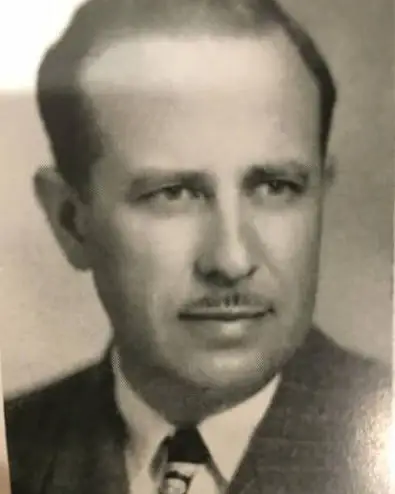
Born
February 22, 1905 · Gilson, Illinois
Died
August 1977 · Spartanburg, South Carolina
Role
Assistant director, B.J. Palmer Chiropractic Clinic, from 1942
Honored
ICA Chiropractor of the Year, 1955
Named for him
Sherman College of Chiropractic, 1973
The research clinic, 1935 to 1961
Lyle Sherman ran the floor of the first instrumented chiropractic research clinic
Lyle W. Sherman was assistant director and chief of staff of the B.J. Palmer Chiropractic Clinic in Davenport, Iowa, from 1942. The clinic opened on August 5, 1935 and ran until B.J. Palmer died in 1961. Sherman ran the analysis, kept the instrument records, and made the daily decision about whether a patient would be adjusted at all.
The clinic was built in two complete divisions. A medical side took the case history, the physical examination and the laboratory work with standard medical equipment. A chiropractic side ran the spinographs, the thermal readings and the adjustment. Every case passed through both, and complete files were kept on each (Chiropractic Clinical Controlled Research, 1951, pp. 736 to 737).
What the B.J. Palmer Chiropractic Clinic measured on every case
Measurement in Sherman's clinic ran on a fixed schedule rather than on the doctor's impression of the day. Neurocalograph, neurocalometer and neurotempometer readings were taken daily. Vital signs and laboratory tests ran weekly. New spinographs were taken every two weeks, and a set of about ten X-ray studies existed by the time a patient left. Senzon's 2018 review of the period sets out that schedule from the clinic's own records.
The archive Sherman's staff produced
At least 7,000 cases were documented in the clinic between 1935 and 1960. Record keeping used 120 separate forms, and the average case file ran about 80 pages. B.J. Palmer put the gross average at 21.85 spinographs per case, taken as a check set every two weeks (1951, p. 30). By August 1951 the clinic held 203,824 graphs recorded inside its shielded booth (p. 14). Killinger's 1998 account describes the later project to preserve those files.
Pattern analysis
Sherman judged an adjustment by whether the pattern changed, not by how the patient felt
The reading came before the adjustment and again after it, on every case, every day. That sequence is the whole of pattern analysis. A new patient in Sherman's clinic was read for about three weeks under controlled conditions, until a stable graph emerged that belonged to that person. B.J. Palmer wrote that the pattern would not change until an adjustment was given (1951, p. 14).
The reading decided the day. The clinic's own instruction was blunt about it. The booth check readings are what you do or do not adjust upon, and upon them depends whether you under-adjust or over-adjust (p. 16). A patient could pass a day, or several days in a row, without being touched.
What the neurocalograph actually recorded
The instrument read a temperature difference rather than a bone. Paired probes ran down either side of the spine and reported asymmetry in skin temperature between left and right. Skin temperature is a readout of sympathetic control of the skin blood vessels, which makes the graph a surface window on the autonomic nervous system. Dossa Evins built the first version and brought it to B.J. Palmer in April 1923.
The two-point rule
Sherman's clinic set a numerical threshold for action. The instruction was to adjust only the subluxation carrying the major reading, and only when that reading came in at two points or more (1951, p. 574). Below two points the direction was explicit. Do not give an adjustment (p. 572). The threshold turned a judgment call into a stated criterion that a second examiner could apply to the same graph.
Over-adjusting was named as the clinic's principal danger
The 1951 volume lists three ways to over-adjust. Too many places in one spine at one time. One place too often, at times when no subluxation was present. One segment carried too far in any direction (p. 574). Each error has its own signature in the record. Carrying a segment too far reverses the reading, so a case that arrived reading two points left and returned reading two points right had been pushed past the correction.
much damage can be done to the ultimate correction by an adjustic thrust given before pressure has returned permanently again
The B.J. Palmer Chiropractic Clinic case records, run under Lyle Sherman · Chiropractic Clinical Controlled Research, 1951, p. 369Cycles of correction
Sherman's clinic waited for the heat pattern to come back and hold before adjusting again
The return of the pattern was not by itself a reason to adjust. The pattern had to return and stay returned. The 1951 case records name the phenomenon. After an adjustment the consistent graph is broken, and the variation that follows over the next days was called a cycle of correction (p. 369).
Restraint follows from that reading. At the first return of evidence of nerve interference the clinic usually did not re-adjust, on the reasoning that the muscles of the spine had to finish the work themselves (p. 451). An adjustment given inside the cycle was described as seldom justified (p. 437). That restraint is the center of Sherman's contribution.
The one exception Sherman's clinic allowed
A single class of event overrode the waiting rule. A fall, a jar or a fast movement of the head was taken as a mechanical reason for the pattern to come back, and a return after such an event was adjusted (1951, p. 451). Absent an injury, the instruction was that considerable time should pass before re-adjusting (p. 369).
What the restraint cost in adjustments delivered
The clinic's own arithmetic shows how rarely the criterion was met. Records from the research period gave one vertebral subluxation adjusted once every 23.9 days (1951, p. 344). A standard stay ran two weeks, and a patient could leave having received one adjustment inside it (p. 473). Sherman's clinic held people out of adjustment for most of the time they were in it.
Sherman appears in the case files by name
The 1951 records carry Sherman as a working clinician. A mother described bringing her son to Davenport in August 1945 and meeting Doctor Palmer and Doctor Sherman (p. 467). Another family addressed its follow-up letter to Dr. L. W. Sherman twenty-seven months after discharge. The letter records that Sherman had advised the patient to wait rather than proceed with a scheduled operation (p. 474).
to know WHEN NOT TO GIVE an adjustment is more vital than to know when to give one
B.J. Palmer, on the rule his research clinic ran under · Chiropractic Clinical Controlled Research, 1951, p. 573Instrumentation
Sherman built the fixtures that made one reading comparable to the next
Sherman's engineering is the reason the clinic's graphs could be compared at all. He is credited with work on the neurotempometer, the neurocalograph and the cervical X-ray chair, and with a large part in the development of pattern analysis. Hart's 1996 memorial in Chiropractic History describes him as a published author and co-developer of chiropractic instruments.
The problem the instruments solved was the operator. Speed of travel down the spine changed the result. Read fast and a mean line came out as a break, read slow and a break came out as a mean line (1951, p. 13). The neurotempometer fixed a normal speed of travel and forced the probes level and square to the neck. Sherman standardized the examiner, not the patient.
The shielded booth removed the rest of the noise
Sherman's clinic recorded inside a grounded and shielded booth built to exclude outside fields, after finding that radio band and electrical waves moved the readings enough to show in the calibration (1951, pp. 13 to 14). A staff member was posted at the door to ground each patient on the way in. The clinic counted 22 major variables that had to be excluded before a graph could be trusted.
The 1949 test that showed the human eye could not do the job
Clay Thompson brought a device called the visograph to the 1949 Pre-Lyceum class at Palmer. It reproduced a neurocalometer needle at auditorium scale, synchronized to a crayon trace hidden behind the board. Doctors watched the needle, drew what they saw, then compared their drawing with the original. Very few produced one accurate drawing (1951, pp. 15 to 16). That result is why Sherman's clinic recorded graphs instead of impressions.
What modern reliability studies found when they tested the same measurement
The measurement Sherman standardized has since been tested directly. Owens and colleagues reported intraexaminer reliability of 0.953 to 0.984 and interexaminer reliability of 0.918 to 0.975 for paraspinal thermal scans in 2004. McCoy and colleagues reported intraclass correlations of 0.959 to 0.976 across 100 subjects in 2011. Interpretation is the weaker link. Mansholt and colleagues in 2015 found agreement of 0.73 for a full pattern and 0.05 to 0.22 for partial ones among 17 examiners.
That split is what the evidence says about Sherman's method. The instrument reproduces. Reading a pattern off the instrument is a trained judgment, and it agrees best at the extremes. Sherman's two-point threshold and his full-pattern-or-nothing rule were both attempts to keep the decision at the end of the scale where examiners agree.
The Truscott test, 1945
Sherman was the man the clinic sent when an outside claim needed checking
In July 1945 the Palmer clinic put an outside analytical system through a test, and Sherman ran it. Sherman and Don Pharaoh took the Truscott System course on July 21, 22 and 23, then reported to B.J. Palmer in a conversation printed in Fight to Climb (1950, pp. 245 to 248). The system claimed that light contacts at the upper neck changed the relative length of the legs.
Sherman's report separated two questions that are easy to run together. He said plainly that some of the physiological reactions the system claimed do take place, because he had checked them on different individuals. He added that he did not know whether the leg length change carried any analytical value (p. 245).
Sherman's objection was about time
The sharpest line in Sherman's 1945 report is a verification objection. He noted that adjusting a sixth dorsal temporarily leveled the legs, and that the legs pulled back as soon as the subject stood and walked. They have never tried waiting and seeing what would happen over a period of time, he told the room (Fight to Climb, 1950, p. 247). A change that does not survive time is not a correction.
The clinic then ran the claim against its own controls
On July 28, 1945 the clinic called in eight test cases and reproduced the leg change while breaking every condition the system required. Subjects were tested inside the shielded and grounded booth, wearing rings and watches, lying face up. Pressure at the femoral tubercles alone changed leg length in seven of the eight, with no contact made at the neck (1950, pp. 254 to 255). Twenty students were tested two days later.
The design matters more than the verdict
The Davenport tests were small and unblinded, so the counts carry little weight now. The design carries a great deal. B.J. Palmer wrote out numbered experiments and addressed them to Sherman and Pharaoh by name over four consecutive days, each one removing a condition the claim depended on (1950, pp. 252 to 254). That is a control series, run inside a chiropractic clinic in 1945, on a technique the clinic had no stake in.
The published record, 1949 to 1951
Sherman's name is on the clinic's published research, and those documents are case series
The B.J. Palmer Chiropractic Clinic issued bulletins whose titles named their case counts. Hematological Changes Under Specific Chiropractic Adjustment reported on 1,054 cases and carries B.J. Palmer, L.W. Sherman and W.W. Coulter as its authors, published by the Palmer School of Chiropractic around 1949. A companion bulletin on urological change reported 2,006 cases in 1949. A third covered basal metabolic change in 909 cases.
Sherman was the man who presented that work to the field. Speaking to the Chiropractic Society of Iowa in 1950, W. Heath Quigley pointed his audience at the clinic's new books on hematology and urology and said that Dr. Sherman would tell them about the research (Fight to Climb, 1950, p. 546).
What those documents are
They are uncontrolled case series with before and after laboratory values, published by the institution that produced them. None of them carries a control group, randomization or blinding. The first bulletin describes itself as number one in a series of experiments proving the effectiveness of specific chiropractic technic, which states the intent on the cover. Senzon lists the objectives printed in the urological pamphlet, one of which was to prove the subluxation exists.
What they can carry and what they cannot
The outcome numbers in these bulletins cannot bear the weight a controlled trial would carry, and nothing on this page rests on them. What survives is the protocol. Senzon's review of the 1928 to 1949 research era reaches the same conclusion. The work of that period had real limits and is still not worthless, because the systems of analysis built then became the foundation of modern practice.
Why Sherman's protocol outran his data
Sherman's clinic did four things that clinical research now takes as standard. It defined an objective measure. It recorded that measure before the intervention and again after it. It set a numerical threshold for acting. It treated a non-response as information rather than as a reason to push harder. The outcome data from 1949 has not aged well. The decision rule has.
Tone in Sherman's work
Sherman's contribution to tone is verification
Sherman's clinic ran on a claim the Unified Model of Tone now states outright. The effect of an input is decided by the state it arrives at. The same adjustment delivered to a system that is settling and to a system that is holding a fixed pattern is, in the strict biological sense, two different events. Sherman's answer was to read the state before the input and again afterward, from 1942.
Tone is the organizing state of the nervous system, and it can be read before the outcome is known. The thermal graph is one such reading. It reports asymmetry in sympathetic control of the skin vessels, which is a direct measure of autonomic output. Heart rate variability is a second reading of the same variable, taken at the heart instead of the skin.
Readiness is a state, and Sherman treated it as one
The clinic's rule was that a stable, reproducing pattern licenses an input and an unstable one does not. In the model's terms that is readiness. A system in the middle of reorganizing has already received its signal and is still using it. A second input inside that window competes with the first. Sherman reached the rule from graphs, and the model states it as the reason input quality outranks force.
The cycle of correction is time course, named in 1951
Sherman's cycle of correction is time course seen from inside a clinic. A response to an input is a trajectory rather than a step, and one reading taken immediately afterward says almost nothing about where the system will settle. Sherman's staff learned that by watching graphs move for days after a single adjustment. The model takes the same position. The interval over which a system returns to baseline is part of the measurement.
Where the Unified Model of Tone parts from Sherman's clinic
The clinic held that a subluxation can exist only at the atlas or the axis, and adjusted nowhere else from 1935 until the mid-1950s. The model holds that a body carries several points of critical tension at once, and that the reach of each one shifts with the system's state from week to week. There is no single lynchpin waiting to be found. What the model keeps from Sherman without revision is the sequence. Read the system, act only on a stated criterion, then read it again.
The instrument line runs forward from Sherman
The thermal instruments used in upper cervical practice today descend from the ones Sherman standardized after 1942. Toftness Technique carried the detection idea into a correction delivered in ounces. The H.I.O. Knee Chest page sets out the anatomy, the toggle recoil and the modern procedure the clinic used. Evins built the first neurocalometer, and Sherman is the reason its output became comparable from one day to the next.
The dated record
Eight dated facts about Lyle Sherman, with the source for each
1905 to 1942
1905. Lyle Wheeler Sherman was born on February 22 at Gilson, Knox County, Illinois, according to his Find a Grave memorial. Sherman College records that he came to chiropractic through his wife, whose health improved under care.
1942. Sherman became second in command at the B.J. Palmer Chiropractic Clinic, seven years after it opened, with the title of assistant director and chief of staff.
1945 to 1955
1945. Sherman ran the Palmer clinic's evaluation of the Truscott System and took the course in July. He reported that its physiological effects were real and its analytical value unproven (Fight to Climb, 1950, pp. 245 to 248).
1949. The clinic published Hematological Changes Under Specific Chiropractic Adjustment on 1,054 cases, with Sherman named as an author alongside B.J. Palmer and W.W. Coulter.
1954. Sherman wrote a piece titled Chiropractic equipment reaches Ethiopia for the October issue of the ICA International Review of Chiropractic, page 11, recorded in Keating's chronology of B.J. Palmer. In the same year Sherman left Davenport for Spartanburg, South Carolina.
1955. The International Chiropractors Association named Sherman its Chiropractor of the Year. He sat on the ICA Board of Control during B.J. Palmer's presidency.
1973 to 1977
1973. Thom Gelardi founded a chiropractic college in Spartanburg and named it for his mentor. Sherman College of Chiropractic was the first chiropractic college in the southeastern United States, and Sherman chaired its board of trustees from 1973 until his death. Its first class graduated on September 18, 1976, the anniversary of the first chiropractic adjustment.
1977. Sherman died in August at Spartanburg at the age of 72, and is buried at Greenlawn Memorial Gardens there.
The library web
Where Sherman's line runs in this library
B.J. Palmer built the clinic Sherman ran and set the rule it enforced from 1935. Dossa Evins built the instrument that turned interference into a reading. H.I.O. Knee Chest carries the anatomy and the procedure. Toftness Technique carries the detection idea into a low force correction.
Tone states the variable the clinic's graphs were tracking. The autonomic nervous system explains why skin temperature reports on it. Time course explains the cycle of correction, and input quality explains why the clinic adjusted so rarely. The Legends collects the people who built the profession, and the Unified Model of Tone carries the whole argument with the measurements attached.
Questions people ask
Common questions about Lyle Sherman
What did Lyle Sherman contribute to the understanding of tone?
Verification. Sherman ran a clinic in which the nervous system was read on an instrument before every adjustment and again after it, and the adjustment was judged by whether the reading changed. He also enforced the harder half of that rule, which is holding the patient out of adjustment until the pattern indicated readiness. The Unified Model of Tone formalizes both halves: tone is readable before the outcome is known, and readiness decides how an input lands.
What was Lyle Sherman's role at the B.J. Palmer Chiropractic Clinic?
Sherman was assistant director and chief of staff from 1942, which made him second in command behind B.J. Palmer. He ran the analysis, kept the instrument records and made the daily decision about whether a patient was adjusted. He also engineered clinic equipment, including work on the neurotempometer, the neurocalograph and the cervical X-ray chair. The clinic documented at least 7,000 cases between 1935 and 1960.
What is pattern analysis in chiropractic?
Pattern analysis reads paired skin temperature down both sides of the spine and treats the resulting graph as a signature of that person's nervous system. In Sherman's clinic a new patient was read for about three weeks until a stable graph emerged. A consistent pattern was taken as evidence of interference. A pattern that broke and stayed broken after an adjustment was taken as evidence the adjustment had landed.
Why did Sherman's clinic wait before adjusting again?
Because the clinic separated a temporary return of the pattern from a real one. The 1951 case records call the days after an adjustment a cycle of correction, in which the reading fluctuates while the body finishes the work. Adjusting inside that window was described as seldom justified. The rule was to wait for the pattern to return and hold, unless a fall or a jar gave a mechanical reason for it.
Is Sherman College of Chiropractic named after Lyle Sherman?
Yes. Thom Gelardi founded the college in Spartanburg, South Carolina in 1973 and named it for Sherman, who had moved there from Davenport in 1954 and became his mentor. It was the first chiropractic college in the southeastern United States. Sherman chaired the board of trustees from 1973 until he died in August 1977. The first class graduated on September 18, 1976.
How well does paraspinal thermography hold up under modern testing?
The instrument reproduces well and the interpretation is harder. Owens and colleagues in 2004 reported intraexaminer reliability of 0.953 to 0.984 and interexaminer reliability of 0.918 to 0.975. McCoy and colleagues in 2011 reported intraclass correlations of 0.959 to 0.976. Mansholt and colleagues in 2015 tested pattern interpretation among 17 examiners and found agreement of 0.73 for a full pattern and 0.05 to 0.22 for partial ones.
Sources
Sources for this page
- Palmer BJ. Chiropractic Clinical Controlled Research. Volume XXV. Davenport, IA: Palmer School of Chiropractic; 1951. Pages cited. 13 to 16, the neurotempometer, the shielded booth, the visograph test and the rule that the booth readings decide whether to adjust. 30, the 21.85 spinograph average. 344, one subluxation adjusted every 23.9 days. 369 and 437 and 451, cycles of correction. 467 and 474, Sherman in the case files. 473, the two week stay. 572 to 574, the two-point rule and over-adjusting. 736 to 737, the two divisions of the clinic.
- Palmer BJ. Fight to Climb. Volume XXIV. Davenport, IA: Palmer College of Chiropractic; 1950. Pages cited. 245 to 248, the report by Drs. Sherman and Pharaoh on the Truscott System. 252 to 255, the numbered experiments addressed to Sherman and the eight case control series. 546, W. Heath Quigley naming Sherman as the presenter of the clinic's hematology and urology research.
- Hart JF. Remembering Dr. Lyle Wheeler Sherman. Chiropractic History. 1996;16(2):67-75. PubMed 11619057
- Killinger LZ. The resurrection of the B.J. Palmer Clinic research: a personal view. Chiropractic History. 1998;18(1):53-58. PubMed 11620297
- Senzon SA. The Chiropractic Vertebral Subluxation Part 6: Renaissance of D.D. Palmer's Paradigm From 1949 to 1961. Journal of Chiropractic Humanities. 2018;25:86-98. PMC6472123
- Senzon SA. The Chiropractic Vertebral Subluxation Part 5: The First Research Era From 1928 to 1949. Journal of Chiropractic Humanities. 2018;25:67-85. PMC6472114
- Palmer BJ, Sherman LW, Coulter WW. Hematological Changes Under Specific Chiropractic Adjustment: Research on 1054 Cases in the B.J. Palmer Chiropractic Clinic. Davenport, IA: Palmer School of Chiropractic; c. 1949. Bibliographic record as carried in the reference list of Ernst E. Chiropractic: a critical evaluation. Journal of Pain and Symptom Management. 2008;35(5):544-562. doi:10.1016/j.jpainsymman.2007.07.004
- Palmer BJ. Urological Changes Under Specific Chiropractic Adjustments: Research on 2006 Cases at the B.J. Palmer Chiropractic Clinic. Davenport, IA: Palmer School of Chiropractic; 1949. Cited and described in Senzon 2018, Part 5.
- Owens EF Jr, Hart JF, Donofrio JJ, Haralambous J, Mierzejewski E. Paraspinal skin temperature patterns: an interexaminer and intraexaminer reliability study. Journal of Manipulative and Physiological Therapeutics. 2004;27(3):155-159. PubMed 15129197
- McCoy M, Campbell I, Stone P, Fedorchuk C, Wijayawardana S, Easley K. Intra-examiner and inter-examiner reproducibility of paraspinal thermography. PLoS One. 2011;6(2):e16535. PubMed 21347290
- Mansholt BA, Vining RD, Long CR, Goertz CM. Inter-examiner reliability of the interpretation of paraspinal thermographic pattern analysis. Journal of the Canadian Chiropractic Association. 2015;59(2):157-164. PubMed 26136608
- Keating JC. B.J. Palmer: A Chronology. National Institute of Chiropractic Research. Entry for the October 1954 ICA International Review of Chiropractic, page 11. chiro.org
- Sherman College of Chiropractic. Sherman becomes latest ICA affiliated educational institution. Source for Sherman's assistant directorship, his seat on the ICA Board of Control and the 1955 Chiropractor of the Year award. sherman.edu
- Find a Grave. Dr Lyle Wheeler Sherman, memorial 188812040. Birth February 22, 1905 at Gilson, Illinois. Death August 1977 at Spartanburg, South Carolina. findagrave.com
This page is education and history, not medical advice. Passages from the B.J. Palmer Chiropractic Clinic literature are transcribed from the 1950 and 1951 volumes, with page numbers given for each. The clinic's published case series are period documents without controls, and no outcome claim on this page rests on them.