
Our Approach · The Legends · Era I
The Founding · 1881 to 1949
Mabel Heath Palmer
First Lady of Chiropractic
Mabel Heath Palmer (1881 to 1949) graduated salutatorian from the Palmer School of Chiropractic in 1905 and taught its anatomy course for more than 35 years. She wrote Chiropractic Anatomy in 1918 as Volume 9 of the green book series, and served as the school's treasurer and business manager. Anatomy is the map the Unified Model of Tone reads, and Mabel Palmer drew it for the profession's first generation.
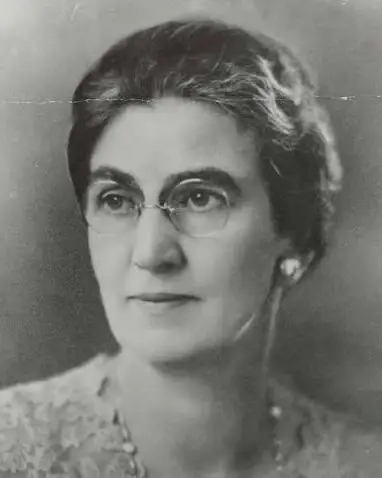
Born
June 5, 1881, Milan, Illinois
Died
March 30, 1949, Davenport, Iowa
Graduated
Palmer School, June 1905, salutatorian
Wrote
Chiropractic Anatomy, 1918, green book Volume 9
Also wrote
Stepping Stones, 1942
Her anatomy classroom
Mabel Palmer taught the anatomy that the first generation of chiropractors learned
Mabel Heath Palmer held the anatomy chair at the Palmer School of Chiropractic for more than 35 years. August Dye, writing the profession's own history in 1939, placed her arrival in the classroom at the start of the school's academic program. Instruction then still ran out of a converted barn on Brady Hill in Davenport.
Mabel Palmer trained for the anatomy chair at a medical college
Dye records that Mabel Palmer went outside chiropractic for her preparation. He writes that she became instructor in Anatomy in the early stages of the educational development of Chiropractic at the P. S. C., after completion of a special course in that specialty at one of the outstanding medical colleges of the midwest (Dye, 1939, p. 72). A chiropractic school in 1906 had no anatomy tradition of its own to draw on. Mabel Palmer went and acquired one, then brought it back and built the course around it.
Neurology entered the curriculum through Mabel Palmer's anatomy class
Dye's account of the Old Barn years names the subject a new student met first. He writes that a freshman would enter class in the “Old Barn” and start in with the subject of Neurology in Mrs. Palmer's Anatomy class (Dye, 1939, p. 65). The nervous system reached the profession's students as a branch of her anatomy course, before philosophy and before technique. That sequence is the order the tone model still teaches in.
A visitor in 1920 recorded a junior anatomy class of 500
A.W. Nixon spent time at the school and published The Spirit of the P.S.C. in 1920. In his own prefatory account of the visit he gives her title and her function in one line, as Dr. Mabel Palmer, professor of anatomy and her husband's able confidential adviser (Nixon, 1920, p. 5). Later in the book he puts 500 students in her junior anatomy section. He adds that she would be accorded honors nearly equal to her husband's once the history of chiropractic was written (p. 71). The school enrolled in the thousands through the 1920s, and anatomy was compulsory.
Chiropractic Anatomy
Chiropractic Anatomy became Volume 9 of the green books
Mabel Palmer wrote Chiropractic Anatomy, and the Palmer School published it in 1918 inside the numbered green book series that carried the profession's core texts. Her volume is number 9. The series is where D.D. Palmer, B.J. Palmer and Ralph Stephenson published, and she is in it on the same terms as any of them.
B.J. Palmer's technique textbook sends its students to her volume
A Textbook on the Palmer Technique of Chiropractic (1920) is the school's manual of adjusting, and it does not carry its own anatomy. Where a reader needs the nerve tracings, the book hands the question to her. On page 422 it states that what the cervical peripheral nerves supply, and what their anatomical tracings are, is thoroughly described in the text on Chiropractic Anatomy, Volume IX. It repeats the referral for the brachial plexus on page 426. The institution's own technique text treated her volume as the authority behind it.
Craven listed Chiropractic Anatomy beside Gray's and Cunningham's
J.H. Craven names his sources in the front of Chiropractic Orthopedy (1948). The list opens Chiropractic Anatomy by Palmer, Cunningham's Anatomy, Gray's Anatomy, Human Anatomy by Piersol (Craven, 1948, p. 9). Her book stands first in a list whose other three entries are the standard anatomies of the English speaking world. Craven adds that for ligaments and muscles the text on Chiropractic Anatomy has been closely followed, with the kind permission of the author, Dr. Mabel H. Palmer. At the muscle chapter itself he sends the reader back to her again (p. 352). Craven's acknowledgments thank her for criticizing his drawings and his ligament and muscle sections (p. 8), and he took two of his pelvis figures from her plates (p. 13).
Stephenson quoted her in the Chiropractic Text Book
Ralph Stephenson opens the Chiropractic Text Book (1948) by naming who he took from. He writes that he has quoted freely from Dr. Palmer's books, and from Dr. Mabel Palmer and Dr. Craven, citing Volumes V, IX and XV. Volume IX is hers. The two textbooks that formed the profession's early academic spine, Stephenson's on principles and Craven's on orthopedics, both route their anatomy through Mabel Palmer.
Chiropractic Anatomy ran to five editions in five years
Palmer College's own record of the green books gives the print history. The first edition appeared in 1918 at 487 pages. An expanded second edition followed in 1919 at 569 pages, third and fourth editions came in 1920, and a revised fifth edition appeared in 1923 at 573 pages. Every edition carried an index, a glossary, colored anatomical plates and a frontispiece portrait of the author. Five editions in five years is the demand curve of a required text.
Mabel Palmer spent five years writing it and claimed the first
B.J. Palmer announced the book in the Fountain Head News of March 16, 1918, reporting that his wife had been writing it for five years of reshaping and rewriting. Mabel Palmer described the work herself in a letter of May 25, 1918 to Edward W. Collins, D.C. She wrote that she had tried to make it a book for the chiropractic student, and that in her own way she had written the first book on chiropractic anatomy.
A paragraph of Mabel Palmer's anatomy prose survives in Craven
Craven quotes her directly at page 357, and the quotation is the longest sample of her anatomical writing recoverable from the green book library. Her definition of the linea alba runs structure, extent, dimension, composition and function, in that order, with no ornament anywhere in it. That is the register of a working dissection teacher, and it is why the school's other authors could lift from her without adjustment.
The linea alba (white line) is a tendinous cord, extending from the ensiform cartilage to the symphysis pubes. It is a strong, dense, fibrous band, about one half inch broad at its upper part, above the umbilicus, but it becomes narrow below. It is formed by the decussation of the aponeurosis of the abdominal muscles of the opposite sides, except the Recti muscles, and this line serves to strengthen the Wall.
Mabel Palmer, Chiropractic Anatomy, quoted verbatim in Craven, Chiropractic Orthopedy, 1948, p. 357A doctorate in the founding decade
Mabel Palmer graduated salutatorian in June 1905, and D.D. Palmer printed her degree in 1906
Mabel Sarah Heath married B.J. Palmer in 1904 and graduated from the Palmer School of Chiropractic in June 1905, second in her class behind the valedictorian Charles Ray Parker. She took her Iowa license in 1921, in the first year the state issued them.
Two class group plates in the 1906 volume print her degree
The earliest documentary proof of the degree sits in the founder's own book. The Science of Chiropractic (1906) carries photographic plates of the Palmer School class groups, and the captions name the people in them. Illustration No. 18 lists Dr. D. D. Palmer, Discoverer and Developer of Chiropractic, then B. J. Palmer, D. C., then Mabel Heath Palmer, D. C. Illustration No. 21 repeats the three names in the same order. Those captions fix her degree to the first decade of the profession, at a school whose total graduate count then ran in the dozens. Dye's 1939 history adds the school's second credential, listing her as Mabel Heath Palmer, D.C., Ph.C. (Dye, 1939, p. 71).
Mabel Palmer was born in 1881, and the widely circulated 1885 date is wrong
Wikipedia, Wikidata and Find a Grave give her birth year as 1885. The county record gives 1881. The index to certificates of birth for Rock Island County, Illinois, Book 1, covering 1877 to 1907, carries a single Mabel Heath: born 1881, father William L. Heath, mother Eva E. Heath. No Mabel Heath is indexed for 1885. Palmer College gives June 5, 1881 in its own biography, and the bronze bust on the Davenport campus is inscribed 1881 to 1949. She was 67 when she died on March 30, 1949.
Mabel Palmer reached the school through her father and as a patient
Dye traces the route. William Heath, D.C., known at the school as Daddy Heath, taught at the Palmer Infirmary and Chiropractic Institute and later served as Outside Clinic Director on the Palmer School faculty from 1910 until his death. He was still on the published faculty roster in December 1916, listed as W.L. Heath alongside his daughter. Dye writes that shortly before the school was organized, Heath's daughter appears in the record as a patient, and identifies that young woman as Mabel Heath (Dye, 1939, p. 71). She entered chiropractic through the clinic, took the degree, and then took the subject the clinic depended on.
The 1906 plates place other women in the same rooms
Illustration No. 21 also lists Selma Doeltz, Minnie Oas, and Martha M. Brake of Australia. Women were enrolled in the founding classes alongside the men. What separates Mabel Palmer from the other women in those photographs is what came next. She took the anatomy chair and wrote the volume the school taught from.
The school's finances
Mabel Palmer held the money that kept the Palmer School open
Palmer College states in its own biography of her that Mabel Palmer served as the school's treasurer and business manager. The profession's own historian, writing in 1939 while everyone involved was alive to contradict him, describes what that meant in practice.
Dye names her as the check on B.J. Palmer's spending
Writing in 1939, while every person involved was alive to contradict him, Dye states the arrangement without hedging. He calls Mabel Palmer one of the steadying influences in the development of chiropractic, then gives the reason. B.J. Palmer lost sight of the financial angle, and her hand kept him under control so the research could continue without fear of financial oblivion (Dye, 1939, p. 72). The school that trained the first two generations of the profession stayed solvent because she controlled what it spent.
Nixon's 1920 account describes the same role from inside
Nixon reached the same conclusion nineteen years earlier. His preface calls her B.J. Palmer's able confidential adviser (Nixon, 1920, p. 5), and his Davenport townspeople describe her as holding the chair of anatomy and serving as the doctor's shrewdest counselor (p. 9). Two observers, in 1920 and in 1939, describe an executive.
D.D. Palmer signed the school holdings over to Mabel Palmer in 1906
Vernon Gielow's biography of the founder records that in 1906 D.D. Palmer signed the school holdings over to Mabel Palmer (Gielow, 1981, p. 116). She was 25 years old, one year out of the graduating class, and the legal owner of the institution that would train the profession.
Mabel Palmer fired the school's business manager in 1932
Frank W. Elliott ran the Palmer School's business office through the acquisition of radio station WHO. Around 1932 Mabel Palmer dismissed him, and the position went to her son Dave. The account comes from an interview with the chiropractic historian W. Heath Quigley, recorded on November 19, 1996 and preserved in Joseph Keating's Palmer chronologies. Hiring and firing the top administrator is an executive act.
Mabel Palmer held property in her own name and willed it herself
B.J. Palmer's Up From Below The Bottom (1950) sets out a family trust arrangement in which he is first party and Mabel Palmer is second party. He records that in the fall of 1946 she deeded her holdings to their son and to two other family members. In the fall of 1948 she executed a further will going beyond the first (p. 682). A woman who could redirect the Palmer estate by her own instrument, without her husband's knowledge, held title in her own name. That is the concrete form of the control Dye described.
It has needed her hand to keep him under control so he could continue his research and development of Chiropractic without complete fear of financial oblivion.
August Dye on Mabel Palmer, The Evolution of Chiropractic, 1939, p. 72Stepping Stones, 1942
Stepping Stones is Mabel Palmer's own book, and it records the school's first years
Mabel Palmer published Stepping Stones through The P.S.C. Press in 1942, as a private edition of 426 pages carrying 43 stories. The book collects travel narratives and personal sketches rather than clinical or anatomical writing, and it is dedicated to B. J. and Dave. It is the only place in the green book library where Mabel Palmer speaks in the first person at length.
The book comes out of thirty-eight years of notebooks
Her preface gives the provenance. She writes that the stories are compiled from experiences covering a period of over thirty-eight years, jotted down in her notebook as she went. She never anticipated writing a book from them (Stepping Stones, 1942, p. 9). B.J. and their son asked her to type them up because the places she had written about were by 1941 in the news. She had already lectured on the material.
One chapter is the founding of the Palmer School, told by the house
The chapter titled A Soliloquy runs from page 233 to page 250, and it is narrated by the Brady Street house itself. The house dates its own purchase to 1905 and describes the birth of their son on a snowy afternoon in January, in the room at the south end (pp. 235 and 237). The school then outgrows the building. Rain came in on the students' feet in the basement classroom, the attic became a second classroom, and a Drill Hall went up on the back lawn (pp. 238 and 239).
Mabel Palmer kept the anatomical collection herself
The same chapter records who handled the school's specimens. Mabel Palmer writes that the couple arrived with bones and skeletons of man and various animals, and that the students studied from them. Her own figure in the story always takes charge of the collection (p. 240). The school's teaching anatomy was physically in her keeping, moved room to room as the building filled.
She worked the spinographs alongside B.J. Palmer
The house describes the locked upstairs room where the first spinal radiographs were read, and records the two of them working in there late into the night studying the pictures (p. 241). On the facing page she notes that she cooked for sixty or seventy patients, watched them overnight when they were seriously ill, and taught classes throughout (p. 240).
When the Little Builder and my Hurry Lady came to my place, they brot all kinds of bones and skeletons of man and various animals. I expect I just stared in amazement as they came to my house. At first I couldn't bear to have them around me. ... These “specimens”, as I learned they were called, were used for study by the students, so I became quite agreeable about their being placed most anywhere. In fact, I looked forward to what room they would be in, because my Hurry Lady always took charge of them.
Mabel Palmer, Stepping Stones, 1942, p. 240Lecturing and organizing
Mabel Palmer lectured to the profession and led a women's organization outside it
Mabel Palmer's work reached past the Davenport classroom in two directions. She lectured, and she built organizations for women, one inside chiropractic and one far outside it.
She founded Sigma Phi Chi in 1911
Mabel Palmer formed the Sigma Phi Chi professional sorority in 1911, six years after her own graduation. Palmer College describes it as the oldest chiropractic organization in the world. It gave the school's women students a standing body of their own inside a sixteen year old profession.
She was international president of Quota by 1927
Quota is a service organization of professional women founded in 1919. The Davenport Democrat of September 26, 1927 reported that Mrs. B.J. Palmer of Davenport, president of Quota International, was leaving for Canada to present the charter to the new club at Regina. Palmer College also credits her with forming the first Quota chapter in Australia. In 1928 Governor John Hammill named her Iowa's state delegate to the Women's World's Fair in Chicago, an appointment made once a year.
A lecture series in New York, around 1920
The chapter Two Satsuma Vases dates a pair of porcelain vases in the Palmer home. Professional friends presented them to the couple more than twenty years earlier, when the Palmers were in New York giving a series of lectures (Stepping Stones, 1942, p. 314).
Her own account of the Quota work in London
Stepping Stones records the organizing work in her own voice. She writes of an appointment with Lady Manby, whom she had planned to interview regarding the formation of a Quota Club in London. A separate meeting at the Piccadilly Hotel followed, on her Quota Club plans (1942, pp. 326 and 327).
She wrote part of Round the World With B.J. Palmer
The 1926 volume Round the World With B.J. Palmer carries a prefatory note explaining why its voice shifts between I, we, the speaker and the author. One reason given is that parts of the book were written by B.J. and Mabel. Her hand is in a second green book, credited in print.
The dated record
Ten dated facts about Mabel Palmer, with the source for each
1906. D.D. Palmer prints Mabel Heath Palmer, D. C. in two class group captions in The Science of Chiropractic, Illustrations No. 18 and No. 21. Her degree predates almost every chiropractic licensing statute in the United States.
1920. B.J. Palmer's A Textbook on the Palmer Technique of Chiropractic refers students to Chiropractic Anatomy, Volume IX, at pages 422 and 426, which fixes her book as published and in service by that year.
1927. The Davenport Democrat of September 26 reports that Mrs. B.J. Palmer of Davenport, president of Quota International, is leaving to present the charter to the new club at Regina, Canada.
From the 1930s to her death in 1949
1934. B.J. Palmer dedicates The Subluxation Specific, The Adjustment Specific to My Mabel and my Dave who lived with me thru these years of trying times (p. 9). He thanks her separately in the acknowledgments for the endorsement that carried the work (p. 18).
1939. Dye records that she still maintains a very active interest in anatomy instruction, although most of the classroom work is by then conducted by other faculty members (p. 72). She had stepped back from daily lecturing by the end of the 1930s while keeping the subject.
1942. Stepping Stones is published by The P.S.C. Press in a private edition of 426 pages. She had also issued a pamphlet, A Woman's Appeal to Women, in the early 1920s.
1949. Mabel Palmer dies in Davenport on March 30. A correspondent writing to B.J. Palmer shortly afterward, quoted in Up From Below The Bottom, describes attending her funeral and hearing a minister review the sacrifices made by the leading lady in Chiropractic (p. 614). She is buried at Oakdale Memorial Gardens.
What the institution said about her afterward
1964. At a Palmer College homecoming ceremony on August 16, Dave Palmer conferred posthumous honorary doctorates of Chiropractic Humanities on his grandfather, his father and his mother. The citations named D.D. Palmer the founder, B.J. Palmer the developer, and Mabel Palmer the co-developer.
1966. A bronze bust of her is installed at Palmer College. It stands today in Heritage Court on Brady Street with three others, on a wall inscribed The Foundation of Chiropractic. Her daughter in law Agnes High Palmer sculpted it.
2006. Palmer College names her a Fellow of the Palmer Academy of Chiropractic, which is why her name carries FPAC in the college's own materials.
Anatomy and tone
Anatomy is the substrate the tone model runs on, and Mabel Palmer supplied it
Every claim the Unified Model of Tone makes about a specific input producing a specific change depends on knowing where things are. Mabel Palmer's contribution to the understanding of tone is the map. She taught the profession's first generation which nerve reaches which tissue, and she wrote the volume they checked it in.
Correspondence is an anatomical claim before it is anything else
The model holds that specificity is correspondence rather than force. A restoring input works because it lands where the distortion of tone actually sits. That claim is empty without anatomy. Deciding that a contact at one segment should change something in the gut, the heart rate or the diaphragm is a statement about routes and connections, and it is checkable against a dissection. The 31 pairs of spinal nerves and the sympathetic chain beside them are the routes in question, and Mabel Palmer put them on the syllabus. Input quality and constraint both cash out in tissue that a student has to be able to name.
Teaching neurology inside anatomy is the order the model still uses
Dye's line about a freshman starting neurology inside Mrs. Palmer's anatomy class describes a curriculum decision with consequences. A student met the vagus, the sympathetic chain and the brachial plexus as structures with courses and destinations before meeting any philosophy about them. The autonomic nervous system page teaches in exactly that order, and for the same reason: the regulation argument is only as good as the wiring diagram under it.
What the model adds to what Mabel Palmer taught
Anatomy tells you what is connected. It does not tell you what state the connected system is holding. The Unified Model of Tone supplies the second half. The nervous system, the tissues and the vessels behave as one organized state. The measures that read that state, from heart rate variability to tissue compliance, move together because they are readings of one variable. Distortion of that state in either direction, too tense or too slack, is what illness expresses. Tone held inside its range keeps the flexibility to adapt, and that flexibility is health. Mabel Palmer's map is the structure the state runs on.
Questions
Common questions about Mabel Heath Palmer
Who was Mabel Heath Palmer?
Mabel Heath Palmer (1881 to 1949) was a chiropractor, anatomy instructor and author at the Palmer School of Chiropractic in Davenport, Iowa. She graduated salutatorian in 1905 and taught the school's anatomy course for more than 35 years. She wrote Chiropractic Anatomy in 1918 as Volume 9 of the green book series, and served as the school's treasurer and business manager. She married B.J. Palmer in 1904.
What did Mabel Palmer write?
She wrote Chiropractic Anatomy, first published in 1918 as Volume 9 of the Palmer green book series and used as the anatomy text at Palmer and at other chiropractic schools. It ran to five editions by 1923. She also wrote Stepping Stones, a 426 page collection of travel narratives issued by The P.S.C. Press in 1942, and a pamphlet titled A Woman's Appeal to Women. She is credited with writing part of Round the World With B.J. Palmer (1926).
Is Stepping Stones a chiropractic textbook?
No. Stepping Stones is a private edition collection of 43 travel stories and personal sketches, drawn from thirty-eight years of Mabel Palmer's notebooks and published in 1942. Its value to chiropractic history lies in one chapter, A Soliloquy, which narrates the founding years of the Palmer School from inside the Brady Street house and dates the purchase of that house to 1905.
Did Mabel Palmer really control the Palmer School's money?
Yes. Palmer College names her the school's treasurer and business manager. D.D. Palmer signed the school holdings over to her in 1906, and August Dye's 1939 history states that B.J. Palmer lost sight of the financial angle and that her hand kept him under control. She dismissed the school's business manager around 1932. B.J. Palmer's own 1950 book records her deeding her holdings and executing a will of her own in 1948.
When was Mabel Palmer born, and why do sources disagree?
She was born on June 5, 1881 in Milan, Rock Island County, Illinois, and died on March 30, 1949 in Davenport, Iowa. Wikipedia, Wikidata and Find a Grave give 1885, which the record contradicts. The Rock Island County index of birth certificates lists one Mabel Heath, born 1881 to William L. and Eva E. Heath, and none for 1885. Palmer College and her campus memorial both give 1881.
What did Mabel Palmer contribute to the understanding of tone?
She supplied the anatomy the whole argument depends on. The Unified Model of Tone holds that specificity is correspondence rather than force, which is a claim about routes and connections and is checkable only against a dissection. Mabel Palmer taught neurology inside anatomy, so the profession's first generation met the nervous system as named structure before meeting any philosophy about it.
Sources
Sources for this page
- Palmer DD. The Science of Chiropractic: Its Principles and Adjustments. Palmer School of Chiropractic; 1906. Illustration No. 18 and Illustration No. 21, class group plates naming Mabel Heath Palmer, D.C.
- Palmer BJ. A Textbook on the Palmer Technique of Chiropractic. Palmer School of Chiropractic; 1920. Pages cited. 422 and 426, referrals to Chiropractic Anatomy, Volume IX, for cervical nerve tracings and the brachial plexus.
- Nixon AW. The Spirit of the P.S.C. Palmer School of Chiropractic; 1920. Pages cited. 5, professor of anatomy and confidential adviser. 9, the chair of anatomy and the counselor role. 71, the junior anatomy section of 500 and the assessment of her standing.
- Palmer BJ. Round the World With B.J. Palmer. Palmer School of Chiropractic; 1926. Prefatory note, crediting parts of the text to B.J. and Mabel Palmer.
- Palmer BJ. The Subluxation Specific, The Adjustment Specific. Palmer School of Chiropractic; 1934. Page 9, the dedication naming Mabel and Dave. Page 18, the acknowledgment of her endorsement.
- Dye AA. The Evolution of Chiropractic: Its Discovery and Development. Philadelphia; 1939. Pages cited. 65, neurology taught inside her anatomy class in the Old Barn. 71, the Heath family, her arrival as a patient, and the D.C., Ph.C. credentials. 72, the financial control, the medical college anatomy course, the authorship of Chiropractic Anatomy, and its adoption at other schools.
- Palmer MH. Stepping Stones. The P.S.C. Press; 1942. Private edition, 426 pages. Pages cited. 9, the preface and the thirty-eight years of notebooks. 233 to 250, the chapter A Soliloquy. 235, the 1905 purchase of the Brady Street house. 237, the birth of their son and the arrival of chiropractic. 238 and 239, the school outgrowing the building. 240, the anatomical specimens in her keeping and the teaching alongside the nursing. 241, the spinograph room. 314, the New York lecture series. 326 and 327, the Quota Club work in London.
- Craven JH. Chiropractic Orthopedy. Palmer School of Chiropractic; 1948. Pages cited. 8, the acknowledgment to Mabel H. Palmer for her criticism of the drawings and of the ligament and muscle sections. 9, the reference list opening with Chiropractic Anatomy, and the permission to follow her text. 13, the pelvis figures taken from her plates. 352, the referral of students to her book. 357, a paragraph of her anatomical prose quoted verbatim.
- Stephenson RW. Chiropractic Text Book. Palmer School of Chiropractic; 1948 printing. Preface, naming Dr. Mabel Palmer among the authors quoted and citing Volume IX.
- Palmer BJ. Up From Below The Bottom. Palmer School of Chiropractic; 1950. Pages cited. 614, the account of her funeral and the phrase the leading lady in Chiropractic. 682, the trust arrangement, the 1946 deeds and the 1948 will.
- Palmer College of Chiropractic. Biography: Mabel Heath Palmer. Davenport, Iowa. Birth and death dates, the treasurer and business manager role, the founding of Sigma Phi Chi in 1911, the Quota work, and the 2006 Fellowship of the Palmer Academy of Chiropractic. palmer.edu
- David D. Palmer Health Sciences Library, Palmer College of Chiropractic. The Green Books, Volume 9: Chiropractic Anatomy. Edition history, page counts and printers for the 1918, 1919, 1920 and 1923 printings. library.palmer.edu
- Keating JC Jr. Chronology of Mabel Heath Palmer, D.C. National Institute of Chiropractic Research, Phoenix, Arizona. Dated entries used here. June 1905, the salutatorian standing, citing Zarbuck MV, Chiropractic parallax, Part 2, IPSCA Journal of Chiropractic 1988;9(4). March 16, 1918 and May 25, 1918, the Fountain Head News announcement and her letter to Edward W. Collins. September 26, 1927, the Davenport Democrat notice of her Quota International presidency. 1928, the Women's World's Fair appointment. 1921, the Iowa license. Companion chronologies for B.J. and David Palmer supply the 1916 faculty roster listing W.L. Heath, the 1906 transfer of the school holdings citing Gielow V, Old Dad Chiro (1981), p. 116, the 1932 dismissal of Frank W. Elliott from the Quigley interview of November 19, 1996, and the August 16, 1964 posthumous doctorates naming Mabel Palmer the co-developer.
- Index to Certificates of Births, Rock Island County, Illinois, Book 1, 1877 to 1907. Blackhawk Genealogical Society transcription. Entry: Heath, Mabel; William L.; Eva E.; 1881; book 1, p. 229. ricigs.org
- Ferguson A. The sweetheart of the PSC: Mabel Heath Palmer, the early years. Chiropractic History 1984;4(1):25-28. PMID 11611591. pubmed.ncbi.nlm.nih.gov
- Walters B. Art in plain sight: Palmer busts. River Cities' Reader, February 9, 2012. The Heritage Court busts, the 1881 to 1949 inscription, and the sculptor Agnes High Palmer. rcreader.com
The library
Where Mabel Palmer sits in the rest of the library
D.D. Palmer named tone as the basic principle in 1910 and left the anatomy of it unfinished. B.J. Palmer built the research and instrumentation program on top of her curriculum, and his technique textbook sent its readers to her volume for the tracings. Ralph Stephenson quoted Volume IX in the 1948 textbook that formalized the 33 principles. The Legends collects the rest of the people who carried the work, and the history timeline places the founding decade among the other turning points.
The tone pillar states the variable her anatomy served, with current measurements attached. The autonomic nervous system is the structure her students met first. Coupling gives the model's account of why separate readings of it move together, and movement covers the tissue side.
This page is education and history, not medical advice. Quotations are transcribed from the editions named in the sources list, with page numbers given for each. Stepping Stones is a collection of travel narratives, and its chapter A Soliloquy is a first person account narrated in the voice of the Palmer family house.
