
Our Approach · The Legends · Era I
The Founding · 1845 to 1913
D.D. Palmer
The Founder
Daniel David Palmer (1845 to 1913) founded chiropractic in Davenport, Iowa, gave the first adjustment on September 18, 1895, and wrote the profession's founding text in 1910. That book opens on one sentence: life is the expression of tone. Palmer defined tone as the normal degree of nerve tension and placed disease in departure from it, nerves too tense or too slack. The Unified Model of Tone formalizes the variable he named.
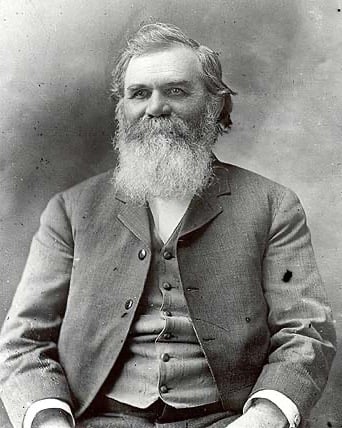
Born
Mar 7, 1845 · Port Perry, Ontario
Died
Oct 20, 1913 · Los Angeles
First adjustment
Sept 18, 1895 · Davenport
Founding text
The Chiropractor's Adjuster, 1910
First school
Davenport, late 1890s
Tone in the founding text
Palmer named tone as the basic principle of chiropractic
Palmer put his definition on page 7 of The Chiropractor's Adjuster, ahead of every case, argument and history in the book. The passage reads: Life is the expression of tone. In that sentence is the basic principle of Chiropractic. Tone is the normal degree of nerve tension. Tone is expressed in functions by normal elasticity, activity, strength and excitability of the various organs, as observed in a state of health. Consequently, the cause of disease is any variation of tone, and Palmer finishes the sentence with the two directions that variation can take, nerves too tense or too slack.
Six lines carry four separate claims. Palmer names tone as the basic principle. He defines it as nerve tension held at a normal degree. He states that tone shows itself across many organs through several properties at once, listing elasticity, activity, strength and excitability. Then he defines disease as departure from that normal degree in either direction. Nothing in the passage depends on a bone, a joint, or a single anatomical site.
What Palmer meant by the word tone
Palmer used tone to mean a working property of living tissue. On page 328 of the 1910 book he wrote that tone is that state of tension or firmness in nerves and organs necessary for normal transmission of impulses and the proper performance of functions. The definition is functional. Tone is what allows an impulse to travel correctly and an organ to do its job. Palmer then named the two failure modes separately. Excess tension produces irritation and overactivity. Deficient tension produces weakness.
That is a regulatory account of illness written in 1910. Palmer is describing a value that the body holds within a range, and a range that can be departed from at either edge. The tone pillar in this library states the same structure with modern measurements attached.
Tone at every scale, in Palmer's own words
Palmer applied tone across scales rather than to the spine alone. On page 659 he defined it as that state or condition of a body, or any of its organs or parts, in which the organic or animal functions are performed with due vigor. A body, an organ, or a part. On the same page he tied the levels together: The tone or tension of muscles and organs depends upon the tonicity of the nervous system. Muscle tone and organ tone are downstream readings of nervous system tone.
He also stated the bidirectional claim outright on page 659, describing any deviation from normal tone, that of being too tense or too slack. Two ideas that the Unified Model of Tone treats as canon, multiscale expression and deviation in either direction, are already present in the founding text with page numbers attached.
Upon the comprehension of tone I built the grandest science of this or any age.
D.D. Palmer · The Chiropractor's Adjuster, 1910, p. 879Measurement, 1910
Palmer claimed tone is measurable and reached for blood pressure as his analogy
On page 791 Palmer answered the question of how tone would ever be quantified. He wrote: Tone is measured by a tonometer, an instrument for measuring tension, or the degree of resistance to pressure, as in estimating the tension of the eyeball, blood pressure, etc. It is not weighed on a scale, nor measured by the gallon.
The sentence does specific work. Palmer places tone in a class with intraocular pressure and arterial pressure, two quantities that clinicians already measured in 1910 with instruments and reported as numbers. He is claiming that tone belongs to the family of measurable tensions, and he rules out the measurement classes it does not belong to, weight and volume.
Why the blood pressure analogy matters to the model
The Unified Model of Tone describes tone as a regulated variable of the body, as basic as blood pressure or blood pH. Palmer arrived at the same comparison from the other end, more than a century earlier, while trying to explain what kind of quantity he had named. The model and the founder reached for blood pressure independently, a century apart.
Modern instrumentation caught up to the claim. Heart rate variability, quantitative sensory testing, cortical excitability measures and tissue compliance measures all produce numbers for aspects of the same regulation. The library's page on heart rate variability covers the best developed of them.
What Palmer set as the disease criterion
Palmer pressed the criterion on his own readers and repeated it across the volume. On page 36 he wrote, I wish that all Chiropractors could take in this basic principle of our science, then named it as too much or not enough energy. On page 35 he put it in plainer terms. Departure from normal may cause the exhibition of either too much or not enough life; we may live too fast or too slow.
A criterion with two directions demands a two directional test, and that is the shape the model uses now. Restoration is measured as movement toward the middle from both edges at once. The tone pillar sets out the test and the primary record behind it.
The question behind the discovery
Palmer set out to explain why one person falls ill and the person beside them does not
Palmer described his search as driven by a single comparison. On page 18 of the 1910 book he named the question that stayed uppermost in his mind. Why was one person ailing while an associate eating at the same table working in the same shop, at the same bench, was not? He listed the diseases the comparison covered, pneumonia, catarrh, typhoid and rheumatism, and asked what difference between two similarly placed people decided which of them fell ill.
The question rules out an answer based on exposure alone. Same table, same shop, same bench. Whatever separated the two men had to be a property of the person rather than of the environment. Palmer spent years looking for that property and settled on the condition of the nervous system.
Palmer's background before 1895
Palmer was born on March 7, 1845, in Port Perry, a small town in Ontario, and had lived in Davenport, Iowa, for years before the discovery. August Dye's 1939 history of the profession places Palmer in magnetic healing at What Cheer and Davenport for several years before 1895. Dye records that he held a large practice by that year (The Evolution of Chiropractic, 1939, p. 13). He came to the question as a working healer with a decade of clinical observation behind him.
Harvey Lillard, September 18, 1895
Palmer told the story of the first adjustment twice in the 1910 book. On page 18 he wrote that Harvey Lillard, a janitor in the Ryan Block where Palmer kept his office, had been deaf for 17 years. Lillard traced the loss to a moment of exertion in a cramped, stooping position, when he felt something give way in his back. Palmer examined the spine, found a vertebra out of position, and reasoned that replacing it should restore the hearing. He wrote that a half hour of talk persuaded Lillard, and that he then racked it into position by using the spinous process as a lever.
The caption under Lillard's portrait on page 137 dates the visit to September 18, 1895, and repeats the 17 years of deafness. It names the segment Palmer believed he moved, the fourth dorsal, corrected by one move. Palmer insisted in the same passage that the case was neither accidental nor crude, because he had a hypothesis first and obtained the result he expected.
The second case, a heart patient, turned a result into a method
The reasoning step came from the second patient. Palmer wrote on page 18 that shortly after the Lillard case he treated a man with heart trouble who was not improving. He examined the spine, found a displaced vertebra bearing on nerves that supply the heart, adjusted it, and saw immediate relief. Two conditions as unlike each other as deafness and heart trouble had answered to the same kind of correction. He then asked whether other diseases came from a similar cause and began what he called a systematic investigation of the cause of all disease.
That is the move that turned a clinical result into a science. Palmer was testing whether one variable stood behind unrelated presentations, which is the question the tone model asks when it treats coupling across systems as a single organizational property.
Naming the science, 1896
Palmer coined the word chiropractic from two Greek words meaning done by hand
Palmer credited the name to a patient. On page 12 of the 1910 book he wrote that the Reverend Samuel H. Weed, at Palmer's request, selected two Greek words, cheir and praxis, meaning when combined done by hand, and that Palmer coined the word chiropractic from them. Palmer dates it on page 105. Mrs. Weed and her daughter took chiropractic adjustments early in 1896, Weed himself followed, and about that time Palmer asked him for a Greek name meaning done by hand. Dye's history gives the same account from the other side. Weed had studied Greek for the ministry and was an early patient. He asked Palmer's permission to give the new work a name with dignity rather than leaving it as hand treatment of the spine (Dye, 1939, p. 33).
Palmer defined chiropractic as science, art and philosophy at once
Palmer defined the field as three things at once and built the 1910 book on that division. He wrote on page 19 that he founded chiropractic on osteology, neurology and functions, which he glossed as bones, nerves and the manifestations of impulses. The full title of his 1911 volume states the same three part structure, The Science, Art and Philosophy of Chiropractic. Dye records that the profession described its work in those terms from 1895 onward.
The division survives because each part answers a different question. The science names the variable. The art delivers a specific input to it. The philosophy holds that the body governs itself, and that the practitioner's job is to remove what interferes. The Unified Model of Tone keeps all three and gives the first one measurements.
The first school
Palmer taught the method instead of holding it privately
Palmer opened the first chiropractic school in Davenport in the late 1890s, the Palmer Infirmary and Chiropractic Institute. Dye records that it operated until roughly two years after Palmer left the city in 1902 (Dye, 1939, p. 61). The Palmer School of Chiropractic followed, organized in 1904 and incorporated under Iowa law in 1905 as an educational institution. Dye records that the first instruction at the original school was thin in academic subjects and strong in the practical work, digital palpation to locate the problem and a specific adjustment to correct it.
The schools that followed Palmer west
Palmer kept teaching after Davenport. Dye records that Palmer organized several small schools in various localities after 1902. During his travels in the west and southwest he joined Alva Gregory, and the two organized the Palmer-Gregory College of Chiropractic at Oklahoma City (Dye, 1939, pp. 61 to 62). Palmer left the arrangement quickly. The school ran on for several years and graduated students without him.
Palmer died in Los Angeles in 1913, eighteen years after the first adjustment
Palmer died in Los Angeles on October 20, 1913 (Dye, 1939, p. 22). He had returned to Davenport in July of that year to lecture at the Davenport College of Chiropractic and then at the Universal Chiropractic College. Dye, writing 26 years later with access to the people involved, records that Palmer and his son were estranged at the time of the death (Dye, 1939, p. 22). The founder's ashes were later placed in a memorial at Davenport, dedicated on August 21, 1921, at a ceremony where Weed told the story of naming the science.
I am the originator, the Fountain Head of the essential principle that disease is the result of too much or not enough functionating.
D.D. Palmer · The Chiropractor's Adjuster, 1910, p. 19The record
Eight dated facts about D.D. Palmer, with the source for each
1845. Palmer was born on March 7 in Port Perry, Ontario (Dye, 1939, p. 13). The birth date fixes him at 50 years old at the discovery, with a full working life behind him.
Before 1895. Palmer held a large magnetic healing practice by 1895. Dye records that the local medical fraternity treated him as a rival while most people around Davenport respected him (Dye, 1939, p. 13).
September 18, 1895. Palmer adjusted Harvey Lillard in the Ryan Block in Davenport. Fifteen years later he printed Lillard's portrait in his own book and wrote the caption beneath it himself (Adjuster, pp. 18 and 137).
1896. Weed first met Palmer in 1894, after Palmer treated his daughter's sprained ankle by magnetic healing (Adjuster, p. 105). The patient who named the science had been in Palmer's care for two years before he named it.
Late 1890s. Palmer founded the Palmer Infirmary and Chiropractic Institute, the first school of chiropractic (Dye, 1939, p. 61). Dye records that he still held the view that chiropractic should stay inside the Palmer family (Dye, 1939, p. 22).
1902. Palmer left Davenport, and the first school closed about two years later. The Palmer School of Chiropractic was organized in 1904 and incorporated in 1905 (Dye, 1939, p. 61). The institution that carried the work forward dates from those years.
1910. Palmer published The Chiropractor's Adjuster, 1,005 pages, in which the word tone appears 111 times. The 1911 volume The Science, Art and Philosophy of Chiropractic uses it 121 times. Across the two volumes Palmer uses the word 232 times.
October 20, 1913. Palmer died in Los Angeles (Dye, 1939, p. 22). He had lectured in Davenport three months earlier, 18 years after the first adjustment.
Palmer's contribution to the model
Palmer named the variable, and the Unified Model of Tone measures it
Palmer identified a single quantity that living tissue holds within a range, called it tone, and made departure from that range in either direction the definition of illness. That is his contribution to this model. Every other part of his system rests on the claim, by his own statement on page 879 that upon the comprehension of tone he built the science.
The four claims the model inherited
Four specific claims carry forward. Palmer restated all of them on page 971, at the end of the 1910 volume, where he called tone the foundation upon which he built his science. Tone is the organizing variable, stated on page 7 as the basic principle. Tone is expressed at multiple scales, stated on page 659 as a property of a body or any of its organs or parts. Deviation runs in two directions, too tense or too slack, stated on pages 7 and 659. Tone is a measurable tension in the same class as blood pressure, stated on page 791. The model holds all four and attaches instruments to each.
Where the model goes beyond what Palmer wrote
Palmer had one mechanism available to him, mechanical pressure on nerves, and he used it to explain everything. The model does not need that restriction. Tone is carried by rhythmic activity across the nervous system and shaped by the quality of input arriving from the body. Prediction biases it, and the constraints tissue places on movement limit it. The autonomic nervous system is the highest density integrator of these signals, and its output is readable in the numbers no instrument could produce in 1910.
Tone held within its healthy range is health, because the range is what preserves the ability to adapt to load. Tone that drifts or distorts outside that range is what shows up as illness. Palmer wrote that in 1910 with the vocabulary available to him. The library states it with the measurements now available, on the tone pillar and across every condition page that follows from it.
Questions people ask
Common questions about D.D. Palmer
What did D.D. Palmer contribute to the understanding of tone?
Palmer named tone as the organizing variable of the living body and defined it as the normal degree of nerve tension. On page 7 of The Chiropractor's Adjuster in 1910 he called it the basic principle of chiropractic and placed the cause of disease in any variation of tone, nerves too tense or too slack. He applied it to a body or any of its organs, and on page 791 he claimed it is measurable. The Unified Model of Tone formalizes that variable.
What exactly did Palmer write about life and tone?
The opening line of the 1910 book is, life is the expression of tone. Palmer continued that in that sentence is the basic principle of chiropractic, and that tone is the normal degree of nerve tension. Tone, he wrote, is expressed in functions by normal elasticity, activity, strength and excitability of the various organs as observed in health. He closed the passage by defining the cause of disease as any variation of tone, nerves too tense or too slack. It appears on page 7.
When and where did D.D. Palmer give the first chiropractic adjustment?
On September 18, 1895, in the Ryan Block in Davenport, Iowa, where Palmer kept his office. The patient was Harvey Lillard, a janitor in the building who had been deaf for 17 years. Palmer recorded the case himself on page 18 of the 1910 book and again in the caption on page 137, where he named the fourth dorsal vertebra and described correcting it by one move. Palmer wrote that he formed the hypothesis before delivering the adjustment.
Did D.D. Palmer think tone could be measured?
Yes, and he said so in print. On page 791 of The Chiropractor's Adjuster he wrote that tone is measured by a tonometer. He described it as an instrument for measuring tension, or the degree of resistance to pressure, as in estimating the tension of the eyeball and blood pressure. He added that it is not weighed on a scale nor measured by the gallon. Palmer placed tone in the same measurement class as intraocular pressure and arterial blood pressure in 1910.
Who named chiropractic?
The Reverend Samuel H. Weed supplied the Greek and Palmer coined the word. Palmer wrote on page 12 of the 1910 book that Weed, at his request, selected cheir and praxis, meaning when combined done by hand, and that he formed chiropractic from them. August Dye's 1939 history records that Weed had studied Greek for the ministry, was an early patient, and asked Palmer's permission to give the new work a proper name. Weed told the story publicly at Davenport in 1921.
What school did D.D. Palmer found?
Palmer founded the Palmer Infirmary and Chiropractic Institute in Davenport in the late 1890s, the first school of chiropractic. Dye's 1939 history records on page 61 that it operated until about two years after Palmer left Davenport in 1902. The Palmer School of Chiropractic was organized in 1904 and incorporated under Iowa law in 1905. Palmer later organized several smaller schools and co-founded the Palmer-Gregory College of Chiropractic in Oklahoma City with Alva Gregory.
What did Palmer mean by too much or not enough functionating?
He meant that illness is a departure from a normal amount of activity in either direction. Palmer stated it on page 19 of the 1910 book as the essential principle he originated, and repeated it throughout the volume. On page 35 he wrote that variation from normal may cause the exhibition of either too much or not enough life, and that we may live too fast or too slow. Excess produces irritation and overactivity, deficiency produces weakness.
How does the Unified Model of Tone relate to what Palmer wrote?
The model takes Palmer's variable and gives it instruments. Tone is the organizing state of the nervous system, expressed at several scales, deviating in two directions, and readable in measurements such as heart rate variability, cortical excitability and tissue compliance. Palmer stated the first three claims in 1910 and predicted the fourth when he compared tone to blood pressure. The model keeps his definition of health as tone held within a range that preserves the ability to adapt.
Sources
Sources for this page
- Palmer DD. The Chiropractor's Adjuster: The Science, Art and Philosophy of Chiropractic. Portland Printing House Company; 1910. Pages cited. 7, tone as the basic principle. 12, the naming of chiropractic. 18, the question and Harvey Lillard and the heart case. 19, the essential principle. 35 and 36, too much or not enough. 137, the Lillard caption. 328, tone as tension and firmness. 105, the dating of the naming. 659, tone at every scale and in both directions. 791, the tonometer and blood pressure. 879, upon the comprehension of tone. 971, tone as the foundation of the science.
- Dye AA. The Evolution of Chiropractic: Its Discovery and Development. Philadelphia; 1939. Pages cited. 13, birth at Port Perry and magnetic healing at What Cheer. 22, death in Los Angeles on October 20, 1913. 32 and 33, the Lillard case and the naming by Weed. 61 and 62, the first school and the Palmer School of Chiropractic and the Palmer-Gregory College.
- Palmer DD. The Science, Art and Philosophy of Chiropractic. Portland Printing House Company; 1911. The word tone appears 121 times in this volume.
Where this page sits in the library
Palmer's line runs forward through the profession and into the model
B.J. Palmer took the school his father founded and built the research and instrumentation program around it. Mabel Palmer taught the anatomy that the method depended on for decades. Ralph Stephenson wrote the principles into a formal textbook. Solon Langworthy and Willard Carver founded the first schools outside the Palmer line and pushed the structural argument.
The tone pillar states the variable Palmer named with current measurements attached. Origins covers the cultures that described a regulated state long before anyone could measure it. The history timeline places 1895 among the other turning points, and The Legends collects the people who carried the work.
The Unified Model of Tone carries the full argument, with the measurements attached.
This page is education and history, not medical advice. Quotations from D.D. Palmer are transcribed verbatim from the 1910 first edition of The Chiropractor's Adjuster, with page numbers given for each.