
Our Approach · The Legends · Era I
Era I · 1868 to 1922
Solon Langworthy
The Rival
Solon Massey Langworthy (1868 to 1922) opened the American School of Chiropractic and Nature Cure at Cedar Rapids, Iowa, in 1903, the earliest rival to the Palmer school. His faculty published the profession's first textbook in 1906. Langworthy defined the spinal lesion as a change in a vertebra's field of motion, and he held four United States patents on spinal traction equipment. The Unified Model of Tone reads the spine the way Langworthy read it, as one mechanical column.
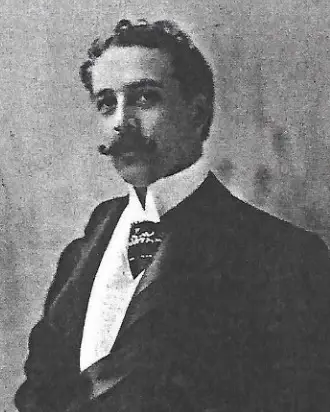
Born
March 23, 1868 · Dubuque, Iowa
Died
September 9, 1922
Graduated
Palmer School of Chiropractic, 1901
Founded
American School of Chiropractic and Nature Cure, Cedar Rapids, 1903
First textbook
Modernized Chiropractic, two volumes, 1906
First journal
Backbone, first issue October 1903
Patents
Four US patents on spinal traction, 1904 to 1910
Langworthy's training
Langworthy came to chiropractic with a manual therapy education already behind him
Langworthy graduated from the Palmer School in 1901, and D.D. Palmer's own roster settles the date. In The Chiropractor's Adjuster Palmer printed a list of the earliest graduates of chiropractic and placed S. M. Langworthy tenth on it, in the class of 1901, one year ahead of B.J. Palmer (p. 778). Fourteen names cover 1898 to 1902. Langworthy sits inside the founding cohort by the founder's own accounting.
Before Davenport
Solon Massey Langworthy was born at Dubuque, Iowa, on March 23, 1868. The Langworthys were an established family in the river city, and Solon trained first for commerce at Bayless Business College. Joseph Keating records that Langworthy also held a diploma from the American College of Manual Therapeutics in Kansas City, and that he was teaching chiropractic and osteopathy at the time he first approached the Palmers. He arrived with a drugless practice already in hand. That one fact explains most of what he did afterward.
The partnership B.J. Palmer refused
Langworthy proposed an amalgamation and was turned down. Keating records that Langworthy met B.J. Palmer to propose partnering in the school business, and to press for an expansion of the Palmer curriculum that would take in nature cure methods. Palmer refused and called the additions mixing. The long division in chiropractic between broad-scope and traditional practice dates from that refusal, and Langworthy is standing on one side of it before 1903.
The second school, 1903
Langworthy opened the first chiropractic school outside Palmer's control
The American School of Chiropractic and Nature Cure opened at Cedar Rapids, Iowa, and its journal carries a first issue dated October 1903. Keating puts the school's origin at about 1902 and calls it one of the earliest of the rival schools. Nothing of the kind had existed before. Every chiropractor then in practice had been taught by D.D. Palmer in person, in Davenport, for a fee. Langworthy moved the teaching to another city and out of the founder's hands.
Oakley Smith and Minora Paxson ran the faculty
Langworthy staffed Cedar Rapids with two more Palmer graduates. August Dye records that Langworthy organized the American School of Chiropractic. Dye names Minora Paxson and Oakley G. Smith as associates in its organization (The Evolution of Chiropractic, 1939, p. 26). Palmer's 1910 roster dates Smith's graduation to 1899, which makes him the third chiropractor ever qualified. Smith served as dean at Cedar Rapids. Paxson headed obstetrics and gynecology.
A two-year course when Davenport taught in months
The curriculum was the school's real weapon. Cedar Rapids ran a two-year course of study while the Palmer School still trained its students in weeks and months. Dye writes that the early Palmer instruction covered a period of but a few weeks or months (p. 38). The difference mattered two years later. The Minnesota licensing bill of 1905 required graduation from a two-year course in chiropractic, which the American School offered and the Palmer School did not.
Modernized Chiropractic, 1906
The profession's first textbook came out of Cedar Rapids, four years before Palmer's
Modernized Chiropractic appeared in two volumes in 1906, published at Cedar Rapids under Langworthy's imprint, with Oakley G. Smith, Langworthy and Minora C. Paxson on the title page. D.D. Palmer's The Chiropractor's Adjuster followed four years later. Palmer recorded the priority himself. Listing the books written on chiropractic, he wrote that Langworthy and Smith put out a book in two volumes, under the title of Modernized Chiropractic, and added that he had not seen it (p. 981).
Who actually wrote it
Authorship of Modernized Chiropractic is not evenly divided across the three names. Simon Senzon, working from a manuscript recovered by Timothy Faulkner, concludes that Smith wrote most or all of the book. Langworthy published it and Paxson edited it. The credit stated here follows both the title page and that finding: the book belongs to the school, the school belongs to Langworthy, and Smith supplied the bulk of the writing.
The book made subluxation the profession's working word
Modernized Chiropractic used the word subluxation 1,186 times. The Palmers' first book used it 48 times. Senzon supplies both counts, and the ratio is the durable fact. Credit for introducing the term into chiropractic is often given to Langworthy, and the documentary record is more specific. Senzon dates the first published chiropractic use to an advertisement placed by O. G. Smith in the Clarinda Herald on February 4, 1902, and finds D.D. Palmer writing sub-luxation in a letter to his son on April 27, 1902. What Cedar Rapids did was make the word unavoidable.
The disc and the foramen carried the mechanism
The Cedar Rapids account of the lesion ran through the disc and the intervertebral foramen. Senzon records that the book emphasized the axis of motion between two vertebrae, and the effect of that motion on the ligaments of the foramina and on the discs. Aberrant motion, not misalignment of the articular surfaces, is what the adjustment was meant to correct. The aim was to return the motion toward the hub where the authors said it belonged.
A simple subluxated vertebra differs from a normal vertebra only in its field of motion and the center of its field of motion.
Smith, Langworthy and Paxson · Modernized Chiropractic, Volume I, 1906Field of motion, 1906
Langworthy defined the lesion as a change in a vertebra's field of motion
The definition printed at Cedar Rapids moved the lesion out of position and into movement. A simple subluxated vertebra, Modernized Chiropractic states, differs from a normal vertebra only in its field of motion and the center of its field of motion. Set that beside the Palmer School definition that Ralph Stephenson later printed. There a subluxation is the condition of a vertebra that has lost its proper juxtaposition with the one above or the one below. One definition describes a place. The other describes a range.
What a field of motion is
A field of motion is the space a joint travels through, together with the point that travel turns around. Langworthy treated every vertebra as a movable bone in a flexible and movable column, each with its own field. On that account a segment can sit in a normal position and still be abnormal, because the fault lies in how far it moves and around what. Steve Troyanovich, writing in the Journal of Contemporary Chiropractic in 2026, reads Langworthy's subluxation as a combination of segmental and postural phenomena.
Group subluxations and the whole column
Langworthy held that subluxations occur in groups. Troyanovich records his position that a group requires simultaneous correction in more than one direction, and that posture itself can indicate the presence of a subluxation. Langworthy also proposed a vertical subluxation, produced by gravitational pressure narrowing the intervertebral discs over years. That is a claim about the column as a loaded structure, not about the position of any single joint in it.
Panjabi named the same quantity the neutral zone in 1992
Modern spine biomechanics measures what Langworthy described. Manohar Panjabi defined the neutral zone in the Journal of Spinal Disorders in 1992 as the part of a joint's range in which motion meets minimal internal resistance. Panjabi argued that clinical instability shows up as an enlarged neutral zone rather than as a loss of total range. Field of motion and its center was written in 1906. Neutral zone and its size was written in 1992. The two phrases name the same property of a joint, and Langworthy had no instrument that could record it.
Four patents, 1904 to 1910
Langworthy patented spinal traction equipment and manufactured it for the profession
Four United States patents name Solon M. Langworthy as inventor. Patent 776,335 covers a vertebral stretcher and was granted on November 29, 1904. Patent 901,628 covers a surgical table and was granted on October 20, 1908. Patent 923,862 covers a surgical head-holder and was granted on June 8, 1909. Patent 978,760 covers a second surgical table and was granted on December 13, 1910. All four are public documents. All four are traction and positioning devices for the spinal column.
The vertebral stretcher, 1904
The 1904 application states its own target. The invention relates to the treatment of the vertebral column for affections peculiar to it, and more particularly distortions or compression. Troyanovich describes the machine as delivering generalized distracting force either to the whole spine or to a chosen region, with the patient controlling how much force is applied. Distortion and compression of the whole column, named in a patent filing in 1904, is the same target the Cedar Rapids textbook named two years later.
The 1910 table may be the profession's first instrument adjusting device
Patent 978,760 describes an adjusting table built around coiled springs of graded elasticity. Separate head, chest and hip carriages allowed traction to be taken locally or across the whole body. An electric motor supplied vibration. A semicircular yoke carried a rubber-tipped applicator that Langworthy called an anatomical adjustor. Troyanovich notes that this may be the first patented instrument adjusting device in the profession. The handheld instruments that carried the same idea into everyday practice arrived more than half a century later.
The Physicians Apparatus Company
Langworthy manufactured and sold what he patented. By 1909 he had established the Physicians Apparatus Company, and its catalog, Inventions of Dr. S. M. Langworthy, survives. The catalog describes a head pull that could be raised, lowered, or rotated to either side at the operator's discretion. Langworthy was equipping other chiropractors with the hardware his own analysis of the spine required, which is how a theory of the column becomes a way of working.
Backbone, October 1903
Langworthy started the profession's first journal and its first national association
Backbone published its first issue in October 1903 from the American School of Chiropractic and Nature Cure at Cedar Rapids. It was the first regular periodical the chiropractic profession had. Langworthy wrote for it himself. His 1904 contributions include an article titled The cause and cure of old age, running from page 203 of volume 1, and a second titled simply Traction, at pages 247 to 251.
The first American Chiropractic Association
Langworthy also organized the profession's first national body, and he called it the American Chiropractic Association. Four later organizations have carried that name. The purpose of the first one was practical rather than ceremonial. It existed to get chiropractic licensed, and its single real campaign is the Minnesota bill of 1905.
A press, a book and a law, inside four years
The sequence at Cedar Rapids is worth stating in order. A school by 1903. A journal in October 1903. A licensing bill through both houses of a state legislature in 1905. A national association, and a two-volume textbook in 1906. Langworthy built the apparatus of a profession while the profession still numbered in the hundreds. None of it required the Palmers' agreement, which is precisely why it drew their fire.
Minnesota, 1905
The first chiropractic licensing bill passed both houses and died by veto
Langworthy and his associates carried a chiropractic licensing bill through both houses of the Minnesota legislature in 1905. It never became law. Keating records that the Palmers, with some help from the medical community, persuaded the governor to veto it. Russell Gibbons examined the episode in Chiropractic History in 1993 under the title Minnesota, 1905: who killed the first chiropractic legislation. The first chiropractic licensing law in the United States passed in Kansas in 1913, eight years later.
What the bill required
The education clause is why the bill failed. An applicant for licensure had to show graduation from a two-year course in chiropractic. The American School of Chiropractic and Nature Cure offered a two-year course. The Palmer School did not. A law written to that standard would have licensed Langworthy's graduates and shut out Palmer's, and both schools understood it.
The founder traveled to St. Paul to stop it
D.D. and B.J. Palmer went to the state capital to argue against the bill. Keating attributes the founder's opposition largely to the length and breadth of the Cedar Rapids curriculum rather than to licensure as such. The men who discovered chiropractic worked to defeat the first law that would have made it legal to practice, and they succeeded.
The Morikubo trial, 1907
Langworthy's textbook was the evidence that won chiropractic's first landmark acquittal
Shegataro Morikubo was tried at La Crosse, Wisconsin, in 1907 for practicing osteopathy without a license. His defense, run by the former state senator Tom Morris for B.J. Palmer's Universal Chiropractors' Association, argued that chiropractic and osteopathy were separate and distinct practices. Morris entered Modernized Chiropractic into evidence to prove it. The jury took 23 minutes to acquit.
Why the book worked as evidence
The defense needed a document showing that chiropractic held a philosophy and a practice of its own, written by chiropractors, in print, before the arrest. One such document existed. Keating records that Morris entered the first text on chiropractic, written by Smith, Paxson and Langworthy of the American School of Chiropractic. The book carried the separate and distinct argument the whole case turned on.
What the acquittal bought
Morikubo's acquittal fixed the legal strategy chiropractic used in court for decades. Philosophy became the profession's defense, and the Palmer School began awarding a Philosopher of Chiropractic degree soon afterward. Morris held the post of chief legal counsel to the Universal Chiropractors' Association until his death in 1928. Langworthy's textbook won the case for the organization run by the man who had killed his licensing bill two years earlier.
The following is largely borrowed from Langworthy and Smith.
D.D. Palmer · The Chiropractor's Adjuster, 1910, p. 455Palmer on Langworthy
D.D. Palmer borrowed from Langworthy's book, rejected his machines, and named him in print
Palmer engaged Cedar Rapids directly in The Chiropractor's Adjuster. On page 455 he introduces a passage with the words the following is largely borrowed from Langworthy and Smith. What follows is their account of the discs. Twenty-four thick, spongy cushions, resilient like rubber, absorbing jolts and holding the vertebrae apart. They keep open the windows through which the spinal nerves leave the column, and they close those windows as they thin. The founder of chiropractic printed a Cedar Rapids explanation of disc mechanics inside his own founding text.
The machines he would not accept
Palmer rejected the traction equipment by name. On page 830 he lists the Langworthy stretching machine beside the O. G. Smith pounding tables and several other practices, and writes that they are not Chiropractic and are antagonistic and detrimental to the philosophy of the science. The objection is doctrinal rather than mechanical. A machine that pulls a whole column is not a hand delivering one specific thrust, and the definition of the profession was being fought over on exactly that line.
Palmer had not read the book he was assessing
Palmer said so himself. Listing the books written on chiropractic on page 981, he named Modernized Chiropractic in two volumes and added that he had not seen it. He assessed it in the same sentence. Palmer also disliked the spelling Chiropractics, which Cedar Rapids used, and said so on the same page as the borrowed disc passage.
The Cedar Rapids method through a patient's eyes
One firsthand account of Langworthy's work survives inside Palmer's book. A Dr. Arnold of New York wrote to Palmer on July 20, 1910. She says she studied with Langworthy after he had cured her of a twenty-year invalidism. She describes the work as severe beyond expression, especially to a highly sensitive nervous system (p. 669). Arnold went on to build a sustained-pressure method of her own, resetting each vertebra in turn beginning at the sacrum. Force was her complaint. The whole-column target was never in dispute.
Langworthy and tone
Langworthy's contribution to the understanding of tone is the column read as one mechanical system
Langworthy treated the spine as a single loaded structure whose parts constrain one another. Group subluxations, posture as an indicator, vertical subluxation from gravitational loading, and traction applied to a region rather than a joint all follow from that one commitment. The Unified Model of Tone makes the same commitment and supplies the physiology it was missing. Tension runs through a continuous connective network, so a change at one point is registered at every other point. That network is the subject of biotensegrity, fascia and mechanotransduction.
Field of motion is a tone measurement
Tone is the tension and readiness state of living tissue, and the motion available at a joint is one readout of it. Langworthy's field of motion and its center is a statement about how a segment is held. Panjabi's neutral zone measures that same held quality in a laboratory with numbers attached. The tone pillar sets out the wider case that tension states are quantities rather than descriptions.
Traction and thrust are different classes of input
The model separates inputs by correspondence rather than by force, and Langworthy's equipment sits on one side of that separation. A thrust delivers a brief, high-velocity signal to one segment. Sustained traction delivers a low load to a whole region, and tissue answers it over minutes rather than milliseconds. Both change tone, through different receptors and on different timescales. The receptor side of that difference is covered in proprioception and interoception, and the movement side in movement and the nervous system.
What the model does with Langworthy's frame now
The Unified Model of Tone treats the spine as one tensioned system, and treats the distortion as a failure of correspondence rather than a part out of place. Langworthy reached the structural half of that in 1906 with no instrument to measure it. What he could not supply is the regulation: why a column holds a distortion for years, and what has to change for it to let go. The Unified Model of Tone supplies that half.
Where the whole-column frame went next
Langworthy's reading of the spine outlived his school. Willard Carver built a full analytic system on distortion at the base compelling compensation through the frame above it, and Hugh Logan reduced that idea to one sustained contact at the sacral base. The full-spine adjusting most chiropractors are taught today, set out on the Diversified page, treats the column as a set of related segments rather than one bone at a time. D.D. Palmer and B.J. Palmer argued for the single specific segment. Both readings are alive in practice. The model holds that a body carries several points of critical tension at once, and that the clinical question is which of them the system is ready to use today.
Questions
Questions about Solon Langworthy
Who was Solon Langworthy?
Solon Massey Langworthy (1868 to 1922) was an early chiropractor from Dubuque, Iowa. He graduated from the Palmer School in 1901 and opened the American School of Chiropractic and Nature Cure at Cedar Rapids in 1903. His school produced the profession's first textbook, its first journal, and its first national association. Langworthy held four United States patents on spinal traction equipment, and he read the spine as one mechanical column rather than a series of separate joints.
Did Solon Langworthy invent the word subluxation?
Langworthy is widely credited with bringing subluxation into chiropractic, and the documentary record is more specific. Simon Senzon dates the first published chiropractic use to an advertisement placed by O. G. Smith in the Clarinda Herald on February 4, 1902, and finds D.D. Palmer writing sub-luxation in a letter dated April 27, 1902. What Langworthy's school did was make the term standard. Modernized Chiropractic used it 1,186 times against 48 in the Palmers' first book.
What was Modernized Chiropractic?
Modernized Chiropractic was the first textbook the chiropractic profession had. It appeared in two volumes in 1906 at Cedar Rapids under Langworthy's imprint, with Oakley G. Smith and Minora C. Paxson. It defined a subluxated vertebra as one differing from normal only in its field of motion and the center of that motion. In 1907 the book was entered as evidence at the Morikubo trial in Wisconsin, and the jury acquitted in 23 minutes.
What did Solon Langworthy contribute to the understanding of tone?
Langworthy framed the spine as a single loaded mechanical column, and defined the lesion as a change in a vertebra's field of motion. Both moves place the fault in the state of a structure rather than the position of one bone. The Unified Model of Tone holds the same position and supplies the physiology Langworthy lacked. Tone is one organizational state carried across the whole tensioned system, and the motion available at a joint is one of its readouts.
Why did D.D. Palmer oppose Solon Langworthy?
Palmer objected to the traction machines and the natural healing methods taught at Cedar Rapids, and he named them in print. On page 830 of The Chiropractor's Adjuster he wrote that the Langworthy stretching machine and similar practices are not chiropractic, and are antagonistic and detrimental to the philosophy of the science. The deeper dispute was over schooling. Langworthy's two-year course became the standard written into the Minnesota licensing bill of 1905.
What happened to Langworthy and his school?
Langworthy died on September 9, 1922, at the age of 54. The American School of Chiropractic and Nature Cure did not survive him, and his name largely dropped out of the profession's account of itself. Russell Gibbons reconstructed the career in Chiropractic History in 1981, in an article subtitled keeper of the flame during the lost years of chiropractic. Steve Troyanovich published a full study of the mechanical work in 2026.
Sources
Sources for this page
- Palmer DD. The Chiropractor's Adjuster: The Science, Art and Philosophy of Chiropractic. Portland Printing House Company; 1910. Pages cited: 455; 669; 778; 830; 981. Catalog record.
- Smith OG, Langworthy SM, Paxson MC. A Text Book, Modernized Chiropractic. Cedar Rapids: Lawrence Press Company; 1906. Two volumes. Catalog record.
- Troyanovich S. Innovation and ideology in early chiropractic: the mechanical vision of Solon Massey Langworthy. Journal of Contemporary Chiropractic. 2026;9(1):298 to 307. Full text.
- Senzon SA. The chiropractic vertebral subluxation part 2: the earliest subluxation theories from 1902 to 1907. Journal of Chiropractic Humanities. 2019;25:22 to 35. PubMed 31019418.
- Keating JC Jr. Chiropractic History: A Primer. Association for the History of Chiropractic; 2005. Pages cited: 10; 14; 15; 18; 19; 38. Full text.
- Dye AA. The Evolution of Chiropractic: Its Discovery and Development. Philadelphia; 1939. Pages cited: 26; 38.
- Langworthy SM. Vertebral stretcher. United States Patent 776,335. Granted November 29, 1904. Patent.
- Langworthy SM. Surgical table. United States Patent 901,628. Granted October 20, 1908. Patent.
- Langworthy SM. Surgical head-holder. United States Patent 923,862. Granted June 8, 1909. Patent.
- Langworthy SM. Surgical table. United States Patent 978,760. Granted December 13, 1910. Patent.
- Langworthy SM. Traction. Backbone. 1904;1(10 and 11):247 to 251. doi:10.1080/08919402.1904.10534099.
- Gibbons RW. Solon Massey Langworthy: keeper of the flame during the lost years of chiropractic. Chiropractic History. 1981;1:14 to 21.
- Gibbons RW. Minnesota, 1905: who killed the first chiropractic legislation. Chiropractic History. 1993;13(1):26 to 32.
- Panjabi MM. The stabilizing system of the spine. Part II. Neutral zone and instability hypothesis. Journal of Spinal Disorders. 1992;5(4):390 to 397. PubMed 1490035.
- Langworthy, Solon Massey Jr. Encyclopedia Dubuque. Birth and death dates. Entry.
This page is education and history, not medical advice. Passages from D.D. Palmer are transcribed from the 1910 first edition of The Chiropractor's Adjuster, with the printed page given for each. Passages from Modernized Chiropractic are reproduced from Troyanovich's 2026 study, which quotes the 1906 volumes directly.