Our Approach · The Legends · Era IV
Era IV · 1935 to 2023
George McAndrews
The Advocate
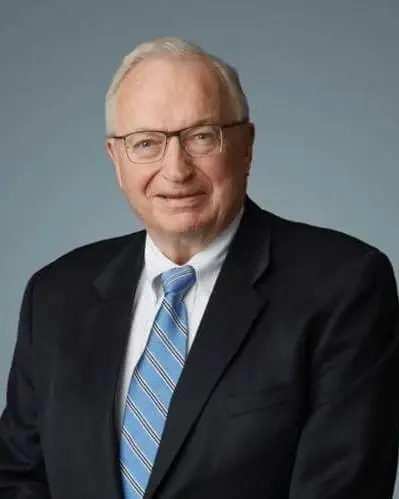
George P. McAndrews (1935 to 2023) was the Chicago patent trial lawyer who led the chiropractic plaintiffs in Wilk v. American Medical Association. The son of an Iowa chiropractor, he took the case in 1975. He lost the first trial and won a new one on appeal. In 1987 a federal court found that the AMA had conspired to contain and eliminate chiropractic. The permanent injunction McAndrews won is the legal ground this library stands on.
Born
July 29, 1935 · Clinton, Iowa
Died
April 7, 2023 · age 87
Trained
University of Notre Dame · engineering and law
Case
Wilk v. AMA · No. 76 C 3777, N.D. Illinois
Judgment
671 F. Supp. 1465 · September 25, 1987
Affirmed
895 F.2d 352 · February 7, 1990
Firm
McAndrews, Held and Malloy · Chicago
Honored
ACA Humanitarian of the Year · 1998
A patent lawyer from Iowa
George McAndrews spent his career in patent litigation and took the chiropractic case because his father was a chiropractor
McAndrews was born on July 29, 1935 in Clinton, Iowa. He was the fifth of seven children of Patrick McAndrews, DC, and Ruth Pellegrin McAndrews. His father had chosen chiropractic after chiropractic care improved his own asthma. The children grew up watching him ridiculed for it. His brother Tom told the Chicago Sun-Times in 2023 that medical doctors in the town warned patients away from chiropractors as quacks. The children heard the same thing at school.
Clinton, Iowa, and a father who was called a quack
The ridicule is the documented reason McAndrews took the case three decades later. Every account of his decision, from the peer-reviewed history to his own obituary, traces it to his father. He was a patent trial attorney by training and by preference, with no interest in health care litigation. Chiropractic was the exception, and it was the family exception.
Notre Dame, the Navy, and Operation Redwing
McAndrews graduated at the top of his class at Saint Mary's High School in Clinton and captained its basketball team to the 1953 Iowa state championship as a 6 foot 3 center. He entered the University of Notre Dame, then broke off his undergraduate studies for a two-year enlistment in the Navy with his brother Tom. The brothers served during Operation Redwing, a series of 17 nuclear detonations at the Enewetak and Bikini atolls, and were later designated Atomic Veterans. He returned to Notre Dame and took a mechanical engineering degree with honors.
Notre Dame Law and a Seventh Circuit clerkship
McAndrews entered Notre Dame Law School and served as editor in chief of the Notre Dame Law Review and chairman of the National Council of Law Review Editors. He graduated in 1962. He then clerked for two years at the United States Court of Appeals for the Seventh Circuit, the court that would hear the chiropractic appeals twenty years later. He went into patent trial practice in Chicago and stayed in it for fifty-five years.
Two brothers, one profession
Two McAndrews brothers shaped chiropractic, and only one of them was a chiropractor
The name causes confusion in the profession's records, so the distinction is worth stating flatly. George P. McAndrews, JD, was a lawyer and never a chiropractor. His brother Jerome F. McAndrews, DC, was a chiropractor and never a lawyer. They worked the same problem from opposite sides for decades.
Jerome McAndrews brought the case to his brother
Jerome McAndrews served as executive director of the International Chiropractors Association. In 1975, after extended conversations with him, George agreed to take the antitrust case. Howard Wolinsky, the former Sun-Times reporter who interviewed McAndrews at length, recorded Jerome's version of the argument that settled it. If George did not stand up for the profession, their late father would crawl out of the grave and haunt him.
The rest of the family
Chiropractic ran through the household. Patrick McAndrews, the father, practiced in Clinton. Jerome practiced and led the ICA. A sister, Virginia Clark, DC, practiced as well. One of George's own daughters became a chiropractor. The American Chiropractic Association counted a father, two siblings, one daughter and several other relatives in the profession when it wrote his memorial in 2023.
What he had to prove
The AMA formed a Committee on Quackery in 1963, and McAndrews had to prove its purpose from the AMA's own files
The conduct McAndrews litigated is set out in the court's findings. In 1963 the AMA hired as its general counsel the author of the Iowa Medical Society plan to contain chiropractic in Iowa. By September 1963 the AMA's objective was the complete elimination of the chiropractic profession. In November 1963 the AMA authorized the formation of the Committee on Quackery under its Department of Investigation. By 1964 the committee's primary goal was to contain and eliminate chiropractic.
Principle 3 turned an ethics code into a refusal to deal
The instrument was Principle 3 of the AMA's Principles of Medical Ethics. It read that a physician should practice a method of healing founded on a scientific basis, and should not voluntarily professionally associate with anyone who violates that principle. In 1966 the AMA House of Delegates passed a resolution calling chiropractic an unscientific cult. In 1967 the AMA Judicial Council issued an opinion under Principle 3 holding that professional association with chiropractors was unethical. The circle closed with no enforcement required.
What the boycott shut
The court set out the purpose in the injunction order. The AMA set out to stop medical physicians referring patients to chiropractors and accepting referrals from them. It set out to keep chiropractors out of hospital diagnostic services and off hospital medical staffs. It set out to stop physicians teaching at chiropractic colleges or joining chiropractic research. It set out to prevent any cooperation between the two groups in delivering care. Four channels, closed at once.
The witness the court did not believe
H. Doyl Taylor chaired the AMA's Department of Investigation and described the committee's prime mission through the 1960s and early 1970s as the containment and elimination of chiropractic as a recognized health service. At trial he denied it. The court recorded that it found his video deposition denials and his explanation incredible and unworthy of belief. That finding is the kind of result that comes from document work, and document work is what a patent litigator does.
October 12, 1976
McAndrews took the case in 1975 after larger firms refused it, and the complaint was filed on October 12, 1976
Wolinsky recorded that top law firms wanted nothing to do with suing the AMA in antitrust. McAndrews took it. The complaint was filed on October 12, 1976 in the United States District Court for the Northern District of Illinois. It was docketed as case number 76 C 3777 and charged violations of Sections 1 and 2 of the Sherman Act.
Five chiropractors filed and four finished
The plaintiffs at filing were Chester A. Wilk, Patricia B. Arthur, James W. Bryden, Steven G. Lumsden and Michael D. Pedigo. Lumsden later withdrew for personal reasons. The four who remained through both trials were Wilk, Arthur, Bryden and Pedigo, and those are the four named in the reported opinion. Sixteen defendants were named at the start, among them the AMA, the American Hospital Association, the American College of Surgeons and the Joint Commission on Accreditation of Hospitals.
Why an antitrust theory and not a defamation theory
McAndrews framed the case as commerce rather than as medicine. Section 1 of the Sherman Act makes every contract, combination or conspiracy in restraint of trade illegal. Framed that way, the question before the court was whether an ethics rule suppressed competition, and the AMA's internal memoranda became the evidence. A defamation theory would have put chiropractic theory on trial. The antitrust theory put the AMA's conduct on trial instead.
The line his father gave him in 1940
McAndrews traced his career to a single moment. He was five years old in 1940, and his father was listening to war news on the radio. His father turned to him and said that kings and queens and presidents do not run the world, and named lawyers as the ones who do. McAndrews repeated the story for the rest of his life.
The first trial
The first trial ended in a defense verdict in 1981, and McAndrews won a new trial on appeal
The case was tried to a jury before Judge Nicholas J. Bua beginning on December 9, 1980. The jury returned a verdict for the defendants. Johnson and Green record Judge Bua's assessment of the plaintiffs' opening statement in their 2021 history of the case. He called it the finest opening statement he had heard in his entire career. It still lost.
What the Seventh Circuit held in 1983
McAndrews appealed and won. In Wilk v. AMA, 719 F.2d 207, decided in 1983, the Seventh Circuit reversed the judgment and remanded for a new trial. The court held that the legality of the defendants' conduct had to be judged under the rule of reason rather than treated as a per se violation. It also held that a professional association can be found party to an illegal refusal to deal even without coercive enforcement of its guidelines, because professionals comply with ethical opinions to avoid discrediting themselves.
The patient care defense the appeal created
The same 1983 opinion built the defense the AMA would have to establish on retrial. The defendants had to show four things. First, that they genuinely held a concern for scientific method in the care of their own patients. Second, that the concern was objectively reasonable. Third, that it was the dominant motivating factor behind Principle 3 and the conduct implementing it. Fourth, that it could not have been satisfied in a way less restrictive of competition. McAndrews had to defeat one of the four.
The cost of staying in
McAndrews carried the case at personal cost for more than a decade against a defense many times his size
Paul E. Slater of Sperling, Slater and Spitz served as co-counsel. Slater told the Sun-Times in 2023 that their side walked into court with four attorneys and a paralegal, and that the other side probably had a hundred attorneys. He said he turned to McAndrews and asked how they would keep up.
What it cost him at his own firm
Wolinsky recorded that some partners at McAndrews' firm opposed the case and pushed back by withholding his bonuses and his secretarial support, and that some of those partners had children who were medical doctors. To hold down expenses through years of depositions McAndrews slept in his car and ate peanut butter and jelly sandwiches on the road. He carried the case for the profession that had raised him.
How he prepared
Patent litigation is document litigation. McAndrews had spent his career mastering technical records under time pressure, and he turned that method on the AMA's own files, reading the campaign in the defendants' memoranda. The trial record that resulted ran to 3,624 pages of transcript, approximately 1,265 exhibits and excerpts from 73 depositions.
It was the greatest one-man show I ever saw in a legal case, and I'm 78 and have seen a lot of cases.
Paul Slater, co-counsel in Wilk v. AMA, quoted in the Chicago Sun-Times, April 18, 2023The 1987 retrial
The 1987 bench trial produced a 101-page opinion and a permanent injunction against the AMA
Shortly before the retrial the plaintiffs waived their claim for damages and asked only for an injunction. That turned a jury trial into a bench trial and shifted the question from what the AMA had done in the past to what was still true. The case was reassigned to Judge Susan Getzendanner on May 4, 1987 and tried in May and June of that year. Findings and conclusions were entered on August 27, 1987, and the opinion dated September 25, 1987 was substituted for them. It is reported at 671 F. Supp. 1465.
The finding
The court found that the AMA and its officials instituted a boycott of chiropractors in the mid-1960s by telling AMA members that chiropractors were unscientific practitioners and that professional association with them was unethical. It found the purpose of that boycott was to contain and eliminate the chiropractic profession. It held the conduct a conspiracy among the AMA and its members and an unreasonable restraint of trade under Section 1 of the Sherman Act. The American College of Surgeons and the American College of Radiology were found to have knowingly joined it.
Why the patient care defense failed
The court accepted two of the four elements. It concluded that the AMA held a genuine concern for scientific method in patient care and that the concern was the dominant factor motivating its conduct. The defense failed on the other two. The AMA could not show that the concern was objectively reasonable across the whole period of the boycott, from 1966 to 1980, given testimony from both sides that some chiropractic treatment was effective. It also could not show that the concern required a nationwide campaign to eliminate a licensed profession.
The terms of the injunction
The permanent injunction binds the AMA, its officers, agents and employees, along with anyone acting in concert with them. It bars them from restricting, regulating or impeding the freedom of any AMA member, institution or hospital. The freedom protected is the individual decision whether to associate professionally with chiropractors, chiropractic students or chiropractic institutions. The AMA was directed to mail a copy of the order to every member and employee within thirty days. It was directed to publish the order in the Journal of the American Medical Association, indexed under chiropractic. It was directed to report compliance by January 10, 1988. The order ran in JAMA on January 1, 1988.
The purpose of the boycott was to contain and eliminate the chiropractic profession. This conduct constituted a conspiracy among the AMA and its members and an unreasonable restraint of trade in violation of Section 1 of the Sherman Act.
Wilk v. American Medical Association, 671 F. Supp. 1465 (N.D. Ill. 1987), summary of the court's rulingsFourteen years
The Seventh Circuit affirmed on February 7, 1990, and the case ended fourteen years after it was filed
The AMA appealed. On February 7, 1990 the Seventh Circuit affirmed the judgment against it in Wilk v. American Medical Association, 895 F.2d 352. The appellate opinion describes what the district court found as a lengthy, systematic, successful and unlawful boycott. The Supreme Court denied review on November 26, 1990 in American Medical Association v. Wilk, 498 U.S. 982.
The arithmetic of the case
The complaint was filed on October 12, 1976 and the last appeal closed on November 26, 1990. Just over fourteen years separate the two dates. Two full trials, one reversal, one bench judgment, one appellate affirmance and one denial of certiorari sit between them. McAndrews was 41 when he filed and 55 when it ended.
What the judgment opened
The four channels the boycott had closed reopened as a matter of law. Medical physicians could refer patients to chiropractors and accept referrals from them. Hospitals could grant diagnostic access and staff privileges. Physicians could teach at chiropractic colleges. The two groups could do research together. Every subsequent collaboration in the field runs through that ruling.
Three more decades
McAndrews represented the profession for three more decades, and the profession attached his name to its awards
McAndrews co-founded the Chicago firm McAndrews, Held and Malloy in 1988 and built a fifty-five year career on patent trials. He kept taking chiropractic work alongside it. He appeared in Chinnici v. Central DuPage Hospital Association, 136 F.R.D. 464, decided in the Northern District of Illinois in 1991, and in American Chiropractic Association v. Trigon Healthcare, 367 F.3d 212, decided by the Fourth Circuit in 2004.
What the judge said afterward
Susan Getzendanner left the bench and addressed the American Chiropractic Association House of Delegates in 1993. The ACA reported that she credited the outcome to the testimony of the plaintiffs and to McAndrews for what she called his brilliant presentation of the case. The ACA gave him its Humanitarian of the Year Award in 1998.
What carries his name
The ACA established the McAndrews Leadership Lecture in 2015, honoring George and his brother Jerome together, and it has been delivered at the association's annual meeting each year since. Greg Kawchuk, DC, PhD, gave the 2016 lecture and published it in the Journal of Chiropractic Humanities. The NCMIC Research Foundation renamed its Jerome F. McAndrews Memorial Research Fund the George P. and Jerome F. McAndrews Memorial Research Fund after George's death.
April 7, 2023
McAndrews died on April 7, 2023 at the age of 87, after eighteen months with cancer and Alzheimer's disease. He married Kathy on April 11, 1964. She survived him, along with five children, 21 grandchildren and five great-grandchildren. His obituary records that he counted the family he and Kathy raised as the crowning achievement of his life.
What the ruling did and did not settle
The judgment secured the conditions for the work, and it made no finding about how an adjustment works
The 1987 judgment is often read as a scientific verdict on chiropractic. It was not one, and the court said so in the injunction order: None of the court's findings constituted a judicial endorsement of chiropractic. The court recorded that all parties, the plaintiffs included, agreed the historic theory of a single cause and a single cure of disease was wrong. It recorded evidence that the subluxation theory as then stated was unscientific. It declined to decide whether chiropractic theory was scientific, because that question was not the one the Sherman Act asks.
What the model claims for itself
The Unified Model of Tone does not take its authority from that vocabulary or from the research that accumulated around it. The model's account of the distortion it treats is built from established neuroscience and advanced as its own synthesis. It names a persistent distortion of recursive self-registration, locally stabilized and globally consequential, in which a region's tone stops updating against the body's present needs. That claim stands or falls on evidence, and it would stand or fall the same way if Wilk had never been filed.
The channels the injunction reopened are where the evidence comes from
The honest connection between McAndrews and this library runs through supply. The boycott the court described blocked hospital diagnostic access, teaching at chiropractic colleges, and joint research between medical physicians and chiropractors. Those are the exact channels that produce trials, imaging studies and physiological measurement. Work on low back pain and on the response of the autonomic nervous system to spinal input required hospitals, funded laboratories and mixed research teams. The injunction of September 25, 1987 is what made those collaborations lawful.
The honest size of the claim
McAndrews added nothing to the understanding of tone, and nothing here pretends otherwise. He was a patent lawyer who won an antitrust case. What he secured was the condition under which the understanding could be pursued at all. A licensed profession gained the right to compete, to be referred to, to stand in a hospital and to publish alongside anyone else. Every other page in this library assumes that condition. He is the reason it holds.
Where he sits
McAndrews belongs with the figures who secured the right to practice rather than with the figures who built methods
The Legends section holds technique founders, institution builders and defenders. McAndrews is the one figure in it who came to chiropractic as its counsel rather than as its practitioner, and the defense line is where his work belongs.
The people his work runs through
Chester Wilk raised the money, wrote the books and put his name on the complaint in 1976. Herbert Reaver went to jail in Ohio through the 1930s and 1940s so that there was a licensed profession left to defend. Joseph Janse built the academic standing that made the AMA's unscientific cult resolution untenable. The three of them and McAndrews solved the same problem in four different rooms.
Where the case sits in the wider record
The history section follows the profession from its founding through the licensing fights to the modern research era. Wilk v. AMA is the hinge in that account. The peer-reviewed history of the case runs to eight parts in the Journal of Chiropractic Education, published in 2021, and the reported decisions are public documents that anyone can read in full.
Questions people ask
Common questions about George McAndrews
Who was George McAndrews?
George P. McAndrews, JD (1935 to 2023) was a Chicago patent trial attorney who served as lead counsel for the chiropractic plaintiffs in Wilk v. American Medical Association. He was born in Clinton, Iowa, the son of a chiropractor, and took the case in 1975. He won a federal judgment in 1987 finding that the AMA had conspired to contain and eliminate chiropractic, and a permanent injunction against the association.
Was George McAndrews a chiropractor?
No. George McAndrews was a lawyer and never practiced chiropractic. His brother Jerome F. McAndrews, DC, was the chiropractor, and he served as executive director of the International Chiropractors Association. Jerome brought the antitrust case to George in 1975. Their father Patrick McAndrews, a sister, and one of George's daughters were also chiropractors. The two brothers are frequently confused in accounts of the case.
What did the court actually decide in Wilk v. AMA?
Judge Susan Getzendanner found that the AMA instituted a boycott of chiropractors in the mid-1960s to contain and eliminate the profession. She held that the conduct was a conspiracy and an unreasonable restraint of trade under Section 1 of the Sherman Act. She entered a permanent injunction and ordered it published in JAMA. The decision is reported at 671 F. Supp. 1465 and dated September 25, 1987.
Did the Wilk judgment prove that chiropractic works?
No, and the opinion says so directly. In the words of the injunction order, none of the court's findings constituted a judicial endorsement of chiropractic. The court declined to decide whether chiropractic theory was scientific, because an antitrust case asks whether conduct suppressed competition. What the judgment established was the right of chiropractors to compete, to receive referrals, to enter hospitals and to do joint research.
How long did the Wilk case take?
Fourteen years. The complaint was filed on October 12, 1976. The first trial ended in a defense verdict in 1981. The Seventh Circuit reversed and remanded in 1983. The retrial produced judgment for the plaintiffs on September 25, 1987. The Seventh Circuit affirmed on February 7, 1990, and the Supreme Court denied review on November 26, 1990.
What did George McAndrews contribute to the understanding of tone?
Nothing directly, and the record is better served by saying so. McAndrews was a lawyer, not a clinician or a researcher. His contribution was the legal precondition. The boycott the court described blocked referral, hospital access, teaching and joint research, which are the channels that produce clinical evidence. The injunction reopened them, and the research this library cites depends on their being open.
Sources
Sources for this page
- Wilk v. American Medical Association, 671 F. Supp. 1465 (N.D. Ill. 1987). Findings, conclusions and Permanent Injunction Order. CourtListener
- Wilk v. American Medical Association, 719 F.2d 207 (7th Cir. 1983). Reversal, rule of reason, and the patient care defense. CourtListener
- Wilk v. American Medical Association, 895 F.2d 352 (7th Cir. 1990). Affirmance, February 7, 1990. CourtListener
- American Medical Association v. Wilk, certiorari denied, 498 U.S. 982 (November 26, 1990).
- Getzendanner S. Permanent Injunction Order Against AMA. JAMA. 1988;259(1):81-82. doi 10.1001/jama.1988.03720010059044
- Johnson CD, Green BN. Looking back at the lawsuit that transformed the chiropractic profession part 6, preparing for the lawsuit. Journal of Chiropractic Education. 2021;35(S1):85-96. PubMed 34544154
- Johnson CD, Green BN. Looking back at the lawsuit that transformed the chiropractic profession part 7, lawsuit and decisions. Journal of Chiropractic Education. 2021;35(S1):97-116. PubMed 34544149
- Johnson CD, Green BN. Looking back at the lawsuit that transformed the chiropractic profession part 8, judgment impact. Journal of Chiropractic Education. 2021;35(S1):117-131. PubMed 34544159
- Dudek M. George McAndrews waged legal war on behalf of chiropractors, forever changing the profession, dead at 87. Chicago Sun-Times. April 18, 2023. suntimes.com
- American Chiropractic Association. In Memoriam, Wilk v. AMA attorney George McAndrews. April 2023. acatoday.org
- Obituary, George Pellegrin McAndrews, 1935 to 2023. Davenport Family Funeral Homes, Lake Zurich, Illinois. April 2023. davenportfamily.com
- Dynamic Chiropractic Staff. Farewell to Chiropractic's Great Defender. Dynamic Chiropractic. June 2023. dynamicchiropractic.com
- Kawchuk G. The McAndrews Leadership Lecture, February 2016, putting the act back in chiropractic. Journal of Chiropractic Humanities. 2017;24(1):44-48. doi 10.1016/j.echu.2017.09.002
- Chinnici v. Central DuPage Hospital Association, 136 F.R.D. 464 (N.D. Ill. 1991). CourtListener
- American Chiropractic Association v. Trigon Healthcare, Inc., 367 F.3d 212 (4th Cir. 2004). CourtListener
This page is education and history, not medical advice. Quotations from the court are transcribed from the reported decisions at 671 F. Supp. 1465 and 895 F.2d 352. Statements attributed to Paul Slater, Tom McAndrews and Howard Wolinsky come from the Chicago Sun-Times obituary of April 18, 2023.