
Our Approach · The Legends · Era IV
Era IV · 1930 to 2022
Chester A. Wilk
The Plaintiff
Chester A. Wilk (1930 to 2022) was the Chicago chiropractor who took the American Medical Association to federal court under the Sherman Act and won. The suit he filed in 1976 ended in a 1987 finding that the AMA ran an unlawful boycott of chiropractors, a permanent injunction, and affirmance by the Seventh Circuit in 1990. That judgment is the legal ground the Unified Model of Tone is taught on.
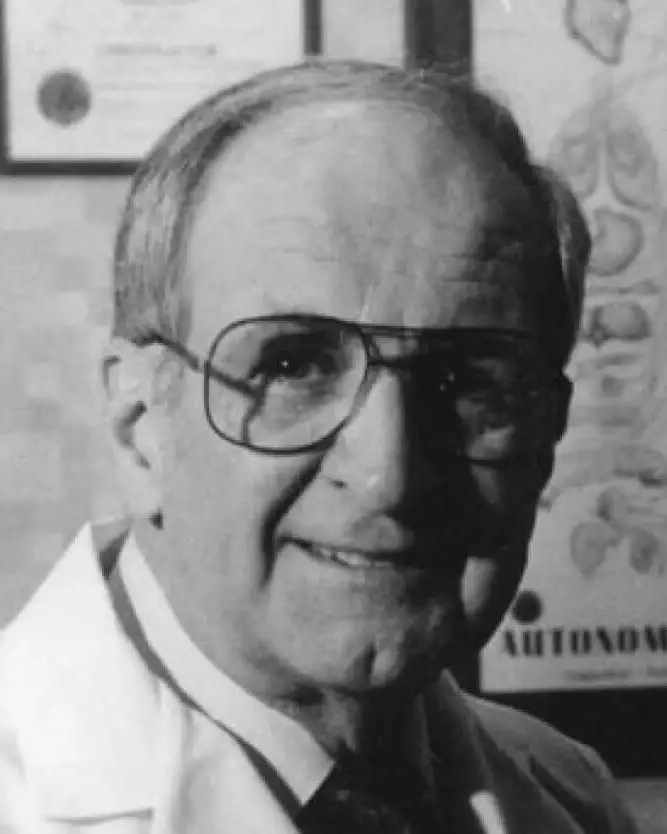
Born
1930 · Chicago, Illinois
Died
April 21, 2022 · Park Ridge, Illinois
Filed
October 12, 1976 · No. 76 C 3777
Ruling
671 F. Supp. 1465 · September 25, 1987
Affirmed
895 F.2d 352 · February 7, 1990
Wrote
Chiropractic Speaks Out (1973) · Medicine, Monopolies and Malice (1996)
The Chicago practice
Chester Wilk practiced in Chicago and sued the American Medical Association in 1976
Chester A. Wilk was born in Chicago in 1930 and kept a practice in the city and in nearby Park Ridge for his whole career. He trained at the National College of Chiropractic, the Illinois school now called National University of Health Sciences. The practice was ordinary. Alongside it he carried an antitrust case against the American Medical Association through the federal courts for fourteen years.
What the boycott looked like from a treatment room
A chiropractor working in the United States in the 1960s and 1970s met a closed door in every direction. Hospitals withheld privileges. Medical physicians would not send referrals, accept referrals, read films for a chiropractor, or teach in a chiropractic college. Judge Susan Getzendanner later described that design in plain terms.
The AMA acted to prevent medical physicians from referring patients to chiropractors and accepting referrals of patients from chiropractors. It acted to prevent chiropractors from obtaining access to hospital diagnostic services and membership on hospital medical staffs. The same finding covers teaching at chiropractic colleges and joint research. Every item on that list is something Wilk could not do in 1970.
Why the case carries Wilk's name
Wilk was the first named plaintiff of five, so the complaint filed in 1976 became Wilk v. American Medical Association, Civil Action No. 76 C 3777 in the Northern District of Illinois. The name stuck through two trials, two appeals, and a petition to the Supreme Court. It is now the standard citation for the proposition that a professional association cannot use an ethics code to boycott a licensed competitor.
The Committee on Quackery
The AMA formed a Committee on Quackery in 1963, and the court found its goal was to contain and eliminate chiropractic
In November 1963 the AMA authorized the formation of the Committee on Quackery inside its Department of Investigation. The district court found that by 1964 the committee's primary goal was to contain and eliminate chiropractic, and that as early as September 1963 the AMA's objective was the complete elimination of the chiropractic profession. Those are findings of fact, entered after a trial, at 671 F. Supp. 1465.
The court also rejected the contrary testimony of H. Doyl Taylor, who chaired the Department of Investigation. Getzendanner found his denials incredible and unworthy of belief. She recorded that Taylor believed chiropractic rested on a single cause and single cure theory of disease, and that the whole profession should therefore be swept away.
Principle 3 turned an ethics code into a boycott
Principle 3 of the AMA's Principles of Medical Ethics ran to a single sentence. A physician should practice a method of healing founded on a scientific basis; and he should not voluntarily professionally associate with anyone who violates this principle. In 1966 the AMA House of Delegates adopted a resolution calling chiropractic an unscientific cult. In 1967 the AMA Judicial Council issued an opinion under Principle 3 holding that professional association with chiropractors was unethical.
The court spelled out what association meant. It included referring patients to chiropractors, accepting referrals from them, providing diagnostic, laboratory or radiology services, teaching chiropractors, and practicing together in any form. The 1967 opinion went into the 1969 Opinions and Reports of the Judicial Council and was sent to 56 medical specialty boards and associations.
Standard X closed the hospital door
In 1973 the AMA drafted Standard X, which wrote the unscientific practitioner bar into the hospital accreditation standards of the Joint Commission on Accreditation of Hospitals. The AMA urged adoption and the Joint Commission complied. In the same period the AMA's general counsel published an article in its own journal titled The Right and Duty of Hospitals to Exclude Chiropractors, which told hospital attorneys that accreditation could be at risk.
The committee disbanded in December 1974 and called itself a success
By the time the Committee on Quackery closed, chiropractic was licensed in all fifty states. Chiropractic services were reimbursable under Medicare, Medicaid and most private plans. Chiropractic education had been recognized by the United States Office of Education. The committee nevertheless recorded itself a success, and the court accepted that admission. The Department of Investigation was disbanded in May 1975 and Taylor left the AMA.
This was the necessary tool with which your Committee has been able to widen the base of its chiropractic campaign.
AMA Committee on Quackery, 1971 report to the Board of Trustees, quoted at 671 F. Supp. 1465Chiropractic Speaks Out, 1973
Wilk answered the campaign in print three years before he answered it in court
Wilk published Chiropractic Speaks Out: A Reply to Medical Propaganda, Bigotry and Ignorance through his own imprint, Wilk Publishing Company, in 1973. A single practicing chiropractor set out the case against a national campaign in book form, at his own expense, while the campaign was still running. The lawsuit came later and rested on the same argument.
Wilk trained himself to argue in public
Green and Johnson, writing in the Journal of Chiropractic Humanities in 2019, record that Wilk took a communications course taught by Leonard Fay at the National College of Chiropractic. In 1974 he traveled to chiropractic conventions promoting a communications system and a set of cassette tapes for a chiropractic speakers bureau. The book and the tapes came from one decision, which was to stop conceding the public argument.
The money had to be raised before a complaint could be filed
The National Chiropractic Antitrust Committee was established on March 4, 1975 as a tax exempt nonprofit, with Clair O'Dell as chairman and Michael Pedigo among its early members. Its stated function was to raise money for legal action against boycott and restraint of trade. By July 1976 it had raised about ninety thousand dollars. The complaint followed three months later.
Confidential AMA material surfaced in 1975
Internal AMA documents began reaching chiropractic organizations, Congress and the Federal Trade Commission in 1975, sent anonymously under the name Sore Throat. Johnson and Green trace the underlying copies to an operation that photographed AMA files between 1969 and 1972. What mattered legally is that the committee's own memoranda later came into evidence as plaintiffs' exhibits and are quoted throughout the 1987 opinion.
The 1976 complaint
Five chiropractors filed suit on October 12, 1976 in the Northern District of Illinois
The plaintiffs were Chester A. Wilk, James W. Bryden, Patricia B. Arthur, Steven G. Lumsden and Michael D. Pedigo, all licensed chiropractors, and all named in the caption of the 1983 appeal at 719 F.2d 207. Four of the five, Wilk, Bryden, Arthur and Pedigo, remained through the second trial and are the plaintiffs named in the 1987 judgment and the 1990 affirmance. The complaint charged violations of Sections 1 and 2 of the Sherman Act.
What Section 1 of the Sherman Act does
Section 1, codified at 15 U.S.C. 1, declares illegal every contract, combination or conspiracy in restraint of trade or commerce. Section 2 reaches monopolization and conspiracy to monopolize. The plaintiffs' theory joined three things: Principle 3, the unscientific cult label, and the 1967 Judicial Council opinion. Together they amounted to an agreement to refuse to deal with an entire licensed profession.
George McAndrews led the case
George McAndrews of Allegretti, Newitt, Witcoff and McAndrews was counsel of record for the plaintiffs, listed first in the reported opinion, with Paul E. Slater of Sperling, Slater and Spitz as co-counsel. McAndrews was the son of a chiropractor, and he tried the case for years at his own cost. The two records belong together.
The defendants
The original defendants ran to sixteen. They included the AMA, the American Hospital Association, the American College of Surgeons and the Joint Commission on Accreditation of Hospitals. They also included the American College of Physicians, the American College of Radiology, the American Academy of Orthopaedic Surgeons and the American Osteopathic Association. Three Illinois medical societies and four individuals were named, among them H. Doyl Taylor. By the 1987 retrial only the AMA, the Joint Commission and the Academy of Orthopaedic Surgeons were left.
The first trial and Wilk I
The first trial ended in a verdict for the AMA, and the Seventh Circuit ordered a new one
A jury heard the chiropractic antitrust case in 1980 and returned a verdict for the defendants. The plaintiffs appealed, and on September 19, 1983 the Seventh Circuit reversed. The panel opinion, written by Senior District Judge James E. Doyle sitting by designation, ends without qualification: The judgment appealed from is reversed and the case is remanded for a new trial. That decision is reported at 719 F.2d 207 and is called Wilk I in the later opinions. The Sherman Act claims went back for a second trial in full.
The appeal set the standard as rule of reason
The Seventh Circuit declined to treat the conduct as a per se violation. A canon of medical ethics addressing scientific method, the panel wrote, raises questions of sufficient delicacy and novelty at least to escape per se treatment. The panel added that such a canon purports to do so surely not frivolously. Under the rule of reason the question becomes whether the agreement promotes competition or suppresses it.
The patient care defense the appeal created
The same opinion built the defense the AMA would later fail. At 719 F.2d 227 the court set out four elements. The defendants had to show they genuinely entertained a concern for what they perceive as scientific method in each doctor and patient relationship. They had to show that concern was objectively reasonable. They had to show it was the dominant motivating factor behind Principle 3 and the conduct implementing it. Finally they had to show it could not have been adequately satisfied in a manner less restrictive of competition.
The plaintiffs gave up damages to get a bench trial
Shortly before the retrial the plaintiffs waived their claim for damages and asked only for an injunction under Section 16 of the Clayton Act. That removed the jury and put the case in front of a single judge. It also moved the inquiry from what the AMA had done in 1966 to what was still true in 1987.
The 1987 judgment
Judge Getzendanner found an unlawful conspiracy and entered a permanent injunction against the AMA
The retrial ran through May and June of 1987 before United States District Judge Susan Getzendanner. The record she decided on consisted of 3,624 pages of transcript, roughly 1,265 exhibits, and excerpts from 73 depositions. Her opinion issued August 27, 1987 and was substituted by an amended opinion dated September 25, 1987, reported as Wilk v. American Medical Ass'n, 671 F. Supp. 1465 (N.D. Ill. 1987).
The injunction order opens with the court's own account of what it had done. The court conducted a lengthy trial of this case in May and June of 1987. On August 27, 1987 it issued a 101 page opinion finding that the American Medical Association (AMA) and its members participated in a conspiracy against chiropractors in violation of the nation's antitrust laws.
The finding
The summary of rulings states the holding in three sentences. The AMA instituted a boycott of chiropractors in the mid 1960s by telling its members that chiropractors were unscientific practitioners and that association with them was unethical. The purpose of the boycott was to contain and eliminate the chiropractic profession. That conduct was a conspiracy among the AMA and its members and an unreasonable restraint of trade in violation of Section 1 of the Sherman Act.
The patient care defense failed on two of its four elements
Getzendanner accepted that the AMA held a genuine concern for scientific method, and that the concern was the dominant motivating factor. The AMA lost on the second and fourth elements. It could not show its position was objectively reasonable across the whole boycott, from 1966 to 1980. It also could not show that a nationwide boycott was the only way to satisfy the AMA's concern for the use of scientific method in patient care. A public education campaign, the court found, was never tried.
What the court declined to decide
The opinion is explicit about its own limits. At the start of trial the court told the parties that whether chiropractic is scientific was not an issue in the case and would not be decided. The opinion states that none of its findings constituted a judicial endorsement of chiropractic. The ruling is about conduct in a market, which is why it has held up.
It also records what the evidence showed. Some forms of chiropractic manipulation of the spine and joints were therapeutic. AMA witnesses said so under oath. The then chairman of the AMA Board of Trustees testified that chiropractic treatment including manipulation can be therapeutic in conditions such as back pain syndrome. The AMA's own witnesses put that on the record in 1987.
The terms of the injunction
The order permanently enjoined the AMA and everyone acting in concert with it. They were barred from restricting, regulating or impeding the freedom of any AMA member, institution or hospital. The freedom protected is the freedom to decide individually whether to associate professionally with chiropractors, chiropractic students or chiropractic institutions. The AMA had to mail the order to every member and employee within thirty days. It had to publish the order in its journal and index it under Chiropractic. It had to file a compliance report by January 10, 1988. The order appeared in JAMA in the January 1, 1988 issue.
In the early 1960s, the AMA decided to contain and eliminate chiropractic as a profession. In 1963 the AMA's Committee on Quackery was formed.
Permanent Injunction Order Against AMA, Wilk v. American Medical Ass'n, 671 F. Supp. 1465 (N.D. Ill. 1987)The 1990 affirmance
The Seventh Circuit affirmed on February 7, 1990 and the Supreme Court denied review that November
The AMA appealed the finding of liability and argued that an injunction was unnecessary. The plaintiffs cross appealed against the Joint Commission and the American College of Physicians. On February 7, 1990 the Seventh Circuit decided both appeals in Wilk v. American Medical Ass'n, 895 F.2d 352, Nos. 87-2672 and 87-2777, in an opinion by Circuit Judge Daniel Manion. The AMA lost.
What the Seventh Circuit affirmed
The conclusion is one sentence long. We affirm the district court's finding that the AMA violated Section 1 of the Sherman Act by conducting an illegal boycott of chiropractors, and the district court's decision to grant an injunction against the AMA. The panel held the district court had not relied on conduct protected by the Noerr-Pennington doctrine, and that its factual findings were not clearly erroneous.
The court defended the publication order
The AMA objected to being made to mail and publish the order. The Seventh Circuit answered that the district court's form of injunction and method of ensuring its publication was a reasonable attempt at eliminating the consequences of the AMA's lengthy, systematic, successful, and unlawful boycott. Those are the appellate court's own words for the conduct.
The case ended on November 26, 1990
The AMA petitioned for certiorari. The Supreme Court denied it in American Medical Assn. v. Wilk, No. 90-542, 498 U.S. 982 (1990), on November 26, 1990. Fourteen years and six weeks after the complaint was filed, the judgment was final and there was nowhere left to appeal.
What the plaintiffs did not take
Wilk and his co-plaintiffs took no damages. They abandoned the damages claim before the second trial, and Green and Johnson record that the plaintiffs entered that trial stating they did not want a personal settlement. The remedy they asked for and won was an order that changed the rules for everyone in the profession.
The record
Nine dated facts about Chester Wilk and Wilk v. AMA, with the source for each
1963. The AMA authorized the Committee on Quackery in November, and the court found the AMA's objective as early as September 1963 was complete elimination of the chiropractic profession (671 F. Supp. 1465).
1966. The AMA House of Delegates adopted a resolution labeling chiropractic an unscientific cult, which triggered Principle 3 and made association unethical (671 F. Supp. 1465).
1973. Wilk published Chiropractic Speaks Out: A Reply to Medical Propaganda, Bigotry and Ignorance through Wilk Publishing Company, three years before the complaint.
March 4, 1975. The National Chiropractic Antitrust Committee was incorporated to fund the litigation, and had raised about ninety thousand dollars by July 1976 (Green and Johnson, 2019).
October 12, 1976. Five chiropractors filed the complaint in the Northern District of Illinois, Civil Action No. 76 C 3777.
September 19, 1983. The Seventh Circuit reversed the defense verdict and remanded for a new trial, creating the patient care defense in the process (719 F.2d 207).
September 25, 1987. Getzendanner's amended opinion held the AMA liable under Section 1 and entered a permanent injunction (671 F. Supp. 1465).
January 1, 1988. The AMA published the Permanent Injunction Order in JAMA, as the order required (JAMA 1988;259(1):81 to 82).
November 26, 1990. Certiorari denied, 498 U.S. 982, ending the case fourteen years after filing.
After the judgment
Wilk kept writing about the case for the rest of his life
In 1996 Avery Publishing Group issued Wilk's second book, Medicine, Monopolies and Malice, his own account of the twenty years between the Committee on Quackery and the Supreme Court's denial of review. He wrote it as a participant with the trial record in hand. The opinions remain the authority, and Wilk's book supplies what the opinions leave out.
Teaching
Wilk served for many years on the postgraduate faculty at Cleveland Chiropractic College. He continued to write a newsletter for the profession into his late eighties. He was still discussing the case publicly in 2021, when the journalist Howard Wolinsky published Contain and Eliminate. That book is a full length history of the conspiracy built on the same documents.
Wilk died on April 21, 2022
Wilk died at Advocate Lutheran General Hospital in Park Ridge, Illinois, at ninety-one. The Chicago Sun-Times ran an obituary the following day. He was survived by three daughters and four grandchildren. His daughter Kimberly told the paper that making chiropractic care available to everyone was his biggest life's mission.
What Wilk secured
Wilk won the legal precondition for everything else in this section
Wilk built no technique and published no measurement. He secured something the other forty-one people in The Legends needed and could not have won for themselves, which is the lawful ability to be referred to, consulted with, taught alongside, and studied. Before 1980 a medical physician who sent a patient across the street risked being called unethical by his own association. After the injunction, that decision belonged to the physician alone.
Referral, imaging, and shared research are what the injunction actually opened
The injunction names the conduct it protects. The list covers referrals, consultations, group practice and alternative delivery systems. It covers treatment privileges and diagnostic services in hospital facilities. It covers educational programs for chiropractic students and cooperation in research, seminars and continuing education. Those are the exact channels through which a claim about tone can be tested against imaging, autonomic measurement, and outcome data.
Wilk's contribution to the understanding of tone
Every figure in this section added something to the understanding of tone as a regulated variable in the nervous system. Wilk added the conditions under which that work can be done in the open. A model that reads the autonomic nervous system alongside tissue compliance and cortical excitability requires shared instruments and shared patients. The 1987 injunction is what makes shared instruments and shared patients lawful in American health care.
The clinical consequence is visible in the literature. In 2017 the American College of Physicians, an original defendant in the case and later dismissed from it, recommended spinal manipulation as a first line option for acute and subacute low back pain. That guideline ran in Annals of Internal Medicine. The same body of work now connects manual input to movement and to autonomic regulation. The court left the correctness of the chiropractic account of the body undecided. What the court decided is that the account could be argued, funded, and measured in the open.
Where Wilk sits among the legends
George McAndrews tried the case and has his own record in this section. D.D. Palmer named tone as the basic principle of chiropractic in 1910, and the technique pages carry the methods the founders built for acting on it. Wilk's record explains why the rest of that work could be taught, funded and published in the open after 1990.
Questions people ask
Common questions about Chester Wilk and Wilk v. AMA
What was Wilk v. American Medical Association?
Wilk v. American Medical Association was a federal antitrust suit filed on October 12, 1976 by five licensed chiropractors in the Northern District of Illinois. It charged the AMA and other medical organizations with violating Sections 1 and 2 of the Sherman Act by boycotting chiropractors. After two trials and two appeals, the courts held the AMA liable and entered a permanent injunction against it.
What did the court actually rule in 1987?
Judge Susan Getzendanner held that the AMA instituted a boycott of chiropractors in the mid 1960s. She found the purpose of the boycott was to contain and eliminate the chiropractic profession. She held the conduct was a conspiracy in unreasonable restraint of trade under Section 1 of the Sherman Act. She entered a permanent injunction and required the AMA to mail the order to every member and publish it in JAMA.
Did the court rule that chiropractic is scientific?
No, and the opinion says so directly. Getzendanner told the parties at the start of trial that whether chiropractic is scientific was not an issue and would not be decided. The opinion states that none of the findings constituted a judicial endorsement of chiropractic. The case turned on conduct in a market. The court did find that some forms of chiropractic manipulation were therapeutic, on testimony from AMA witnesses.
Who were the plaintiffs in Wilk v. AMA?
The complaint named five chiropractors: Chester A. Wilk, James W. Bryden, Patricia B. Arthur, Steven G. Lumsden and Michael D. Pedigo. Four of them, Wilk, Bryden, Arthur and Pedigo, remained through the 1987 bench trial and appear in the caption of the 1990 Seventh Circuit opinion. George McAndrews was lead counsel. The plaintiffs waived damages and sought only injunctive relief.
When did Wilk v. AMA finally end?
The Seventh Circuit affirmed the judgment and the injunction on February 7, 1990 at 895 F.2d 352. The AMA petitioned the Supreme Court, and certiorari was denied on November 26, 1990 in American Medical Assn. v. Wilk, 498 U.S. 982. That ended the case fourteen years after the complaint was filed and twenty-seven years after the Committee on Quackery was formed.
What did Chester Wilk contribute to the understanding of tone?
Wilk contributed the legal conditions under which tone can be studied and taught in the open. The 1987 injunction protects referral, consultation, hospital diagnostic access, joint teaching and shared research by name. A model that treats tone as one regulated variable read across autonomic, cortical and tissue measures depends on exactly those channels. Wilk made them lawful, and the Unified Model of Tone is built on that ground.
Sources
Sources for this page
- Wilk v. American Medical Ass'n, 671 F. Supp. 1465 (N.D. Ill. Sept. 25, 1987) (Getzendanner, J.), Civ. A. No. 76 C 3777. Full opinion. Source for the Committee on Quackery findings, Principle 3, the patient care defense, and the Permanent Injunction Order.
- Wilk v. American Medical Ass'n, 895 F.2d 352 (7th Cir. Feb. 7, 1990), Nos. 87-2672 and 87-2777 (Manion, J.). Full opinion. Affirming liability and the injunction.
- Wilk v. American Medical Ass'n, 719 F.2d 207 (7th Cir. Sept. 19, 1983), No. 81-1331 (Doyle, J.). Full opinion. Reversing the first judgment and creating the patient care defense.
- Wilk v. American Medical Ass'n, 635 F.2d 1295 (7th Cir. Dec. 22, 1980), No. 80-1603. Full opinion. Interlocutory appeal during the first trial.
- American Medical Assn. v. Wilk, 498 U.S. 982 (1990), No. 90-542, certiorari denied November 26, 1990. Order list entry.
- Permanent Injunction Order Against AMA. JAMA. 1988;259(1):81 to 82. Citation. The order as the AMA was required to publish it.
- Sherman Antitrust Act, 15 U.S.C. 1 and 15 U.S.C. 2; Clayton Act Section 16, 15 U.S.C. 26.
- Wilk CA. Chiropractic Speaks Out: A Reply to Medical Propaganda, Bigotry and Ignorance. Wilk Publishing Company; 1973.
- Wilk CA. Medicine, Monopolies and Malice. Avery Publishing Group; 1996.
- Green BN, Johnson CD. Fighting injustice: a historical review of the National Chiropractic Antitrust Committee. J Chiropr Humanit. 2019;26:19 to 30. Full text. Source for the March 4, 1975 founding, the fundraising figure, the October 12, 1976 filing date, and the Fay communications course.
- Johnson CD, Green BN. Looking back at the lawsuit that transformed the chiropractic profession part 5: evidence exposed. J Chiropr Educ. 2021;35(S1):74 to 84. Full text. Source for the 1975 Sore Throat documents.
- Johnson CD, Green BN. Looking back at the lawsuit that transformed the chiropractic profession part 6: preparing for the lawsuit. J Chiropr Educ. 2021;35(S1):85 to 96. Citation.
- Johnson CD, Green BN. Looking back at the lawsuit that transformed the chiropractic profession part 7: lawsuit and decisions. J Chiropr Educ. 2021;35(S1):97 to 116. Citation.
- Court Says AMA Wronged Chiropractic. The Washington Post, August 29, 1987. Archive. Contemporaneous coverage of the August 27, 1987 opinion.
- Esposito S. Chicago chiropractor took on the American Medical Association in the mid-1970s. Chicago Sun-Times, April 22, 2022. Obituary.
- Wolinsky H. Contain and Eliminate: The American Medical Association's Conspiracy to Destroy Chiropractic; 2021.
- Qaseem A, Wilt TJ, McLean RM, Forciea MA; Clinical Guidelines Committee of the American College of Physicians. Noninvasive treatments for acute, subacute, and chronic low back pain: a clinical practice guideline from the American College of Physicians. Ann Intern Med. 2017;166(7):514 to 530. Citation.
This page is education and history, not medical advice. Quotations from the courts are transcribed verbatim from the reported opinions, with the reporter citation given for each.