
Our Approach · The Legends · Era I
Era I · 1866 to 1943
Willard Carver
The Constructor
Willard Carver (1866 to 1943) was an Iowa trial lawyer who took up chiropractic at 40 and founded a college at Oklahoma City in 1906. Carver stated the profession's law of structural compensation: move a basic structure and the parts above it are compelled to move with it, or equilibrium is lost. He called the approach constructive and read the whole frame at once. The Unified Model of Tone makes the same claim in the language of biotensegrity.
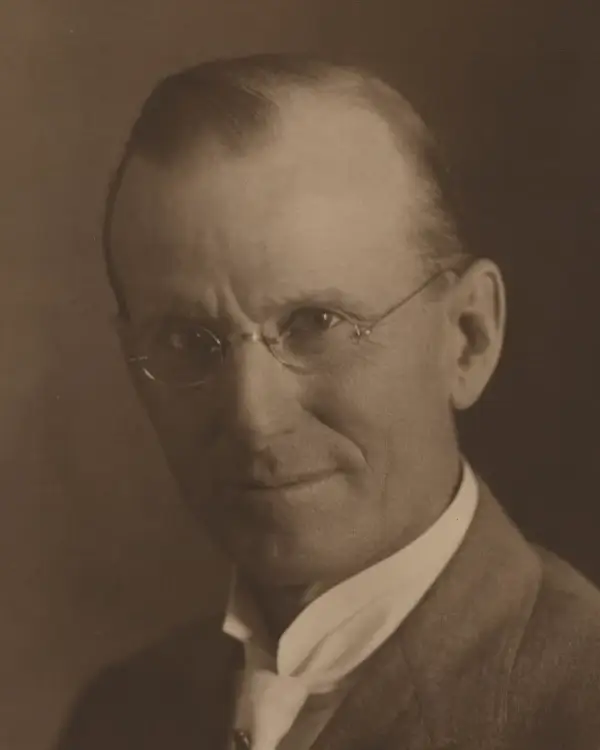
Born
July 14, 1866 · Maysville, Iowa
Died
December 23, 1943 · Oklahoma City
Law
LL.B., Drake University · Iowa bar from 1891
Chiropractic
Charles Ray Parker School, Ottumwa, Iowa, 1906
Founded
Carver-Denny Chiropractic College, Oklahoma City, 1906
Principal work
Carver's Chiropractic Analysis, first edition 1909
College
Merged into Logan Basic College of Chiropractic, 1958
The lawyer, 1891
Carver came to chiropractic from the Iowa bar and never stopped arguing like a lawyer
Carver practiced law for fifteen years before he practiced chiropractic. His own title pages record the credential: Willard Carver, LL.B., D.C., member of the Iowa bar since 1891. He took the law degree at Drake University. Every book he wrote afterward is built the way a brief is built, with terms defined first, principles stated in numbered order, and each conclusion argued back to a stated premise.
Carver did D.D. Palmer's legal work before he did chiropractic
Carver was inside chiropractic before he was a chiropractor. He performed legal services for D.D. Palmer in the profession's earliest years, when Palmer was fighting for the right to practice at all. August Dye records the approach Carver made in return. Carver tried to persuade Palmer to take him as a student on credit, offering free legal advice in exchange for tuition. Palmer declined, and Dye notes that Palmer already had counsel (The Evolution of Chiropractic, 1939, p. 70).
Parker's school at Ottumwa, 1906
Carver enrolled instead at the Charles Ray Parker School of Chiropractic at Ottumwa, Iowa, and graduated in 1906 at the age of 40. Parker had taught alongside Solon Langworthy at Cedar Rapids before opening his own school, so Carver's training descends from the broad-scope side of the early profession rather than from Davenport. Dye records the line of descent plainly (p. 38). Carver went from Ottumwa straight to Oklahoma City to found a college of his own.
What brought Carver to chiropractic in the first place
Palmer records that Carver came to chiropractic as a patient. Quoting page 4 of the first edition of Carver's Chiropractic Analysis, Palmer writes that Carver acknowledged receiving the very crude application of its principles from the founder. Palmer adds that those adjustments relieved Carver of consumption (The Chiropractor's Adjuster, 1910, p. 45). Both men agreed on the fact and disagreed on everything that followed from it.
Carver-Denny, 1906
Carver founded a college at Oklahoma City in 1906 and led it for most of the next 37 years
The Carver-Denny Chiropractic College opened at Oklahoma City in 1906. Joseph Keating lists it in that year with Willard Carver, LL.B., D.C., and Lee L. Denny, D.C., as its founders. Myrtle V. Denny was the third partner. After the Dennys left by 1909 the school ran briefly as Carver-McColl with the attorney and chiropractor A. C. McColl, then settled into the name it kept: Carver Chiropractic College.
The second largest school in the profession by 1910
Carver's college grew quickly. August Dye wrote that the Carver College of Chiropractic was probably the largest school in the profession after the Palmer School in 1910 (p. 69). Its campus at 521 West Ninth Street eventually held three buildings: a converted church holding the administrative offices, a frame building holding classrooms and the clinic, and a dormitory. The course ran eighteen months.
Oklahoma City, New York, and Denver
Carver did not stop at one campus. Dye records that he moved to New York City around 1915 and organized a school there. The 1921 title page of Carver's Chiropractic Analysis carries both Oklahoma City and New York City under his name. A third institution, the Carver Chiropractic University, began classes at Denver on September 24, 1923. The Denver school later operated under several names, including the University of Natural Healing Arts.
Carver ran the Oklahoma City college until his death
Carver led the Oklahoma City school until 1929 and then stepped away. He resumed control on January 28, 1933, and held it until he died on December 23, 1943. Tom Lawrence, who graduated in 1938, remembered a great public speaker with a strong and resonant deep-toned voice and precise enunciation. Thirty-seven years separate the founding from the funeral, and Carver lectured on every subject in the curriculum for most of them.
Basic and compensatory distortion
Carver stated the law that a distortion at the base compels compensation through the whole frame
Carver's central principle is one sentence in Carver's Chiropractic Analysis. He reached it by turning the idea of compensation toward equilibrium, and stated it this way. When a basic structure is moved in a given direction, relative parts are compelled to move so as to maintain a certain relationship to that base, or equilibrium is lost. The chapter carrying it is titled Analysis of Basic Compensation, and it opens on page 269 of the 1921 third edition.
The base of the column is the feet, not the sacrum
Carver worked the argument upward from the floor. The weight of the trunk reaches the ground through the feet, ankles, legs, thighs and innominates. The iliac surfaces are therefore the base the sacrum rests on. At the sacroiliac joints the line of gravity divides again into two channels. A difference in the length of an ankle, a leg or a thigh changes the attitude of the sacrum, and the whole vertebral column follows it (1921, pp. 269 to 270).
The predictions are specific and directional
Carver did not leave the principle abstract. He worked out the compensation for each displacement in turn. A short right leg turns the sacral base to the right of the mesial plane, and left and right compensations are then necessitated headward through the body to restore equilibrium. Ventral displacement of the fibular heads throws the pelvis forward, and dorsal compensation must occur higher in the column. Displacement of the ischial tuberosities forward forces dorsal compensation in the lumbar and thoracic regions, balanced ventrally in the neck (1921, pp. 273 to 276).
The gravity line measured against the mesial plane
Carver turned the principle into a measurement. In the normal body the gravity line lies within the mesial plane, and in no other body does it stay there. The relation the gravity line and the mesial plane hold to each other, Carver wrote, is the criterion to the amount of lateral distortion in the given case (1921, p. 272). That is a stated, checkable index of whole-body distortion, written in 1921 and taught to students on a table.
Two propositions the examiner holds at once
Carver told his students to keep two problems separate while examining a patient lying prone. The first is to work out the effect of gravity on that body while it stands upright. The second is to work out what to do to overcome the compensatory influences that result. He warned against confusing them, because they are very different (1921, p. 273). Reading a structure under load and choosing where to intervene in it are two distinct acts.
When a basic structure is moved in a given direction relative parts are compelled to move so as to maintain a certain relationship to that base, or equilibrium is lost.
Willard Carver · Carver's Chiropractic Analysis, Volume I, 1921, p. 270The constructive definition
Carver widened the target of the adjustment from a joint to the whole organism
Carver rewrote the definition of chiropractic and said so in print. He named the first necessary addition to the founder's meaning. It was this: to place disrelated anatomic parts of the human organism in normal relation, for the purpose of removing interference with the transmission of nerve stimulus. Carver then states what the change accomplishes. The restriction to articulations is removed, and anatomic disrelation is comprehended so completely as to include the whole organism (1921, pp. 8 to 9).
Interference, not pressure
Carver made a second change in the same passage. Where Palmer wrote of removing pressure from nerves, Carver extended the target to all other kinds of interference with the transmission of nerve stimulus. His argument is that pressure was never the point. Palmer wanted the interference gone, and pressure was one way of causing it. That widening is what lets a distortion anywhere in the frame count as a chiropractic finding.
Relatology, the science of place
Carver coined his own vocabulary because the borrowed words would not carry the ideas. Relatology, as he defined it, is the discussion of place in the sense of the relationship of all the tissues and parts of the body (1921, p. 14). It has two halves: the science of relation, and the art of securing relation. The science half he described as the study of somatic and visceral attitude from the standpoint of the structural architecture and mechanics of the human organism (1921, p. viii).
Poseology, the science of position
Poseology is the second term and it governs delivery. Carver defined it as the various positions of the operator's own body needed to secure unit conduct, together with the positions of the patient's body that let the applied skill produce a result (1921, p. 16). The relator, as Carver called the practitioner, also had to know the geometry of the work: the lines, planes and angles along which force must travel in harmony with anatomic structure.
Why historians call it the structural approach
Keating summarizes Carver as offering an alternative view of spinal dysfunction in which the behavior of the backbone is seen as a coordinated system. He names the components: distortion patterns involving multiple segments, compensatory or secondary subluxations, and the relentless influence of gravity on those structures. Keating sets that against the segmentalism of the Palmers, and dates the split to the first decade of the profession.
The books, 1909 to 1930
Carver wrote the profession's first pathology text and five more books besides
Carver published Carver's Chiropractic Analysis in 1909, revised it in 1915, and brought out a two-volume third edition in 1921. The 1921 preface states the reason for the split. The subject matter had grown too large for one volume in the five years since the last revision. Volume One carries pathology and relatology. Carver claims the pathology section as the first treatise on that subject presented to the chiropractic profession.
The first edition ran 468 pages
Palmer supplies the length. Writing to Carver inside The Chiropractor's Adjuster, Palmer refers to the 468 pages of your book (p. 76). By 1921 the same work had become two volumes selling at seven and eight dollars, or fifteen dollars for the pair. Carver states in his acknowledgment that the work had taken thirty-five years, which dates his thinking on it to roughly 1886, twenty years before he qualified.
Psycho-Bio-Physiology, 1920
Psycho-Bio-Physiology is the volume Carver placed first in his series. Its full title runs: applied psychology, biology as the cause of histology and anatomy, and a description of the conduct of anatomic parts, which is physiology. The Library of Congress holds the record. Carver treats psychology in a way meant to classify the causative factors in material formulation and conduct, which is his attempt to put thought and behavior inside the same system as structure.
The rest of the shelf
Carver's 1921 title page lists the other books by their own names: Applied Psychology, Studies Preparatory to That of Chiropractic, and Rough Nuggets. Open Library dates Applied Psychology to 1914, published by the psychic department of Carver Chiropractic College. A History of Chiropractic followed around 1930 and was never published. Carver had been writing chiropractic history since at least July 1913, when Dye records him publishing allegations about the Palmers that he and the college later retracted.
Palmer against Carver
D.D. Palmer's 1910 book argues with Carver across more pages than with any other chiropractor
The founder's book is a running argument with Oklahoma City. Dye states it flatly: The Chiropractor's Adjuster is read by most commentators as a condemnation of B.J. Palmer, and it is in fact much more a condemnation of the teachings of Dr. Carver (1939, p. 21). Carver appears on 47 separate pages of the 1910 volume. Palmer usually calls him the Analyzer, after the title of his book, and Dye confirms the identification (1939, p. 171).
One vertebra or seven
The dispute was about how many places to adjust. Palmer held that a single displaced vertebra caused a given disease and that one correction was enough. Carver taught adjusting several levels at once. Palmer works through the objections case by case. The Analyzer advises adjusting seven vertebrae, he writes on page 44, and on page 46 that to adjust five vertebrae where only one is displaced is not scientific. Dye records Carver's position as adjusting numerous places along the spine, combined with work on other joints and tissues (1939, p. 21).
Carver answered that he taught specificity too
Carver did not accept the charge. Palmer quotes his letter of February 17, 1910, in which Carver answers the question of why not be specific in adjusting by saying that specificity is what he teaches (p. 45). Carver's own definition of the work, quoted by Palmer on page 429, is narrow rather than loose: adjustment is the art of securing by hand the proper relation of the elements of a joint. The two men were arguing about the size of the unit, and both claimed precision within it.
The letters Carver asked Palmer not to print
Palmer printed them anyway, and quoted the request while doing it. On page 45 he reproduces Carver's letter of March 1, 1910. The only thing Carver wanted distinctly understood between them, that letter says, was that Palmer was not permitted to publish his letters or any part of them. Palmer published several. One of them, at page 93, has Carver urging Palmer to go further than the bone. After adjusting the luxated bone in the Story case, Carver wrote, Palmer might have gone on and driven out of the patient's mind all of those adverse and morbid impressions.
Palmer's verdict, and what it cost
Palmer's summary judgment is one clause. Listing the books written on chiropractic, he says that Chiropractic Analysis, by Carver, has nothing in it that is really chiropractic (p. 981). The verdict did not hold. Carver's college outlasted Palmer by thirty years, his structural reading entered mainstream technique, and the record of the quarrel survives mostly because Palmer printed both sides of it in his own book.
Adjustment is the art of securing by hand the proper relation of the elements of a joint.
Willard Carver, quoted in D.D. Palmer · The Chiropractor's Adjuster, 1910, p. 429Oklahoma, 1917 to 1921
Carver went to jail for contempt and Oklahoma licensed chiropractic four years later
Carver took the legislative fight personally and paid for it. In 1917 he charged that the Oklahoma senate had been bribed to block chiropractic legislation. The charge put him in jail for contempt. He kept campaigning after his release, and Oklahoma passed its chiropractic act in 1921, licensing the practice in the state where his college stood.
A lawyer was the right man for that fight
Carver's legal training made him unusual among early chiropractors. Prosecution of chiropractors for unlicensed practice was routine in this period. Keating cites an estimate that chiropractors had collectively faced 15,000 prosecutions by 1931, against a profession that probably never exceeded 12,000 practitioners in that era. Most of them met the courts as defendants. Carver met the legislature as an advocate.
The self-given title
Carver called himself the Constructor of Chiropractic, and the name states a position. Construction is what his system claims to do. A distorted frame is rebuilt toward equilibrium by correcting the base and letting the compensations above it resolve. The label also marked the distance between Oklahoma City and Davenport, and B.J. Palmer traded broadsides with the Constructor for decades.
The Carver line
Carver's frame-first reading traveled through his students into modern technique
Carver's structural approach outlived his college by design, because he taught it to people who founded schools and techniques of their own. Keating names the line: T. F. Ratledge, Hugh B. Logan of Logan Basic Technique, Mortimer Levine, and Carver's own brother Fred, who founded the Postural Method. Four independent methods carry the same starting assumption, which is that the frame compensates as a unit.
Hugh Logan and the sacral base
Logan Basic Technique is Carver's principle reduced to one contact. Logan treated the sacrum as the platform the vertebral segments rest on, and called it the centrum of the body. Correct the base and the column above it reorganizes. Carver had written the same relation in 1921 when he traced the sacral attitude back to leg and innominate length. The Logan Basic page sets out how a sustained thumb contact at the sacrotuberous ligament delivers it.
Ratledge, Levine, and Fred Carver
T. F. Ratledge carried the structural reading to California and founded the Ratledge Chiropractic College, which later became Cleveland Chiropractic College of Los Angeles. Mortimer Levine wrote on the structural analysis into the 1960s. Fred Carver published The Postural Method of Chiropractic Diagnosis and Adjusting at Wichita in 1938, which puts posture itself at the center of the examination. Keating's technique list also records a named Carver Body Drop.
The college merged into Logan in 1958
Carver Chiropractic College operated for 52 years and closed in 1958, when falling enrollment and financial pressure led it to merge with Logan Basic College of Chiropractic in St. Louis. The merger sent Carver's students and records into the school built on Logan's version of Carver's own principle. The institution ended. The idea moved one building over.
Carver and tone
Carver's contribution to the understanding of tone is compensation as a law of the whole frame
Carver's law is a statement about a tensioned system, written before the physics had a name. Move one part and the rest are compelled to move, or the structure loses equilibrium. That is the defining behavior of a tensegrity: a prestressed network in which load applied anywhere redistributes everywhere. Donald Ingber set out the cellular case in the Journal of Cell Science in 1993, and the same architecture scales up through fascia, ligament and bone. The library covers it under biotensegrity, fascia and mechanotransduction.
Biotensegrity in pre-tensegrity language
Carver had no word for prestress and no model of the fascial continuum. What he had was the behavior, observed on thousands of patients and written down as a rule with directional predictions attached. His compensations run head to foot because tension in a body does. The Unified Model of Tone states the mechanism he was missing. Tissue is continuously tensioned from cell to organ, so a change at one point is registered at every other point, and tone is the coordinated state of the whole.
Modern spine research measures Carver's compensations
The compensation chains Carver described are now standard measurements. Cedric Barrey and colleagues, writing in the European Spine Journal in 2011, mapped the compensatory mechanisms by which pelvic retroversion, knee flexion and cervical extension recruit to hold a degenerating spine in balance. Regional interdependence, named by Robert Wainner and colleagues in 2007, is the same observation in clinical form. Ian Stokes showed in 1996 that sustained asymmetric load changes vertebral growth itself.
Holding a compensation costs something
A compensation is not free, and this is where the model goes past Carver. Holding a frame out of equilibrium demands continuous muscular and autonomic work, and Carver himself noted that equilibrium can be maintained at the expense of muscular strain (1921, p. 271). The metabolic price of running an adaptation for years is the subject of allostatic load. Carver could see the geometry. The model reads the cost as a change in tone, and the tone pillar sets out how that state is measured.
The model directs input to the leverage point upstream of the compensation
Carver's rule leads directly to the model's position on where to work. The model separates the leverage point, a focal site where a small matched input can reorganize the system, from the compensation, the region of accumulated tension downstream of it. Force applied to a compensation deepens the defense, because tissue already at its limit reads any addition as further demand. Carver reached the same conclusion from geometry and adjusted the base. The model adds the correction that there is rarely a single lynchpin, and that a body ordinarily holds several points of critical tension at once.
Where Carver's frame sits in the library
Carver's reading runs through the conservative side of musculoskeletal care and into the orthopedics section, where a local complaint is traced to the load pattern producing it. Solon Langworthy reached the whole-column frame first and defined the lesion as a change in motion. Carver supplied the law of how a distortion propagates through that column. The Unified Model of Tone carries both, with the physiology and the measurements attached.
Questions
Questions about Willard Carver
Who was Willard Carver?
Willard Carver (1866 to 1943) was an Iowa lawyer who became a chiropractor at 40 and founded Carver Chiropractic College at Oklahoma City in 1906. He held an LL.B. from Drake University and belonged to the Iowa bar from 1891. Carver built the structural school of chiropractic, which reads the spine as one weight-bearing architecture, and he wrote the profession's first textbook of pathology. He called himself the Constructor of Chiropractic.
What was Carver's principle of basic and compensatory distortion?
Carver held that a change at a supporting structure forces changes above it. In his words, when a basic structure is moved in a given direction, relative parts are compelled to move so as to maintain a certain relationship to that base, or equilibrium is lost. He printed it on page 270 of the 1921 edition of Carver's Chiropractic Analysis, and worked out the specific compensation produced by each displacement of the pelvis and legs.
What is the difference between Carver and the Palmers?
The Palmers taught the single displaced vertebra and the specific adjustment aimed at it. Carver taught the whole frame, with distortion patterns across many segments and secondary compensations produced by gravity. D.D. Palmer argued the point directly in The Chiropractor's Adjuster of 1910, where Carver appears on 47 pages. Historians call the two positions segmentalism and the structural approach, and both are still practiced.
What did Willard Carver contribute to the understanding of tone?
Carver stated that a distortion at one point compels compensation through the entire frame, which is the defining behavior of a tensioned network. He reached it in 1921, decades before tensegrity was described in biology. The Unified Model of Tone carries the same claim with the mechanism attached. Tissue is continuously tensioned from cell to organ, and tone is the coordinated state of that whole network rather than a property of one joint.
What did Willard Carver write?
Carver's principal work is Carver's Chiropractic Analysis, published in 1909, revised in 1915, and expanded to two volumes in 1921. He also wrote Applied Psychology in 1914, Psycho-Bio-Physiology in 1920, Studies Preparatory to That of Chiropractic, and Rough Nuggets. An unpublished History of Chiropractic followed around 1930. The 1921 volumes coined and defined his terms relatology and poseology.
What happened to Carver Chiropractic College?
Carver led the Oklahoma City college until 1929 and resumed control on January 28, 1933. He held it until his death on December 23, 1943. The school operated for 52 years in total. Falling enrollment and financial pressure in the mid 1950s led to a merger with Logan Basic College of Chiropractic in St. Louis in 1958, which is the school built on Hugh Logan's version of Carver's own principle.
Sources
Sources for this page
- Carver W. Carver's Chiropractic Analysis of Chiropractic Principles as Applied to Pathology, Relatology, Symptomology and Diagnosis. Volume One, third edition. Oklahoma City: Carver Chiropractic College; 1921. Pages cited: viii; 8; 9; 14; 16; 269; 270; 271; 272; 273; 276. Full text.
- Palmer DD. The Chiropractor's Adjuster: The Science, Art and Philosophy of Chiropractic. Portland Printing House Company; 1910. Pages cited: 44; 45; 46; 75; 76; 93; 429; 981. Catalog record.
- Dye AA. The Evolution of Chiropractic: Its Discovery and Development. Philadelphia; 1939. Pages cited: 21; 38; 69; 70; 171.
- Keating JC Jr. Chiropractic History: A Primer. Association for the History of Chiropractic; 2005. Pages cited: 14; 15; 18; 25. Full text.
- Carver W. Applied Psychology: A Series of Lectures Presenting an Analysis of Psychology in a Simplified Terminology. Oklahoma City: Psychic Department, Carver Chiropractic College; 1914. Catalog record.
- Carver W. Psycho-Bio-Physiology. Oklahoma City and New York; 1920. Library of Congress record.
- Carver FJ. The Postural Method of Chiropractic Diagnosis and Adjusting. Wichita: the author; 1938.
- Carver College: an Oklahoma contribution to chiropractic. Dynamic Chiropractic. Parts one and two. Part one and part two.
- Carver Chiropractic College. Logan Digital Archive. Exhibit.
- Ingber DE. Cellular tensegrity: defining new rules of biological design that govern the cytoskeleton. Journal of Cell Science. 1993;104(Pt 3):613 to 627. PubMed 8314865.
- Barrey C, Roussouly P, Perrin G, Le Huec JC. Sagittal balance disorders in severe degenerative spine. Can we identify the compensatory mechanisms? European Spine Journal. 2011;20(Suppl 5):626 to 633. PubMed 21796393.
- Wainner RS, Whitman JM, Cleland JA, Flynn TW. Regional interdependence: a musculoskeletal examination model whose time has come. Journal of Orthopaedic and Sports Physical Therapy. 2007;37(11):658 to 660. PubMed 18057674.
- Stokes IAF, Spence H, Aronsson DD, Kilmer N. Mechanical modulation of vertebral body growth. Implications for scoliosis progression. Spine. 1996;21(10):1162 to 1167. PubMed 8727190.
This page is education and history, not medical advice. Passages from Willard Carver are transcribed from the 1921 third edition of Carver's Chiropractic Analysis, Volume One, with the printed page given for each. Passages attributed to Carver before 1911 are quoted as D.D. Palmer printed them in The Chiropractor's Adjuster, with his page numbers given.