
Our Approach · The Legends · Era III
The Innovator
George J. Goodheart, Jr.
George Goodheart practiced for twenty-five years before the case that changed his work. He spent forty more turning a muscle test into a question the nervous system answers within seconds. He assembled the method out of osteopathy, dentistry, acupuncture and nutrition, kept every attribution, and published what he found in an annual manual.
George J. Goodheart, Jr. (1918 to 2008) founded Applied Kinesiology in Detroit in 1964, after correcting a fifteen-year winged scapula by working nodules at the attachments of the serratus anterior. He built the manual muscle test into a diagnostic instrument, adding vertebral challenge in 1973 and therapy localization in 1974, and in 1980 became the first chiropractor on a United States Olympic medical staff. The Unified Model of Tone takes his central finding as a live readout of tone.
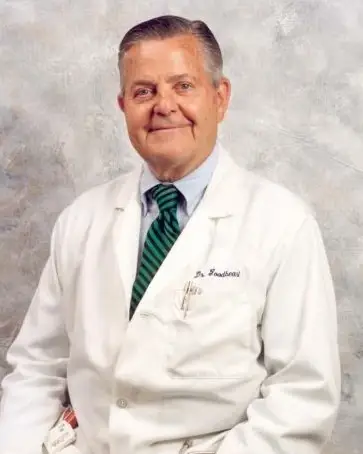
Born
August 18, 1918 · Detroit, Michigan
Died
March 5, 2008 · Grosse Pointe Farms, Michigan
Founded
Applied Kinesiology, 1964
First
US Olympic medical staff, 1980
Detroit, 1918 to 1939
George Goodheart trained inside a second-generation Detroit practice
George Joseph Goodheart, Jr. was born in Detroit on August 18, 1918. His father, Dr. George Goodheart, Sr., adjusted patients downtown. The son entered the same work after the University of Detroit and the National College of Chiropractic, graduating in 1939. Father and son practiced together in downtown Detroit for more than thirty years, and Goodheart later moved to an office in Grosse Pointe. Twenty-five years of ordinary practice preceded the observation that made his name.
The Bronze Star came out of a mechanical problem
Goodheart served in the United States Army Air Forces during the Second World War, stationed in France and England. He reached the rank of major in his twenties. The obituary published by the International College of Applied Kinesiology records his Bronze Star for inventing a bomb release mechanism. The award marks a working habit. Goodheart took a device that half worked, found the part that failed, and rebuilt it. He ran that same procedure on a shoulder twenty years later.
Goodheart's standing instruction was to examine before naming
See with eyes that see and hear with ears that hear. That was Goodheart's counsel to other physicians, recorded in the obituary his college published. The instruction is procedural. Examine first, name the thing second. Goodheart held to it past the point of habit, identifying an abnormal gait in a stranger on the sidewalk. The same instruction governs the order of every Applied Kinesiology examination he later taught.
The 1964 founding case
Applied Kinesiology began in 1964 with a shoulder blade that would not stay flat
Applied Kinesiology dates to a single Detroit case in 1964, and Goodheart's own account of it holds two problems in one patient. A former paratrooper arrived losing his hair rapidly. Goodheart ran an Achilles tendon reflex time test, read the result as an overactive thyroid, treated the picture nutritionally and through the spine, and the hair loss stopped.
Only then did the man raise what had actually cost him. He could not pass the pre-employment physical at a Detroit auto plant, because his shoulder blade lifted off his back whenever he pushed forward. He had carried the winged scapula about fifteen years. Films of both scapulae came back normal.
Goodheart reasoned toward the serratus anterior
The serratus anterior holds the scapula flat against the rib cage. Goodheart reached it through Kendall and Kendall's muscle testing manual, given to him by a chiropractor in Port Huron in trade for treatment of a knee. His first reading of the manual left him unimpressed, since a weak muscle appeared to call only for exercise. Faced with the paratrooper, Goodheart went back to it.
He looked for the wasting that fifteen years of disuse should have produced and found none. Palpating along the muscle's attachments, he found small nodules on one side with no match on the other. He rubbed them hard and they gave way under his fingers. On retest the man nearly drove his hand through the plywood panel he was pushing against, and the strength held the next day.
Origin and insertion technique was the first procedure in the system
That correction became origin and insertion technique, and Goodheart founded Applied Kinesiology on it in 1964. The principle underneath the procedure carried further than the procedure did. A muscle that fails to hold is reporting something, and a muscle that holds after a correction is confirming the answer. Goodheart spent the next decade building tests around that single observation, and his annual research manuals track the additions year by year.
Reading a body state through a reflex was established medicine before 1964
Achilles reflex time was already an endocrine measure when Goodheart used it. Sherman, Goldberg and Larson published it in the Lancet in 1963 as a diagnostic test of thyroid dysfunction, and Ringqvist reported it in Acta Medica Scandinavica in 1970 as a measure of thyroid function. Normal half relaxation falls between 240 and 320 milliseconds. Physicians were reading an endocrine state from the speed of a reflex, and Goodheart carried the same logic from a tendon tap to a voluntary muscle.
Inhibition before spasm
Goodheart made muscle inhibition the primary finding and spasm the consequence
Goodheart concluded after 1964 that the first event in a painful, weak muscle is inhibition, and that the tightness on the opposite side follows it. The teaching he had trained under held the reverse, treating spasm as the problem and calming it as the treatment. Goodheart reported the clinical consequence in stark terms. Before 1964 he saw hundreds of cases he would have called muscle spasm. Once he began looking for the inhibited muscle instead, genuine spasm became rare enough to count.
Goodheart taught the point with a sailboat mast, and it is the reasoning Applied Kinesiology is built on. The mast stands upright because the stays pull evenly on both sides. Loosen one stay and the mast leans, and the tight side carries no fault. The examination therefore starts at the muscle that gave way, at a distance from where the patient reports the pain.
Weakness and inhibition are two different findings
A weak muscle lacks contractile capacity and answers to training over weeks. An inhibited muscle holds its capacity and is not being recruited. Goodheart built that distinction into every test he taught, because it decides what a practitioner does next. Inhibition can reverse in seconds, and no amount of lifting corrects it. Cuthbert and Goodheart defined a strong muscle in 2007 as one able to adapt to the examiner's added force and maintain its contraction.
Joint information can switch a healthy muscle down within minutes
Spencer, Hayes and Alexander demonstrated the mechanism in 1984 in ten healthy volunteers. Saline infused into the knee joint space reduced the vastus medialis H reflex to 55.7 percent of its control value, with the threshold falling between 20 and 30 milliliters (PMID 6712434). Intra-articular lidocaine abolished the effect. Rice and colleagues extended the work in 2014 with transcranial magnetic stimulation across 17 volunteers, and sports medicine now calls the phenomenon arthrogenic muscle inhibition.
Lepley and Lepley summarized the mechanism in 2022 as a sequence starting with altered afferent information from an injured joint and ending in reduced motor output to the muscles around it (PMID 34470911). That literature describes injured joints and belongs to the researchers who built it. Goodheart's claim stands beside it and is his own. The same inhibition is readable by hand, in an unhurt person, and it changes within seconds when the input changes.
The five factors
The five factors of the intervertebral foramen organized every Applied Kinesiology search
Goodheart anchored the method's anatomy at the intervertebral foramen, the opening between two vertebrae where structures leave the spine. Five things pass through it. A nerve, a blood vessel, a lymphatic vessel, cerebrospinal fluid, and what Applied Kinesiology calls an acupuncture meridian connector. Those are the five factors.
A muscle that fails to lock is reporting that something in its supply line has changed. The tested muscle names the circuit, and the five factors name what could be responsible. Goodheart spent the years after 1964 correlating those factors against muscle response one at a time. An Applied Kinesiology finding therefore leads to nerve work, lymphatic contact, vascular contact, cranial technique or meridian work, and never to one fixed correction applied to everyone.
Goodheart assembled the five factors from Chapman, Bennett, Sutherland and Mann
Goodheart took the pieces from outside his own profession and kept the attributions. The neurolymphatic reflexes came from the osteopath Frank Chapman, published through Charles Owens in the late 1930s. The neurovascular points came from the chiropractor Terrence Bennett. The cranial and cerebrospinal fluid concepts trace to the osteopath William Sutherland, and the meridian material to Felix Mann. Goodheart's own father held osteopathic, chiropractic and naturopathic degrees, which is how the reflex literature reached him.
The muscle test told Goodheart which reflex was live
Chapman's maps listed points for specific organs and left one question open. Which point matters for the patient in the room. Goodheart's secretary supplied the test case in 1965. She had a thyroid condition, chronic sinus trouble and a head that tilted, and her sternocleidomastoid tested weak. Origin and insertion work did nothing for her. Goodheart went instead to a Chapman point under the clavicle. The muscle returned immediately and her headache resolved with it.
The pairing solved the problem the reflex literature had left open. The maps supplied candidate locations and the muscle test selected among them. Goodheart grounded the pairing in viscerosomatic relationships, the convergence of visceral and somatic afferent traffic on shared spinal segments that lets organ dysfunction present as muscle and tissue change.
Challenge and therapy localization
The two procedures that completed Applied Kinesiology both came out of failures
Goodheart added the vertebral challenge in 1973 and therapy localization in 1974. He called therapy localization the single greatest advance in the healing arts of his century. Both procedures came out of results he did not predict, and both remain standard in Applied Kinesiology practice.
The vertebral challenge, 1973
A young woman was scheduled for shoulder surgery because her shoulder dislocated in her sleep, without injury, always in the early hours. Goodheart asked what position she slept in, put her in it, and palpated her cervical spine. He pressed on a segment that sat out of place. The shoulder dislocated on his table and he had to reduce it.
The insight came out of that failure. When Goodheart pushed, the body pushed back. He adjusted in the direction that had produced the weakness, then could not make the shoulder dislocate again in any position. She kept the shoulder. Adjusting in the direction that produces weakness remains the standard for the challenge.
Therapy localization, 1974
An Australian tennis player with carpal tunnel signs supplied the first half of the discovery. Goodheart asked her to squeeze the radius and ulna together, which restores the arch of the transverse carpal ligament, and her weak muscle tested strong. She then told him she had not squeezed anything. She had only touched it. He tested it repeatedly. Touch, strong. No touch, weak.
The second half arrived years later, while Goodheart prepared to take his children skiing after his first wife's death, turning over how her illness had gone unfound. The thought that came was to ask the patient to ask the patient. Before therapy localization, a weak muscle meant working through all five factors in turn. After it, the patient's own hand narrowed the search first.
Goodheart set the limit on his own procedure
Goodheart fixed the boundary himself and taught it as a limit. Therapy localization identifies a location. It does not identify a cause, and the physician still has to make the diagnosis. He taught that limit through a patient whose cough had defeated three specialists, all of whom had examined her sitting upright. Goodheart examined her lying flat, found a mummified bee high on the nasal septum, and removed it.
His conclusion from the case was that Applied Kinesiology is a system of diagnosis, and that a practitioner should aim to be a good diagnostician before aiming at spectacular results. The bee turned up because someone examined the patient in a position nobody had tried.
The published record
Reliability in Applied Kinesiology muscle testing tracks which muscle is tested
Piriformis testing reaches a kappa between 0.7 and 0.91 across the published studies, and hamstring testing runs an order lower. That split has held since Lawson and Calderon first measured it in 1997, and a 2025 systematic review found it again. The finding is specific and useful. Some muscles can be isolated in a test position and some cannot, and the isolation decides the agreement.
Manual muscle testing predates Applied Kinesiology by half a century
Cuthbert and Goodheart reviewed more than one hundred studies of manual muscle testing in Chiropractic and Osteopathy in 2007, tracing the method to Robert Lovett's work of 1915 grading polio patients (PMID 17341308). Henry and Florence Kendall codified roughly 43 tests for the same purpose, published through the United States Public Health Service in 1938. Applied Kinesiology expanded that set to several hundred tests isolating individual muscles rather than gross movements.
Conable instrumented the procedure in 2010 using thin film force transducers across 44 subjects. Every manual test used less force than a maximum voluntary isometric contraction. Three second tests found weaknesses that one second tests missed, and agreement between the two durations reached a kappa of 0.54. The parameters of the test change the finding, which makes the procedure a measurable object.
Where the test agrees between examiners
Lawson and Calderon measured interexaminer agreement in 1997 with three clinicians of more than ten years' experience. Piriformis and pectoralis testing reached significant agreement across 32 and 53 subjects, while hamstring and tensor fascia lata testing did not. Soares and colleagues screened 8,720 records down to 7 studies for a 2025 systematic review in the Journal of Manipulative and Physiological Therapeutics, and reported the same split (PMID 41236460).
Their recommendation is specific. Manual muscle testing is clinically useful for the deltoid, gluteus maximus, piriformis and iliopsoas, and inference about nonmusculoskeletal conditions belongs outside what the test settles on its own. Estrazulas and colleagues measured the Applied Kinesiology piriformis test against four validated orthopedic tests in 2020. It identified sacroiliac dysfunction with a sensitivity of 0.89, a specificity of 0.82 and an area under the curve of 0.85.
Goodheart set the limit on inference before the reviews reached it
Haas, Cooperstein and Peterson drew the same line explicitly in 2007, holding that the muscle test as a procedure and Applied Kinesiology as a system of inference are two questions and answer separately. Hall, Lewith, Brien and Little assembled 22 studies in 2008, scored them against four reporting instruments, and recommended a pragmatic effectiveness study as the appropriate next step.
Goodheart had fixed the working rule decades earlier. Test and then prove. The muscle test narrows the search for the person on the table on the day they are there, and laboratory work confirms what it points at. He taught against practicing from a fixed table pairing one muscle to one nutrient, because the same muscle can be inhibited for several different reasons. Goodheart reported that Janet Travell told him she used B12 and folic acid in a high proportion of her patients, which pushed his group toward reading patterns.
Lake Placid, 1980
Goodheart reached the 1980 Olympic medical staff by resolving a surgeon's running cramp
Irving Dardik, the vascular surgeon who founded the United States Olympic Committee's Sports Medicine Council in 1978, could not run more than two miles without a severe cramp. Goodheart treated it as a reactive muscle problem, working the latissimus dorsi to change its relationship with the hamstring. Dardik ran ten miles the following day and ten more the day after without cramping.
In 1979 Dardik recommended that the USOC carry a Doctor of Chiropractic on its medical team at all future Games. Goodheart was appointed to the 1980 Winter Olympics at Lake Placid, the first chiropractor on a United States Olympic medical staff and the first practitioner from outside medicine to serve on that committee. His obituary records the appointment as the honor he valued most.
What the appointment opened for the profession
The reasoning that got Goodheart into the room was the method itself. A cramp that resolves when a different muscle is addressed is a statement about coordination, and it points the examination away from the site of the symptom. Chiropractors have worked in elite sport ever since, and the sports section of this library runs the same reasoning across 64 lessons on athletic performance, injury and recovery.
The ICAK and the manuals
Goodheart gave the method away through annual manuals and a college
Goodheart published his first Applied Kinesiology research manual in 1964 and wrote more than thirty of them across the following decades. Each manual documented that year's findings and revised the previous year, which kept the system moving instead of fixing it in place. Goodheart never sold the method as a finished product.
The Dirty Dozen and the college they built
The chiropractors who first took up the work called themselves the Dirty Dozen, and in 1976 they established what became the International College of Applied Kinesiology. Goodheart chaired its research committee for 32 years. The college reported more than 600 members in the United States and over 3,000 worldwide at his death, organized through national chapters including ICAK-USA, ICAK-UK, ICAK-Canada and ICAK-Australasia.
How Applied Kinesiology is taught now
David S. Walther codified the system in Applied Kinesiology: Synopsis, built out of the workshop manuals Goodheart circulated to his study groups from 1964. Systems DC published the second edition in 2000. Teaching is gated to holders of the Diplomate of the International Board of Applied Kinesiology. The ICAK sets that credential at a minimum of 300 hours of study under two or more teachers, of which 100 hours must be advanced. Three years of clinical practice follow.
Touch for Health and three other methods descend from Goodheart's work
Goodheart's student John Thie built Touch for Health, which carried muscle testing to lay practitioners worldwide. Total Body Modification, Neuro Emotional Technique and Contact Reflex Analysis descend from the same root. Goodheart published on the temporomandibular joint in Dental Clinics of North America in 1983. Melis and Di Giosia reviewed the dental literature in 2022 and found repeated reports that a change in dental occlusion changes isometric muscle strength.
The tone contribution
A muscle test reads the nervous system's integration in real time
That is Goodheart's contribution to the understanding of tone, and the Unified Model of Tone takes it as a working instrument. A muscle's response while an input is applied reports how the nervous system is integrating information at that moment. Goodheart reached the position in 1964, working with a hand and a plywood panel.
The reading and the input are the same event
Therapy localization demonstrates that claim more cleanly than any other procedure in chiropractic. The patient rests a hand flat over an area of their own body, an indicator muscle is retested, and the practitioner applies no force at all. The contact is the question, and the nervous system answers within seconds. Registration sits inside the loop it reports on, so there is no way to sample the body's state without changing it.
Regulation degrades before capacity does
Goodheart separated the regulator from the quantity, and the model makes the same separation at the scale of the whole body. Tissue keeps its capacity while the accuracy of the commands reaching it falls away, and the dynamic measure moves first. An inhibited muscle changes in seconds and a weak one takes weeks. Inhibition and overfacilitation are the two directions in which the nervous system sets its gain on a muscle, and gain is one of the foundations of tone.
What the muscle is actually reporting on
A muscle that stops locking is reporting on the information reaching the nervous system about the body. Spencer's saline experiment makes that concrete in a healthy knee. Change the afferent signal and the motor output falls within minutes, with no tissue damaged and no strength lost. Proprioception and interoception carry that signal, and the accuracy of the signal is one of the foundations of tone.
The retest is a prediction meeting an answer
Every Applied Kinesiology correction ends in an immediate retest of the same muscle. The retest is the practitioner's prediction meeting the body's reply, and a muscle that locks immediately afterward records an update. The nervous system runs on predictions about the state of the body and revises them against what arrives. Goodheart built a bedside test for that revision decades before predictive processing carried a name.
What the model claims, stated exactly
The model's claim rides on the procedure. A muscle's lock changes within seconds when an input is applied, force transducers measure that change, and the change is tone read through the motor system at that moment. Inference from the change to a named disease is a separate act, and Goodheart assigned it to the physician and the laboratory. Test and then prove.
Heart rate variability, cortical excitability and tissue compliance read the same variable through other instruments, and the model holds that they share one organization, with compensation deciding which reading moves and which is held. Goodheart's instrument was a hand, and Applied Kinesiology is the record of what he read with it.
What the model predicts about muscle testing
The model predicts a bidirectional result. A matched input should move an inhibited muscle and an overfacilitated one toward the same middle, narrowing the spread across a group instead of shifting everyone in one direction. Conable's transducer work in 2010 shows that instrumented testing already resolves force and duration finely enough to run that comparison. The model further predicts that a site recorded in advance will outperform an unspecified one.
Grosse Pointe Farms, 2008
Goodheart left one examination language that several professions share
George Goodheart died at his home in Grosse Pointe Farms, Michigan, on March 5, 2008, aged 89. He was survived by his wife JoAnn. Members of the United States Congress had nominated him for the Presidential Medal of Freedom, and TIME featured him in 2001 in an article on a new breed of healers.
JoAnn Goodheart donated much of his memorabilia to the David D. Palmer Health Sciences Library at Palmer College of Chiropractic, where the Goodheart Collection opened in 2010. She chose Davenport so the collection would sit permanently with the archives of D.D. Palmer. Chiropractors, osteopaths, naturopaths, physicians and dentists now hold the Applied Kinesiology diplomate, and what they share is an examination language rather than a treatment.
Where Goodheart sits among the legends
Goodheart belongs with the chiropractors who treated the nervous system as the target and the joint as the way to reach it. Ted Carrick built functional neurology on the same premise, that a circuit can run poorly with no lesion present and that the retest decides whether the input landed. Bertrand DeJarnette reached whole system reading from a different direction, building the first classification of subluxation patterns. The nervous system section covers the reflex architecture every muscle test depends on.
Manual muscle tests evaluate the ability of the nervous system to adapt the muscle to meet the changing pressure of the examiner's test.
Cuthbert SC and Goodheart GJ Jr., Chiropractic and Osteopathy, 2007Common questions
Common questions about George Goodheart
Who was George Goodheart?
George J. Goodheart, Jr. (1918 to 2008) was a second-generation Detroit chiropractor who founded Applied Kinesiology in 1964. He graduated from the National College of Chiropractic in 1939 and practiced with his father downtown for more than thirty years. He wrote over thirty annual research manuals, chaired the International College of Applied Kinesiology research committee for 32 years, and taught the method to chiropractors, osteopaths, physicians and dentists worldwide.
What did George Goodheart contribute to the understanding of tone?
Goodheart established that a muscle's response while an input is applied is a live readout of how the nervous system is integrating information at that moment. Therapy localization is the sharpest form of it, since the practitioner applies no force and the patient's own contact changes the muscle response within seconds. The Unified Model of Tone treats that instant response as tone read through the motor system, one instrument among several that read the same variable.
When did George Goodheart found Applied Kinesiology?
Applied Kinesiology began in 1964. The founding case involved a former paratrooper whose shoulder blade lifted off his back when he pushed forward, a problem he had carried about fifteen years. Goodheart reasoned toward the serratus anterior, found small nodules at the muscle's attachments with no match on the other side, and rubbed them hard. The muscle held on retest. That correction became origin and insertion technique.
Was George Goodheart the first chiropractor at the Olympic Games?
Goodheart was the first chiropractor appointed to a United States Olympic medical staff, at the 1980 Winter Games in Lake Placid. Irving Dardik founded the USOC Sports Medicine Council in 1978 and could not run two miles without cramping. Goodheart worked the latissimus dorsi to change its relationship with the hamstring, and Dardik ran ten miles the next day. In 1979 Dardik recommended a Doctor of Chiropractic at all future Games.
What has been measured about Applied Kinesiology muscle testing?
Reliability tracks which muscle is tested. A 2025 systematic review in the Journal of Manipulative and Physiological Therapeutics screened 8,720 records down to 7 studies and found piriformis reliability running from a kappa of 0.7 to 0.91. It recommends the test for clinical use on the deltoid, gluteus maximus, piriformis and iliopsoas. Goodheart's own rule set the same boundary decades earlier. Test and then prove.
What is therapy localization and who discovered it?
Therapy localization is the procedure in which a patient rests a hand flat over an area of their own body while an indicator muscle is retested. A change in the response in either direction implicates that area. The practitioner applies no force, so the contact itself is the question. Goodheart discovered it in 1974 and stated its limit plainly. It identifies a location rather than a cause, and the physician still makes the diagnosis.
References
References
- Cuthbert SC, Goodheart GJ Jr. On the reliability and validity of manual muscle testing: a literature review. Chiropractic and Osteopathy. 2007;15:4. PMID 17341308
- Haas M, Cooperstein R, Peterson D. Disentangling manual muscle testing and Applied Kinesiology: critique and reinterpretation of a literature review. Chiropractic and Osteopathy. 2007;15:11. PMID 17716373
- Soares JR, Stieven FF, Rocha CSDS, Miranda IF. Reliability of manual muscle testing in Applied Kinesiology: a systematic review. Journal of Manipulative and Physiological Therapeutics. 2025;48(6-9):862-870. PMID 41236460
- Hall S, Lewith G, Brien S, Little P. A review of the literature in applied and specialised kinesiology. Forschende Komplementarmedizin. 2008;15(1):40-46. PMID 18334813
- Lawson A, Calderon L. Interexaminer agreement for applied kinesiology manual muscle testing. Perceptual and Motor Skills. 1997;84(2):539-546. PMID 9106846
- Estrazulas JA, Bueno LS, Lombardi LRO, et al. Accuracy of the applied kinesiology muscle strength test for sacroiliac dysfunction. Revista Brasileira de Ortopedia. 2020;55(3):293-297. PMID 32616973
- Conable KM. Intraexaminer comparison of applied kinesiology manual muscle testing of varying durations: a pilot study. Journal of Chiropractic Medicine. 2010;9(1):3-10. PMID 21572637
- Sherman L, Goldberg M, Larson FC. The Achilles reflex: a diagnostic test of thyroid dysfunction. The Lancet. 1963;1(7275):243-245. PMID 13977185
- Ringqvist I. Achilles reflex time as a measure of thyroid function. Acta Medica Scandinavica. 1970;188(3):231-239. PMID 4110387
- Spencer JD, Hayes KC, Alexander IJ. Knee joint effusion and quadriceps reflex inhibition in man. Archives of Physical Medicine and Rehabilitation. 1984;65(4):171-177. PMID 6712434
- Rice DA, McNair PJ, Lewis GN, Dalbeth N. Quadriceps arthrogenic muscle inhibition: the effects of experimental knee joint effusion on motor cortex excitability. Arthritis Research and Therapy. 2014;16(6):502. PMID 25497133
- Lepley AS, Lepley LK. Mechanisms of arthrogenic muscle inhibition. Journal of Sport Rehabilitation. 2022;31(6):707-716. PMID 34470911
- Goodheart G. Applied kinesiology in dysfunction of the temporomandibular joint. Dental Clinics of North America. 1983;27(3):613-630. PMID 6226544
- Melis M, Di Giosia M. Applied kinesiology and dentistry: a narrative review. Cranio. 2022;40(6):509-516. PMID 32720584
- Fornazieri A, et al. Physiology, viscerosomatic reflexes. StatPearls. Treasure Island: StatPearls Publishing. PMID 32644644
- Goodheart GJ Jr. Applied Kinesiology Research Manuals. Detroit: privately published annually from 1964.
- Kendall HO, Kendall FP. Care During the Recovery Period in Paralytic Poliomyelitis. Public Health Bulletin No. 242. Washington: United States Public Health Service; 1938.
- Walther DS. Applied Kinesiology: Synopsis. 2nd ed. Pueblo: Systems DC; 2000.
- International College of Applied Kinesiology, USA. Dr. George Joseph Goodheart Jr., August 18, 1918 to March 5, 2008. Published obituary
- International College of Applied Kinesiology, USA. The Founder and Father of Applied Kinesiology: Dr. George J. Goodheart. ICAK-USA
- In Memory of George Goodheart. Dynamic Chiropractic. 2008. Published memorial
Education is for general understanding and is not medical advice or a diagnosis. Historical detail follows the published record and Goodheart's own accounts of his cases.