
Our Approach · The Legends · Era II
Era II · 1904 to 1987
Richard Van Rumpt
The Low-Force Founder
Richard Van Rumpt (1904 to 1987) founded Directional Non-Force Technique, the original low-force chiropractic system. He began the work in 1923 as a student at National College of Chiropractic and taught the first seminars between 1940 and 1945. The DNFT correction is a thumb impulse of a few ounces, aimed along a direction the patient's own leg reflex selected. Van Rumpt held that direction outranks force. The Unified Model of Tone names that correspondence.
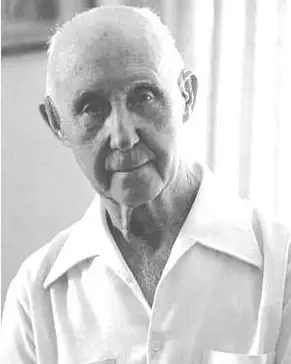
Born
1904
Died
September 23, 1987 · age 83
Began
1923, as a student at National College of Chiropractic
First seminars
1940 to 1945
Taught
Over 6,000 doctors and students across 45 years
The 1923 finding
Van Rumpt's method began with a patient he palpated and never adjusted
In 1923 Richard Van Rumpt sent a patient home from the student clinic with no adjustment, because he had spent the appointment palpating her and run out of time. She came back the next day to praise him. Her headaches had eased. She had slept well, and her digestion and elimination had improved. Van Rumpt had delivered no thrust at all.
Van Rumpt was a former professional boxer with a heavy build, known around National College of Chiropractic as one of its hardest adjusters. The patient who improved had received the one thing he considered preliminary.
Van Rumpt concluded that the palpation had been the adjustment
Van Rumpt redirected a career on that single result, and from 1923 forward he worked one question: how little force will do the job. He gave the account himself in an interview published in The American Chiropractor in 1987. “It was then I realized it was the heavy palpation and I didn’t have to ‘punch away’ like I was and use heavy adjustments.”
The 1923 finding set a research problem, and the technique took seventeen years
Nothing resembling Directional Non-Force Technique existed in 1923. Van Rumpt had an observation and no method to carry it, and seventeen years passed before he taught the system to anyone. The system he arrived at runs as a challenge, a leg check read within about three seconds, and a thumb impulse of a few ounces along one confirmed line. The full protocol runs on the DNFT technique page.
From the ring to National, 1921
Van Rumpt entered chiropractic through a sprained wrist and earned the degree in eighteen months
Richard Van Rumpt fought professionally as a bantamweight for eight years, under three names: Tiny Trinkle, Dickie Van, and Kid Ritchie. His trainer, Dunk Robinson, sent him to a chiropractor named Carl Schilling for a sprained wrist. The wrist settled. So did headaches and indigestion Van Rumpt had never mentioned. He asked where the method was taught. He entered National College of Chiropractic in 1921.
He attended for eighteen months and took the DC, then spent six more months and a thesis on the PhC. National taught the double transverse move and a thumb contact its faculty called the T and M, where Palmer of the same period worked mainly through the pisiform on spinous processes. Van Rumpt's first adjusting vocabulary already put a thumb on the spine.
The degrees Van Rumpt stacked after the DC
Two years of night classes at the Metropolitan School of Physiotherapy earned Van Rumpt a Doctor of Science. A naturopathic degree followed, paid for by four years of teaching dissection at the Philadelphia College of Naturopathy. He learned endonasal and cranial work in the same period and said he taught endonasal technique before Tom Lake did, while giving Lake full credit for popularizing it. Postgraduate study at Palmer College of Chiropractic sits alongside the rest.
Van Rumpt taught for sixteen years before he had a system of his own
Van Rumpt ran his first field seminar in 1924, on a subject titled Neurological Reflexes to Diagnose Diseases of The Nervous System. He was known through the 1920s as a foot adjuster and was teaching that work to the field long before DNFT existed. Sixteen years separate his first seminar from the first seminar on the technique that carries his name.
Direction over amplitude
Van Rumpt's central claim is that direction carries the correction and amplitude does not
A subluxation on Van Rumpt's account never needs to be overpowered. It needs to be met along the one line it actually sits in, and once that line is known a few ounces will do what a full osseous thrust was being asked to do. The D in DNFT carries the whole claim. “The ‘D’ in D.N.F.T. stands for Directional because we thrust in a specific direction as determined by analysis.”
If direction is what corrects, a guessed direction wastes the adjustment no matter how cleanly the thrust lands. DNFT therefore refuses to correct anything the analysis has not first confirmed, including the direction of the displacement. The technique reads and corrects five directions: rotation, laterality, tilt, anteriority, and posteriority.
A DNFT impulse is roughly one newton against a 400 newton manual thrust
A manual thoracic adjustment peaks near 400 newtons and a cervical one near 100, measured by Herzog and colleagues and published in Spine in 1993. A few ounces is roughly one newton. Van Rumpt proposed to reach the same target with something near one part in four hundred of the thoracic figure. He deleted amplitude from the adjustment and kept direction.
Van Rumpt refused to call a thrust an adjustment
The standard Van Rumpt set was a pre-test and an identical post-test. Nothing counted until the post-test came back clean. “A thrust is just a thrust, and is not to be considered an adjustment, unless, or until it succeeds 100% in correcting the subluxation.”
The audible release proves nothing under that rule, and Van Rumpt said so directly. “The mere cracking or popping of a bone does not mean you’ve made an adjustment.”
A DNFT correction produces no audible release at any point, because nothing is carried to a joint barrier. Van Rumpt had removed the one signal most patients and many doctors used as proof that an adjustment had happened. In its place he put a test.
Our premise is, no subluxation, no adjustment. We find it, we fix it, and we leave it alone.
Richard Van Rumpt, interview in The American Chiropractor, 1987The reactive leg, 1923 to 1940
The reactive leg reflex began with a magazine article on polarity and took more than twelve years to make reliable
The analytical half of DNFT came from outside chiropractic. Van Rumpt read in a Rosicrucian magazine that the body carries positive and negative polarity, and that alternate fingers on each hand might carry opposite charge. “That was in 1923 when I started experimenting to see if it was possible to use the positive and negative fingers in making a Chiropractic listing.” The reactive leg reflex came out of that experiment.
Making the check repeatable took Van Rumpt more than twelve years. He taught the method in New York from about 1940, ran the first seminars between 1940 and 1945, and went national late in that decade. Stephen Senzon's 2018 history in the Journal of Chiropractic Humanities dates DNFT to 1940 and records its leg check as the first reactive leg check used to determine a chiropractic vertebral subluxation.
How the DNFT leg check is read
The doctor applies a challenge, which is a small directed push against one structure along one line, then checks the legs within about three seconds. A pull-up of the reactive leg means that structure is displaced in the direction just tested. The reading needs a pull-up of about 13 millimeters to count as an answer, with the patient prone in a modified shoe carrying a roughened heel. The full DNFT protocol sets the reactive side before any structure is challenged.
Van Rumpt separated his leg check from every other leg check
Leg measuring was already taught at National in 1923, and Van Rumpt separated his finding from all of it. “Although leg measuring was taught at National and might have existed hundreds of years, it and other types of leg measurement are not related to the D.N.F.T. ‘reactive leg reflex’.” Congenital and traumatic short legs have no bearing on the finding, he said, on the strength of more than 60 years of his own research.
Van Rumpt's claim of authorship was equally flat. “I am the original developer of the ‘reactive leg reflex’ and I believe I was the first to use the thumb to adjust any and all parts of the body.”
Subluxation and distortion, 1987
Van Rumpt defined the subluxation broadly and separated it from the distortion built around it
Ligament, disc, rib, cranial bone and organ reflex all qualified under the definition Van Rumpt gave in 1987, because that definition never mentions bone. “A subluxation is anything in the body, osseous or soft, that is out of alignment and causing nerve interference.”
DNFT adjusts seven territories on that logic. They are the spine, the pelvis, the cranials, the shoulder, the extremities, the temporomandibular joint, and the organ reflexes. A single vertebral correction takes in the rib, the discs above and below, and the intervertebral ligaments.
Distortion is compensation, and Van Rumpt would not adjust it
Van Rumpt drew a line most of his contemporaries did not. “A distortion is not a subluxation. It is an adaptation or compensation to and for a subluxation.”
He held that the body itself decides how much of the distortion to give up once the subluxation is corrected. The doctor's job stops at the correction. DNFT still applies that rule at the atlas, where the analysis asks whether an atlas misalignment is a true subluxation or a compensation for something below it.
The model splits leverage from compensation, which is Van Rumpt's split renamed
Van Rumpt was refusing to spend adjustments on compensations in the 1920s, and the model draws the same line. The compensation is aggregate downstream tension, already at the limit of what it can dissipate. Added force there deepens the defense. The point of leverage is the focal site where a small matched input reorganizes the system. Van Rumpt's 1987 sentence states that separation in the vocabulary available to a man who began work in 1923. Constraint sets out how a held pattern limits what the body can do next.
The career, 1924 to 1986
Van Rumpt spent fifteen years inside DeJarnette's research society and forty more teaching alone
Van Rumpt directed Major Bertrand DeJarnette's Sacro Occipital Research Society for fifteen years, the first man to hold the post. He had become DeJarnette's student by the late 1920s. “I was also Dr. DeJarnette’s first and only so-called Director of the Sacro Occipital Research Society.” That placed Van Rumpt inside the most systematic investigative program the profession ran through the 1930s and 1940s.
Van Rumpt's own material appears inside DeJarnette's published books
A pamphlet Van Rumpt wrote on foot adjusting was reprinted in one of DeJarnette's books in 1929 or 1930, and his endonasal technique appears in them as well. Van Rumpt ran Sacro-Occipital Technique research on the East Coast, and the model still uses DeJarnette's membrane argument.
What the published history says Van Rumpt combined
Senzon's 2018 account of the first research era is direct about the inheritance. “Van Rumpt combined DeJarnette’s Hurley/Logan approach with some of B. J. Palmer’s methods and perspectives.” Van Rumpt's own list of researchers he studied with names Hurley and Sanders, Logan, DeJarnette, Gonstead, Goodheart, Nemo and Pettibon. “You name them and I have studied with them.” In the same 1987 interview he named the reactive leg reflex as his own invention.
Van Rumpt left the research society and gave up the road into the colleges
Van Rumpt left the society in the 1940s and gave the rest of his career to DNFT. The choice carried a price. DeJarnette and George Goodheart both built techniques that reached the accredited colleges, and Van Rumpt's never did. DNFT moved by seminar for more than 70 years, outside any core curriculum.
Van Rumpt taught over 6,000 doctors and students and kept DNFT in his own hands
The American Chiropractor reported in July 1989 that Van Rumpt had instructed over 6,000 doctors and students across more than forty-five years. He taught at more than a dozen schools as a visiting professor. The list runs National, Columbia, the Eastern Institute, Metropolitan, Standard, Atlantic and Pasadena, plus repeat homecomings at Palmer. DNFT itself he taught alone until 1986.
Van Rumpt taught in small classes on principle
The format was a deliberate choice about what teaching is. “You can lecture to a large class but it is impossible to teach one, therefore small classes are given.” Van Rumpt preferred students to established doctors, on the grounds that students were more receptive. Most of the chiropractors practicing DNFT full time in 1987 were people he had taught as students years earlier.
Van Rumpt tested his own protocols on 20 to 30 free patients a day
Van Rumpt ran his own clinical research at volume. He tested sequence of adjustments, every possible listing, and frequency of adjustments. “In my research I saw 20-30 patients a day for free and put them through every conceivable test.”
His patient list included Babe Ruth and other members of the Yankees, Enrico Caruso, and members of the Theodore Roosevelt family. Edgar Cayce sent him 200 patients. Van Rumpt reported 8,000 to 10,000 letters and calls a year from people hunting for a DNFT chiropractor.
The succession, 1986, and the end
In 1986, a year before his death, Van Rumpt selected Christopher John to carry the research and the teaching. John had first studied DNFT in 1978 as a student at Western States Chiropractic College, graduated in 1982, and has taught the technique since 1986. Van Rumpt died on September 23, 1987, at the age of 83, after 64 years in practice. His wife Franya survived him. Asked how he wanted to be remembered, he answered: “Van - the Innate man!”
Dated facts
Eight dated facts about Richard Van Rumpt, with the source for each
The boxing years, the degrees, and the death date
Van Rumpt fought professionally as a bantamweight for eight years under the names Tiny Trinkle, Dickie Van and Kid Ritchie. He entered National College of Chiropractic in 1921 and took the DC in eighteen months, then the PhC six months after that (The American Chiropractor interview, 1987).
Van Rumpt added a Doctor of Science in physiotherapy over two years of night classes at the Metropolitan School of Physiotherapy. A naturopathic degree followed, earned by four years of teaching dissection at the Philadelphia College of Naturopathy (same interview).
Van Rumpt served as the first director of DeJarnette's Sacro Occipital Research Society and held the post for fifteen years. His foot and endonasal techniques appear in DeJarnette's books from 1929 or 1930 (Gensler memorial).
Van Rumpt died on September 23, 1987, at the age of 83, after a 64 year career, survived by his wife Franya (Gensler memorial).
The dates that fix DNFT in the record
DNFT dates its founding observation to 1923, when spinal palpation alone produced structural, symptomatic and physiologic change in one of Van Rumpt's student clinic patients (D.N.F.T. history).
The peer-reviewed history of the chiropractic subluxation dates DNFT to 1940 and credits it with the first reactive leg check (Senzon, J Chiropr Humanit, 2018).
Van Rumpt taught over 6,000 doctors and students across more than 45 years and selected Christopher John as his successor in 1986 (The American Chiropractor, July 1989).
A prospective case series of 131 adults with chronic low back pain ran across 22 private practices under DNFT protocols, six visits inside four weeks. It was published in the Chiropractic Journal of Australia in December 2011 (Khauv and John).
What descended from Van Rumpt
Three later techniques name Van Rumpt's analysis among their own sources
Three techniques in this library list DNFT or its reactive leg among the methods they were built from, and all three are still taught. Van Rumpt published almost nothing, held no patent, and never reached a college curriculum. His work traveled anyway, because the founders who came after him named him.
Network Chiropractic took the reactive leg
Donald Epstein assembled Network Chiropractic from methods already in circulation, and Van Rumpt's reactive leg from DNFT is on the roster. Epstein's list also runs Logan Basic, Pierce-Stillwagon, Thompson, Sacro-Occipital Technique, Toftness, Goodheart's vertebral challenge and Lowell Ward's Stressology. Epstein defined the spinal meningeal functional unit formally in a paper presented in November 1989, and the analysis he built around it kept Van Rumpt's instrument.
Koren Specific Technique took the challenge and the refusal
Koren Specific Technique names its sources rather than claiming originality, and Van Rumpt is the first of them. Tedd Koren took the challenge from DNFT, along with the refusal to correct anything the analysis has not confirmed. Koren also repeats a clinical rule he credits directly to Van Rumpt: cranials left uncorrected will let the cervicals go again, and ribs left uncorrected will let the thoracics go again. KST swapped the 13 millimeter leg pull-up for an occipital drop that loads no muscle.
Torque Release Technique names DNFT among seven source methods
Torque Release Technique lists the seven methods it draws from, and Van Rumpt's DNFT is one. The other six are Thompson Terminal Point, DeJarnette's Sacro-Occipital Technique, Logan Basic, Toftness, Palmer Upper Cervical, and Network. The leg check as an analytical instrument now runs through a large part of the profession, and TRT carried it into an instrument-delivered form.
The low-force family Van Rumpt opened
DNFT was the first low-force full-spine system, and the family that followed is large. Toftness and Logan Basic are its near contemporaries, and Activator reached the same territory with a fixed instrument where DNFT keeps the thumb and varies the direction. Bio-Geometric Integration descends from Network at one remove, and Sue Brown carried the light contact forward after leaving that work in the late 1990s. MLS, short for Mastery, Love and Service, reaches the same conclusion from the opposite side. Arno Burnier sets the segment at ease before a small fast thrust, where the standard method loads the joint to its barrier first.
Van Rumpt's contribution to the model
Direction outranks force, and the Unified Model of Tone names that correspondence
Van Rumpt reached the model's position on specificity in 1923, roughly fifty years before the profession had a vocabulary for it, by removing force from the adjustment until only direction was left. The Unified Model of Tone holds that specificity is correspondence. What makes an input effective is how closely it matches the pattern a particular body is holding, and amplitude is a separate axis entirely.
The better an input matches, the less of it a body needs
Force is inverse to presence. The more accurately an input corresponds to the distortion a body is holding, the less of it that body requires. Force beyond what the system needs to receive the message degrades the message, and force short of it fails to deliver. Van Rumpt kept reducing force for 64 years and stopped at DNFT: a few ounces, one confirmed line, no twisting of the patient and no audible release. Input quality settles what makes one input land and another pass through.
A few ounces is enough because guarding is motor output
The tissue holding a subluxated segment is mostly not collagen. Guarding and stiffness there are predominantly sustained motor output, which is why they release in seconds under a well-matched input. Joel Pickar's 2002 review in The Spine Journal set out how mechanical input to the spine alters Group I, II, III and IV afferent discharge, and that is the pathway a light directed contact travels. The correction is performed by the patient's own motor system.
What the model predicts about a DNFT correction
Two predictions follow, and both are measurable with existing equipment. The model predicts a larger change in central and autonomic measures when a DNFT impulse lands at a site named in advance by challenge, against the same few ounces at an unspecified site. It also predicts convergence. Assemble two groups on one variable such as resting tone or heart rate variability, one above its healthy range and one below. A matched correction moves both toward the middle, and the spread of the treated cohort narrows.
Three of Van Rumpt's claims survive intact inside the model
Direction outranks amplitude, the subluxation includes soft tissue, and the distortion around a subluxation belongs to the body. The model calls those the point of leverage, the tensional continuum, and the compensation. Van Rumpt arrived at all three by 1987 with a thumb and a pair of legs for instruments.
Where this page sits in the library
Van Rumpt's line runs forward through the low-force family and into the model
Directional Non-Force Technique is the method itself, with the challenge, the reactive leg protocol, the thumb thrust and the published research.
The Unified Model of Tone supplies the reason a few ounces can do the work of a thrust, by locating the correction in correspondence rather than in amplitude.
Input quality explains why the same amount of force lands differently depending on where and how it arrives.
Tone names the variable Van Rumpt moved without a word for it, and D.D. Palmer put that word in print in 1910.
Constraint carries the distinction between a held pattern and the compensation stacked on top of it, which Van Rumpt called distortion.
Bertrand DeJarnette ran the research society Van Rumpt directed for fifteen years before leaving to teach his own system.
Donald Epstein and Tedd Koren both named Van Rumpt's analysis among their own sources.
D.D. Palmer set the premise Van Rumpt worked inside. Find the subluxation, correct it, and leave the healing to the body.
Questions people ask
Common questions about Richard Van Rumpt
Who was Richard Van Rumpt?
Richard Van Rumpt (1904 to 1987) was the chiropractor who founded Directional Non-Force Technique, the profession's original low-force full-spine system. He fought professionally as a bantamweight for eight years, entered National College of Chiropractic in 1921, and took the degree in eighteen months. He directed DeJarnette's Sacro Occipital Research Society for fifteen years, then taught DNFT single-handed from about 1940 until 1986. He died on September 23, 1987.
What did Richard Van Rumpt contribute to the understanding of tone?
Van Rumpt established that direction outranks amplitude. He stripped nearly all the force out of the chiropractic adjustment and kept only the confirmed line of displacement, which makes DNFT the profession's sharpest test of specificity as correspondence. The Unified Model of Tone takes that claim whole. Force is inverse to presence, so an input matched to the pattern a body holds needs very little of it.
When did Richard Van Rumpt start DNFT?
Van Rumpt dates the founding observation to 1923, during his final year as a student. A patient he had palpated and never adjusted came back reporting that her headaches, sleep and digestion had all improved. He started work on the reactive leg reflex the same year, after reading a Rosicrucian article on polarity. Making that check reliable took more than twelve years, and the first DNFT seminars ran between 1940 and 1945.
Did Richard Van Rumpt invent the leg check?
Van Rumpt invented the reactive leg reflex, and he distinguished it sharply from leg measuring in general. Leg measuring was taught at National in the 1920s and is far older than that. Van Rumpt held that congenital and traumatic short legs have no bearing on his finding, which reports whether a challenged structure is displaced along the line just tested. Stephen Senzon's 2018 history records it as the first reactive leg check used to determine a subluxation.
Which techniques descend from Richard Van Rumpt?
Network Chiropractic, Koren Specific Technique and Torque Release Technique all name DNFT or its reactive leg among their own source methods. Tedd Koren goes further and repeats a clinical rule he credits to Van Rumpt by name. The leg check as an analytical instrument now runs through a large part of the profession. DNFT was also the first low-force full-spine system, which puts Activator, Toftness and the rest of that family downstream of it.
Why is Richard Van Rumpt less known than DeJarnette or Goodheart?
Van Rumpt left almost no published record and kept DNFT out of the accredited curriculum. He taught it himself in small classes for more than forty-five years, then handed it to a single successor in 1986. Roughly 6,000 doctors and students learned it that way. His influence reached the profession through the founders who borrowed from him, which spreads a method while leaving its author uncredited on the page.
Sources
Sources
- An Interview with Dr. Richard VanRumpt. The American Chiropractor, 1987. The primary source for every first-person quotation on this page.
- Senzon SA. The Chiropractic Vertebral Subluxation Part 5: The First Research Era From 1928 to 1949. J Chiropr Humanit. 2018;25:67-85. doi:10.1016/j.echu.2018.10.004
- Gensler H. Memorial to Dr. Richard Van Rumpt. Death date, career length, the fifteen years at the Sacro-Occipital Research Society, and the ring names.
- Directional Non-Force Technique: history, philosophy and technical description. D.N.F.T. Chiropractic.
- The American Chiropractor, July 1989: D.N.F.T. Source for the 6,000 doctors taught across more than forty-five years and the 1986 succession.
- Khauv K, John C. Health-related Quality of Life Improvements in Adult Patients with Chronic Low Back Pain under Low-force Chiropractic Care: A Practice-based Study. Chiropr J Aust. 2011;41(4).
- Herzog W, Conway PJ, Kawchuk GN, Zhang Y, Hasler EM. Forces exerted during spinal manipulative therapy. Spine. 1993;18(9):1206-1212.
- Pickar JG. Neurophysiological effects of spinal manipulation. Spine J. 2002;2(5):357-371.
- Introduction to DNFT Chiropractic. Official D.N.F.T. channel. Source for the 13 millimeter pull-up threshold and the modified shoe.
- Sparer H, DC, on DNFT. Source for the 5 directions DNFT reads and corrects.
Educational content on the history of chiropractic technique. Quotations from Richard Van Rumpt are taken verbatim from the 1987 interview published in The American Chiropractor. Chiropractic care is not a substitute for medical diagnosis or emergency treatment.