
Our Approach · The Legends · Era I
The Founding · 1881 to 1961
B.J. Palmer
The Developer
Bartlett Joshua Palmer (1881 to 1961) ran the Palmer School of Chiropractic from 1906 until his death, narrowed the adjustment to the atlas and axis, and opened the profession's first instrumented research clinic in 1935. He measured nerve activity before and after every adjustment, and wrote that the purpose of an adjustment is to restore below par quantity up to a normal par quantity. The Unified Model of Tone names that quantity tone.
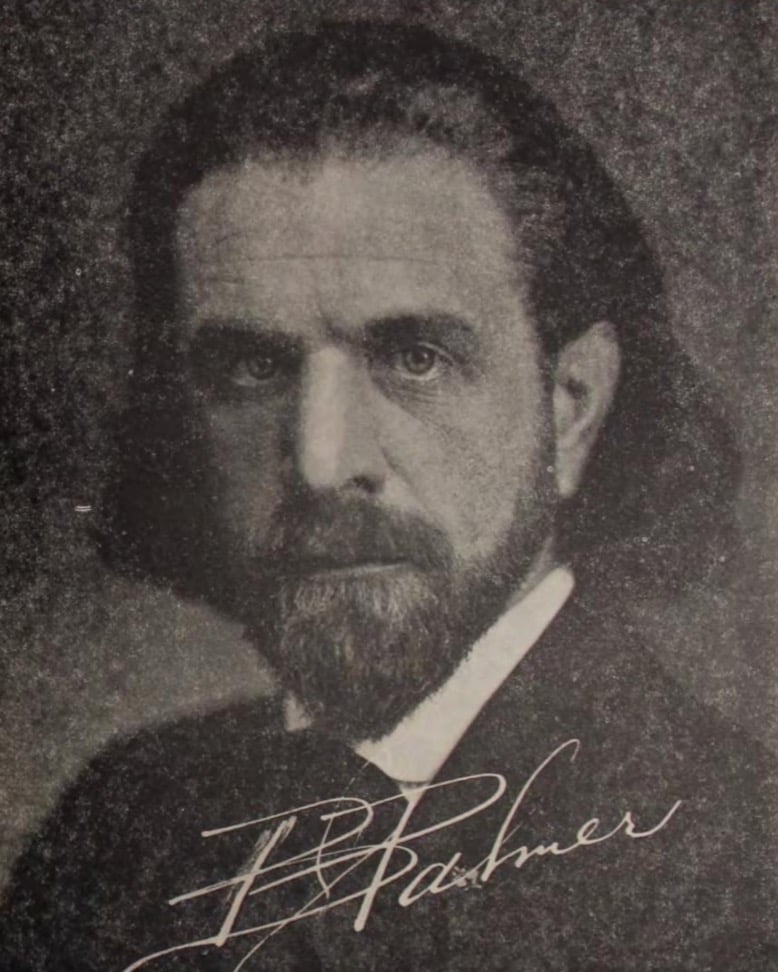
Born
Sept 1881 or 1882 · What Cheer, Iowa
Died
May 27, 1961 · Sarasota, Florida
Led
Palmer School of Chiropractic, 1906 to 1961
Built
B.J. Palmer Chiropractic Clinic, Aug 5, 1935
Wrote
The Subluxation Specific, The Adjustment Specific, 1934
The Developer, 1906 to 1961
B.J. Palmer ran the Palmer School of Chiropractic for fifty-five years
B.J. Palmer took charge of the Palmer School of Chiropractic in Davenport, Iowa, in 1906, while he was in his twenties, and held it until his death in 1961. D.D. Palmer discovered the method and named it. B.J. Palmer built the school, the instruments, the research program and the printed literature that carried the method out of Davenport.
The operation was unusual in scale for a healing profession. B.J. Palmer obtained a license in 1922 for radio station WOC in Davenport, reported as the second station licensed to broadcast in the United States, and later added WHO in Des Moines. He ran a printery at the school and issued a numbered series of volumes under his own name that reached Volume XXXVIII. He built the annual Lyceum into the profession's central gathering, and used it in 1931 to announce the rule that defined the rest of his career.
The birth date B.J. Palmer recorded for himself
B.J. Palmer wrote that he was born at What Cheer, Iowa, on September 10, 1881, and he recorded a one year discrepancy in the same paragraph. The family album he kept in the clinic museum gave 1882. The family portrait his father printed for patients said 1881 (Fight to Climb, 1950, p. 54). The Biographical Dictionary of Iowa carries September 10, 1881, and Palmer College printed 1881 to 1961 on the title page of his last book. The year is genuinely unsettled. The 1961 memorial notices and Quigley's 1995 study in Chiropractic History carry September 10, 1881. Joseph Keating's chronology and Palmer College's own library carry September 14, 1882, citing Rehm and Gielow. This page states both and rests nothing on either.
Mabel Heath Palmer taught the anatomy the method depended on
Mabel Heath Palmer married B.J. Palmer on May 30, 1904, taught anatomy at the Palmer School for four decades, and wrote the first anatomy textbook prepared for chiropractic students in 1918. She managed the school's finances alongside the teaching. She died on March 30, 1949, twelve years before her husband. Her page in this library covers the work.
Spinograph and neurocalometer
B.J. Palmer put instruments into chiropractic before he put a doctrine on top of them
Two instruments decided everything B.J. Palmer later claimed. He introduced X-ray of the spine to the profession and named it the spinograph. He introduced the neurocalometer, a paired probe device that read skin temperature down either side of the spine. Writing in 1951 he dated his own development from those two arrivals, the spinograph from 1910 and the neurocalometer from 1923 (Chiropractic Clinical Controlled Research, p. 694).
B.J. Palmer was blunt about the state of the field before the instruments landed. Until 1923, he wrote, chiropractic was beginning to die of dry rot, and it was top heavy with theory (p. 235). The spinograph told him where a vertebra sat. The neurocalometer told him whether interference existed at all. Neither reading depended on the patient's report or on the doctor's conviction, which is what B.J. Palmer wanted from both.
What the neurocalometer actually read
The neurocalometer read a temperature difference rather than a bone. Dossa D. Evins, an electrical engineer and Palmer School graduate, began laboratory work on the instrument in 1920 and brought it to B.J. Palmer in April 1923. Deliveries to the field began in June 1924. Two probes ran down either side of the spine and reported asymmetry in skin temperature, which is a readout of sympathetic control of the skin vessels. B.J. Palmer had found a way to watch the autonomic nervous system from the surface, and the thermal instruments used in upper cervical practice today descend from it directly.
The neurocalometer cost B.J. Palmer the field
B.J. Palmer did not sell the neurocalometer. He leased it, and the terms climbed through 1924 from 500 dollars to 600, then to 750, with a contract he held at 2,200 dollars. Joseph Keating's chronology of the instrument tracks the escalation month by month. The profession read the terms as a levy imposed by the man who ran its largest school. Nash, Johnson and Green record the 1924 introduction as a controversy that shook the field, and the Hole In One announcement of the early 1930s as a second one. The organizational split that followed never closed in B.J. Palmer's lifetime.
The two bone rule
B.J. Palmer cut the whole spine down to two bones and held the rule for thirty years
B.J. Palmer announced the specific principle in 1930 and the Hole In One system in 1931, and set both out in 1934 in The Subluxation Specific, The Adjustment Specific. The rule was that a true vertebral subluxation can exist only at the atlas or the axis. Below the axis a vertebra can be misaligned and realigned, and B.J. Palmer held that it cannot be subluxated or adjusted. He wrote the rule into his school clinic, into his research program and into his required vocabulary, and never withdrew it.
The anatomy behind the rule, the knee chest posture, the toggle recoil thrust and the modern procedure are set out in full on the H.I.O. Knee Chest page. What belongs to the biography is the enforcement. From 1935 until 1961 the only chiropractic method used on any case in his research clinic was a specific adjustment of the atlas or the axis. No adjustment was given at any other place in the spinal column (Chiropractic Clinical Controlled Research, p. 737).
The field data B.J. Palmer collected to test whether the rule held
B.J. Palmer published an analysis of 3,000 cases reported by 171 chiropractors, an average of about 17 cases each (p. 697). Of 2,963 cases in which the adjusted segment was named, the axis carried 1,722, or 58.11 percent, and the atlas carried 1,089, or 36.78 percent. The third cervical accounted for 107 cases, 3.61 percent. Every other vertebra in the body, including the occiput, sacrum and coccyx, accounted for 56.
The number that carries the argument is 96.9 percent. In 2,907 of the 3,000 cases the doctor adjusted one place only. Cases averaged 8.2 adjustments. What B.J. Palmer set out to measure was whether a scattered field of practitioners could hold a discipline he had no way to supervise, and the answer he printed was that they could.
The research clinic, 1935
The B.J. Palmer Chiropractic Clinic opened on August 5, 1935 and was built to measure
B.J. Palmer opened his research clinic in Davenport on August 5, 1935, and ran it until his death. He built it in two complete divisions. A medical side took the history, the examination and the pathology with standard medical equipment, staffed by two medical men. A chiropractic side ran the analysis, the adjustment and the instrument records. Every case entering the clinic went through both, and the files were kept complete on each (pp. 736 to 737).
The design was an argument. B.J. Palmer wanted sickness proved by the same tests a physician would use, then change proved by the same tests afterward, with nothing given in between except the adjustment (p. 234). By 1951 he could write that after sixteen years the clinic held complete case files, medical and chiropractic, before and after adjustment of thousands of cases (p. 737).
The clinic ran on the smallest input that would do the job
B.J. Palmer stated the clinic's operating rule in one sentence and then measured himself against it for twenty-six years. The gross average across the clinic was 21.85 spinographs per case, taken as a check set every two weeks (p. 30). Clinic records showed one vertebral subluxation adjusted once every 23.9 days (p. 344). He spent ten years and 50,000 dollars building equipment that did not exist when he started.
That rule is specificity in its strict sense. Accuracy sits in the reading rather than in the size of the push, which is what input quality means in this library. An input matched to what the body is holding does more with less, and an input that is merely bigger does not.
The instrument B.J. Palmer built to read nerve activity directly
The clinic's central instrument had a name B.J. Palmer coined himself, the electroencephaloneuromentimpograph. It recorded electrical activity at five places at once: the brain, the subluxation, the nerve's exit below the subluxation, a point between the spine and the periphery, and the periphery itself (p. 244). The signal it hunted measured about five millionths of a volt. Instrument number two entered service in May 1945 with eight pick-up channels and a ninth for timing.
The room was built for the measurement. The laboratory ran 15 by 40 feet with a 16 foot ceiling and held two grounded and shielded booths, the larger with more than 1.5 tons of iron in its walls (pp. 241 to 242). Every reading was taken before the adjustment and again after it. Lyle Sherman served as the clinic's second in command from 1942 to 1955 and ran much of the analysis.
to see HOW LITTLE we can do, at HOW FEW PLACES, HOW RARELY and HOW QUICKLY it can be done, to accomplish greatest change IN SHORTEST SPACE OF TIME, AT LEAST COST to case
B.J. Palmer, on the founding rule of his research clinic · Chiropractic Clinical Controlled Research, 1951, p. 235Drug graphs and recovery
B.J. Palmer measured what a drug does to nerve activity and found an overshoot followed by a longer collapse
Between 1935 and 1951 the clinic ran thousands of tests of water, milk, tea, coffee, whiskey, infrared, massage, aspirin, injections and colonic irrigation, recording what each did to the graph of nerve activity (pp. 612 to 613). B.J. Palmer wanted one number from every test: whether the substance raised or lowered the flow, and for how long. The shape that came back was the same every time.
The whiskey protocol shows it plainly. A baseline graph ran at five in the morning. Three shots went in at six. The trace rose sharply, held, then fell. It then ran below par for hours, and took eighteen to forty-eight hours to return to the five o'clock baseline (pp. 613 to 614). Aspirin took about twenty-four hours to clear its own depression of the flow. Depressants produced the mirror image, starting low.
B.J. Palmer's summary is the finding. Stimulating or inhibiting the flow of nerve force, he wrote, produced a reasonably short period of inflation and a much longer period of deflation (p. 614). He also recorded escalation. As each agent wore out its value, stronger ones became necessary, and the period of blocking lengthened week after week.
B.J. Palmer separated restoring from blocking in 1951
The conclusion he drew from the graphs is the most modern thing in the book. A treatment, whatever it is, adds a block to the block already present. An adjustment aims the other way. B.J. Palmer stated it as a purpose: to restore below par quantity up to a normal par quantity (p. 615). He then gave the arithmetic. Restore fifty percent by adjustment, block fifty percent by treatment, and the case holds at status quo indefinitely.
That is the distinction between restoring regulation and masking a symptom, drawn from instrument records rather than from philosophy, in 1951. This library draws the same line and tests it the same way, by asking which direction a measure moves and how long the change lasts.
What the model reads in the same graphs
The overshoot and the long undershoot are the signature of a regulated system pushed off its set point and correcting past it. The escalation B.J. Palmer recorded is the set point moving, so that the old dose no longer reaches the old value. The eighteen to forty-eight hour return, lengthening with repetition, is time course, which is why a single reading after an input says almost nothing about what the input did. B.J. Palmer had the right experiment and the wrong vocabulary, and the vocabulary is the part this library supplies.
Where adjustment method is given, purpose is TO RESTORE below par quantity up to a NORMAL PAR quantity.
B.J. Palmer · Chiropractic Clinical Controlled Research, 1951, p. 615Tone in B.J. Palmer's work
B.J. Palmer's contribution to tone is measurement, and he stated the criterion in two directions himself
B.J. Palmer rarely used the word tone. It appears three times in the body of the 2,070 page 1934 text, against 111 uses in his father's 1910 volume. What he added to the understanding of tone came in two other forms. He required the variable to be read off an instrument before the input and again after it. And he wrote the criterion for illness in both directions, the same way D.D. Palmer had.
The sentence is in the 1951 research volume. Describing what a subluxation does downstream, B.J. Palmer named the failure as lowering or increasing of action being symptoms and pathologies of dis-ease. He then named both modes in the tissue itself. The loss of supply lowers tone, and introduces more or less permanent contracture or permanent relaxation (p. 670). Too tight and too slack, in one sentence, sixteen years into the clinic's records.
B.J. Palmer knew whose idea tone was. Writing in 1950 about his father's hatred of music, he broke off to note that it was peculiar that in later years D.D. Palmer wrote much about tone in functional physiology in health (Fight to Climb, p. 56). The tone pillar in this library carries D.D. Palmer's definition. B.J. Palmer supplied the demand that it be measured.
B.J. Palmer reprinted a definition of nervous system tonus inside his own research volume
In 1951 B.J. Palmer reprinted long passages from A Basis for the Theory of Medicine by A.D. Speransky, director of pathophysiology at the Soviet Union Institute of Experimental Medicine, published in 1935. The passage he selected defines the state of the whole nervous chain rather than the state of any link in it. Speransky called it tonus, the degree of working readiness, and wrote that it is measured by the threshold of stimulation (Chiropractic Clinical Controlled Research, p. 133).
The choice shows what B.J. Palmer was after. Speransky's next claim is that the nervous system cannot be altered locally, and that local interference affects the whole nervous network (p. 134). A definition of tonus as measurable readiness, and a statement that a local input reaches the whole system, are the two claims this model runs on. B.J. Palmer put both into a chiropractic volume in 1951, three decades before coupling across systems became a routine finding in the physiology literature.
Where the model parts from B.J. Palmer
B.J. Palmer held that the atlas and the axis are the only places a subluxation can exist. The Unified Model of Tone holds that a body carries several points of critical tension at once, and that the reach each one has into the whole system shifts from week to week. That difference is worked out in full on the H.I.O. Knee Chest page, and it is why 33 techniques contacting 33 places all report change. What survives from B.J. Palmer without a word of revision is the method: read the system, specify the input, deliver the least that will do it, then read the system again.
The dated record
Eight dated facts about B.J. Palmer, with the source for each
1881. B.J. Palmer was born at What Cheer, Iowa, on September 10, and printed the competing family evidence for 1881 and 1882 himself (Fight to Climb, p. 54). He was four years old when his father moved the household to Davenport.
1904. Mabel Heath married B.J. Palmer on May 30. She founded Sigma Phi Chi, the first chiropractic sorority. Her 1918 anatomy text was the first written for chiropractic students, which put the school's basic science in the hands of a Palmer for a generation.
1906. B.J. Palmer took charge of the Palmer School of Chiropractic. The 1906 volume The Science of Chiropractic lists D.D. Palmer as author and B.J. Palmer as secretary of the school and compiler of the work.
1922. B.J. Palmer obtained the license for WOC in Davenport. His own slogan for the station, capitalized across the country, ran: out where the West begins and in the State where the tall corn grows (Fight to Climb, p. 314).
1923. Dossa D. Evins brought the neurocalometer to B.J. Palmer in April, after three years of laboratory work. Field deliveries began in June 1924, and B.J. Palmer dated the modern era of his own practice from that instrument (Chiropractic Clinical Controlled Research, p. 694).
1934. The Subluxation Specific, The Adjustment Specific ran 2,070 pages, 43 chapters and 470 numbered spinograph illustrations. B.J. Palmer had turned a hand skill into something a doctor was expected to compute before delivering it.
August 5, 1935. The B.J. Palmer Chiropractic Clinic opened. B.J. Palmer spent ten years and 50,000 dollars building recording equipment that did not exist when he began, because he wanted every claim checked against a graph (Chiropractic Clinical Controlled Research, p. 30).
May 27, 1961. B.J. Palmer died at Sarasota, Florida, at seventy-nine. The osteological laboratory he built for the clinic held more than 19,000 human bone specimens, which the Biographical Dictionary of Iowa calls the world's largest collection of skeletal material.
The divide
What the record shows about B.J. Palmer, his father, and the profession
D.D. Palmer and B.J. Palmer were estranged for years before the founder's death in Los Angeles on October 20, 1913. August Dye's 1939 history states that the two were estranged at the time of the death, and that D.D. Palmer held to the end that chiropractic should stay inside the Palmer family (Dye, 1939, p. 22). Frank W. Elliott, who lived next door to D.D. Palmer in Los Angeles from May 1911, wrote that the older man used their daily conversations to give his own account of a raw deal from his son. Elliott also called him a brilliant self-educated man and a clear thinker on chiropractic (Fight to Climb, pp. 50 to 51).
The 1913 parade
An allegation followed D.D. Palmer's death that B.J. Palmer had struck his father with an automobile during a Palmer School homecoming parade in Davenport in August 1913. B.J. Palmer printed a first hand account of the episode in his own book. Elliott, who was standing at D.D. Palmer's side, wrote that he took the older man by the arm and started for the sidewalk, that D.D. Palmer broke away and ran down the hill, and that there never was the slightest chance of his being struck by the car (Fight to Climb, p. 51). The recorded cause of death was typhoid.
What The Great Divide is about
The divide in the title of B.J. Palmer's last book is not the profession's split. He dates it to about 500 BC, when Thales separated mind from matter, and argues that a living body cannot be divided that way. He wrote the manuscript during winter residences at Sarasota, Florida, in 1959 and 1960. Palmer College published it after his death as Volume XXXVIII, at his instruction, with a foreword by his son David D. Palmer.
The school held the upper cervical line long after the field left it
The Palmer School stayed with upper cervical teaching well into the 1950s, and generations of its students had to seek adjusting instruction off campus to pass some state practical examinations. When the curriculum broadened again is not settled in the published record. The upper cervical line he started did not stop with him. NUCCA came through John Grostic and Ralph Gregory, and Atlas Orthogonal through Roy Sweat. Both keep his target and replaced his thrust with a measured low force contact.
The library web
Where B.J. Palmer's line runs in this library
B.J. Palmer sits at the junction of the people, the technique and the measurements in this library, and each connection is specific.
D.D. Palmer named tone as the basic principle of chiropractic and defined it by the return. Mabel Palmer taught the anatomy the method rested on for four decades. Dossa Evins built the instrument that turned interference into a reading. Lyle Sherman ran the analysis inside the research clinic from 1942 to 1955.
H.I.O. Knee Chest carries the anatomy, the toggle recoil and the modern procedure. Tone states the variable B.J. Palmer spent his fortune measuring. Set point explains the overshoot in his drug graphs, and time course explains why the return took two days. The Legends collects the people who built the profession, and the Unified Model of Tone carries the whole argument with the measurements attached.
Questions people ask
Common questions about B.J. Palmer
What did B.J. Palmer contribute to the understanding of tone?
He made it a measurement. B.J. Palmer built instruments that read nerve activity before an adjustment and again after it, and ran them on every case in his clinic from 1935 to 1961. He also stated the criterion in both directions, writing in 1951 that a subluxation produces lowering or increasing of action, and that the loss of supply lowers tone and brings on contracture or relaxation. The Unified Model of Tone formalizes that two directional criterion.
What was the B.J. Palmer Chiropractic Clinic?
A research clinic in Davenport that opened on August 5, 1935 and ran until B.J. Palmer's death. It was built in two divisions. A medical side documented the pathology with standard medical equipment and two medical men on staff. A chiropractic side ran the spinographs, the thermal readings and the adjustment. Every case passed through both, and the only method used on any case was a specific adjustment of the atlas or the axis.
Why did B.J. Palmer adjust only the atlas and axis?
He held that a true subluxation requires displacement in three directions at once, and that the discs and interlocking joints below the axis make that combination impossible to hold. Below the axis a vertebra can be misaligned and realigned, and on his rule it cannot be subluxated or adjusted. He announced the specific principle in 1930, presented the Hole In One at the 1931 Lyceum, and codified it in 1934.
What was the neurocalometer and why did it split the profession?
A dual probe instrument that read skin temperature down either side of the spine, developed by Dossa D. Evins from 1920 and brought to B.J. Palmer in April 1923. Deliveries began in June 1924. B.J. Palmer leased rather than sold it, and the terms climbed through 1924 from 500 dollars toward 2,200. Practitioners read the arrangement as a levy from the head of the largest school, and the split that followed lasted the rest of his life.
When was B.J. Palmer born and when did he die?
B.J. Palmer wrote that he was born at What Cheer, Iowa, on September 10, 1881, and noted in the same paragraph that his family album gave 1882 while his father's portrait gave 1881. The Biographical Dictionary of Iowa carries September 10, 1881. He died on May 27, 1961, at Sarasota, Florida, at seventy-nine. Palmer College printed 1881 to 1961 on the title page of his final volume.
Did B.J. Palmer cause his father's death?
D.D. Palmer died in Los Angeles on October 20, 1913, and the recorded cause was typhoid. An allegation circulated that B.J. Palmer struck him with a car during a Davenport parade that August. B.J. Palmer printed an eyewitness account in Fight to Climb from Frank W. Elliott, who was holding D.D. Palmer's arm at the time and wrote that the older man broke away and ran, and that the car never came near him.
Sources
Sources for this page
- Palmer BJ. Chiropractic Clinical Controlled Research. Volume XXV. Davenport: Palmer School of Chiropractic; 1951. Pages cited. 30, the clinic opening date, the spinograph average and the ten year build. 133 to 134, the Speransky reprint on tonus. 234 to 235, the clinic's design and its operating rule. 241 to 242 and 244, the shielded laboratory and the recording instrument. 344, one subluxation every 23.9 days. 612 to 615, the drug graphs and the restoring versus blocking conclusion. 670, lowering or increasing of action, contracture or relaxation. 694, the 1910 and 1923 instrument dates. 697, the 3,000 case analysis. 736 to 737, the two divisions and the sixteen year file.
- Palmer BJ. Fight to Climb. Davenport: Palmer School of Chiropractic; 1950. Pages cited. 50 to 51, Frank W. Elliott on D.D. Palmer and the 1913 parade, and Theodore Schreiber on the 1906 volume. 54, the birth date and the one year discrepancy. 56, D.D. Palmer writing much about tone in functional physiology. 58, the move to Davenport in 1885. 314, the WOC slogan.
- Palmer BJ. The Subluxation Specific, The Adjustment Specific. Volume XVIII. Davenport: Palmer School of Chiropractic; 1934. 2,070 pages, 43 chapters, 470 numbered spinograph illustrations.
- Palmer BJ. The Great Divide. Volume XXXVIII. Davenport: Palmer College of Chiropractic. Written at Sarasota, Florida, 1959 to 1960, published posthumously with a foreword by David D. Palmer. Title page dated 1961.
- Speransky AD. A Basis for the Theory of Medicine. New York: International Publishers; 1935. Quoted at length by B.J. Palmer in Chiropractic Clinical Controlled Research, pp. 133 to 134, including the definition of tonus as the degree of working readiness measured by the threshold of stimulation.
- Horton LN. Palmer, Bartlett Joshua. In: The Biographical Dictionary of Iowa. Iowa City: University of Iowa Press. Gives September 10, 1881 at What Cheer and May 27, 1961 at Sarasota, the 1922 WOC license, the neurocalometer with Dossa Evins, and the research clinic and its skeletal collection. uipress.lib.uiowa.edu
- Nash J, Johnson CD, Green BN. Hole in one: a history of its founding. Chiropractic History. 1996;16(2):76 to 80. PMID 11619058. Records the 1924 neurocalometer introduction and the early 1930s Hole In One announcement as the two controversies that shook the profession.
- Hynes RJR, Callender AK. Technique in the classroom at Palmer College of Chiropractic: a history in the art of chiropractic. Journal of Chiropractic Humanities. 2008;15:31 to 40. Traces the narrowing of Palmer School teaching through the college catalogs, including the 1918 knee chest table and the 1931 Lyceum announcement.
- Keating JC. Chronology of the Neurocalometer. National Institute of Chiropractic Research. Tracks the 1924 leasing terms from 500 dollars to a contract held at 2,200 dollars.
- Palmer DD. The Chiropractor's Adjuster: The Science, Art and Philosophy of Chiropractic. Portland Printing House Company; 1910. The word tone appears 111 times. Page 7 states tone as the basic principle of chiropractic, and page 971 defines it by the return to normal size, shape and position.
- Dye AA. The Evolution of Chiropractic: Its Discovery and Development. Philadelphia; 1939. Page 22, the estrangement and D.D. Palmer's death in Los Angeles on October 20, 1913.
This page is education and history, not medical advice. Quotations from B.J. Palmer are transcribed verbatim from the Palmer School editions named above, with printed page numbers given for each. Capitalization inside quotations is his own.