
Our Approach · The Legends · Era II
Era II · 1895 to 1983
Thurman Fleet
The Visionary
Thurman Fleet (1895 to 1983) was the San Antonio chiropractor who built Zone Technique in 1931 and founded the Concept-Therapy Institute in 1949. He held that six control centers in the brain govern six body systems, and he read those centers at the base of the skull. The Unified Model of Tone reads Fleet's six centers as six real access sites to one distributed regulatory system. His method names its target before a hand touches the spine.
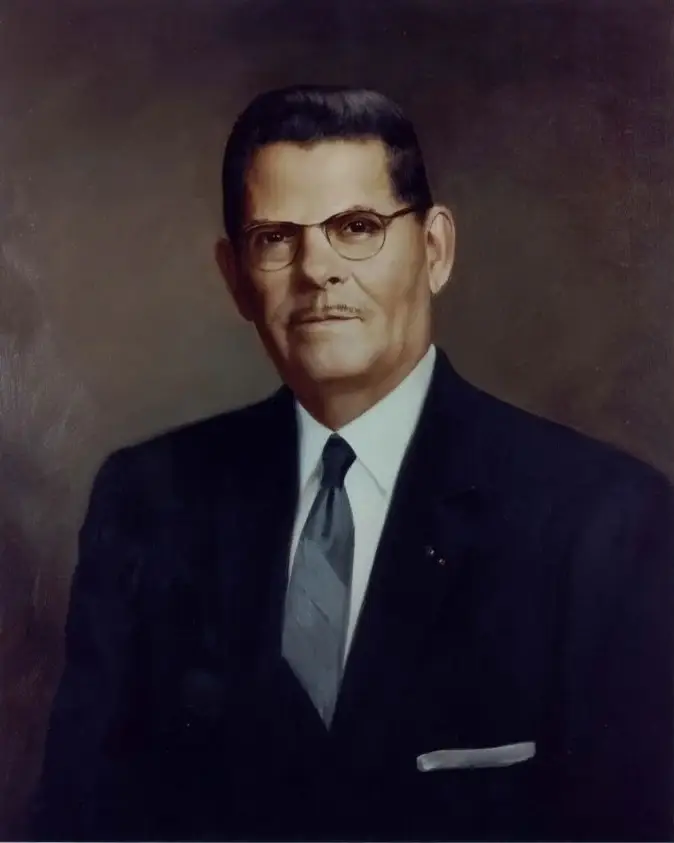
Born
September 14, 1895 · Blacksburg, Virginia
Died
1983 · San Antonio, Texas
Built Zone
1931 · San Antonio
Founded
Concept-Therapy Institute, 1949
Blacksburg to San Antonio
Thurman Fleet reached chiropractic at thirty-four, as a patient
Army medical authorities gave Fleet a year to live in 1929, and the documentary record of what followed is unusually complete. Joseph C. Keating, Jr. reconstructed it with Fleet's son, George T. Fleet, Jr., and presented the result to the Association for the History of Chiropractic in February 1997. Keating worked from Texas Chiropractic College enrollment files, the college yearbook, and the Concept-Therapy Institute's own papers, and every date in this account traces to one of those three.
The Virginia years and the sixth grade
George Thurman Fleet was born in Blacksburg, Virginia, on September 14, 1895. He grew up across several Virginia communities and completed the sixth grade. No further schooling appears anywhere in Keating's account. The man who later wrote textbooks and supervised a 317 acre campus carried six years of formal education.
The First Division, and the decorations Keating lists
Fleet served in France with the United States Army's 26th Infantry, First Division, in Pershing's Allied Expeditionary Forces. He arrived in Europe a sergeant and rose to captain through a battlefield commission. Keating lists his decorations as the Distinguished Service Cross, the Silver Star, the Purple Heart, and France's Croix de Guerre, and records his admission to the Legion of Valor on November 21, 1919. Through the 1920s Fleet earned his living selling meat display cases for the Weber Company. Keating credits that sales training directly for the seminar business Fleet built two decades later.
The 1929 prognosis, and the fifty-four years that followed it
Army medical authorities told Fleet in 1929 that wounds suffered in combat left him about a year to live. He went to a chiropractor in Corpus Christi, Texas, a Dr. Anderson, and began care. Fleet died in 1983 at the age of 88. The prognosis was wrong by fifty-four years, and Fleet spent every one of them working on the reason he believed it was wrong.
Texas Chiropractic College, entered twice
Harry A. Porter, a chiropractor who later practiced Logan Basic Technique, advised Fleet to enroll in 1930. Keating notes the discrepancy that follows: the Texas Chiropractic College enrollment record shows matriculation on May 28, 1931. Fleet's photograph in the 1931 yearbook, The Dixie-Chiro, carries a motto he spent the next decade proving to his mentor, "Where there is a will there is a way". He left before completing the course and practiced from his home in San Antonio, which was possible in what was then an unlicensed state. He returned in 1935 and received his diploma on June 1 of that year.
Drain's ten-year condition
James R. Drain made Fleet prove the method for ten years before he would hear it
Fleet formulated the principles that became his life's work in 1931 and took them straight to James R. Drain, president of Texas Chiropractic College and his mentor. Drain listened, then proposed that Fleet continue his informal investigations for ten years, and said he would spend more time with the new procedures afterward if Fleet still judged them worthwhile.
What sent Fleet looking in the first place
In his first years of practice Fleet followed his college methods closely. He grew concerned that his patients did not all respond equally well. That unevenness is the problem he set out to solve, and he attacked it by keeping detailed records of his patients' outcomes. Keating also documents a 1931 episode Fleet described as a "peak experience" bringing him into contact with a "cosmic consciousness," and dates the formulation of the principles to it. The clinical system and the philosophical system were born in the same year from the same event.
The Milam Building practice, 1932 to 1942
Fleet ran one of the largest chiropractic practices in Texas across those ten years. His total case load rose to 1,800 individuals, and the clinic recorded as many as 250 patient visits in a single day. By the mid-1930s it operated as the Universal Health Foundation from the sixth floor of the Milam Building in San Antonio. Volume on that scale is what made Drain's ten-year condition answerable.
The Department Store of Health
The Universal Health Foundation advertised in San Antonio newspapers under that name. A multi-disciplinary team of chiropractic and allopathic practitioners provided manipulative, medical, massage, physiotherapeutic, dietetic, and educational care to patients enrolled in a prepaid health program. A pamphlet handed to patients claimed Fleet had extracted the truth from every system of healing and combined it into one. Including a licensed medical practitioner, a Dr. Barker, gave Fleet and his chiropractic colleagues legal cover in unlicensed Texas. Local medical authorities prosecuted him repeatedly over his advertising, and Keating records that the medical profession eventually forced the clinic to close through politics.
What Drain said afterward
At the end of the ten years Fleet returned with thousands of signed affidavits and testimonials from his patients, many of them from people Drain knew by name. Drain granted him the audience and became the method's first prominent advocate. Fleet then had his patients' testimonials framed and delivered to the Texas Chiropractic College lawn by a two-ton truck.
For ten long years he practiced Concept-Therapy Chiropractic in San Antonio, and at the ten-year expiration he came to me with thousands of affidavits and testimonials, many of them from prominent people whom I knew.
James R. Drain, DC, president of Texas Chiropractic College, quoted in Keating and Fleet, Chiropractic History, 1997, volume 17, number 1, pages 57 to 65Six centers, 1931
Zone Technique holds that six control centers in the brain govern six body systems
Fleet drew the six zones in San Antonio in 1931, and the claim behind them is one no other chiropractic system makes. Every disturbance a body can suffer traces back to one of six centers, each governing a single major system. The Zone Technique page carries the full clinical method. Fleet first called the work Zone Therapy.
The six zones and the seats Fleet gave them
Zone one is glandular, seated in the cerebellum, covering the thyroid, adrenals, pituitary, pancreas, gonads, and every other secreting tissue. Zone two is eliminative, seated in the cerebrum, covering lungs, kidneys, bladder, bowel, sinuses, and skin. Zone three is nervous, also seated in the cerebrum, covering brain, cord, and peripheral nerves. Zone four is digestive, seated in the fourth ventricle. Zone five is muscular, seated in the cerebellum. Zone six is circulatory, seated in the caudate nuclei. Four anatomical sites carry all six centers, which is why the cerebrum and the cerebellum each hold two. Zone one's territory is the endocrine system, covered in full on the endocrine research page.
The reading happens at the base of the skull
Fleet put the analysis on the occiput. The practitioner palpates six points along the superior nuchal line, the bony ridge across the base of the head, with the patient lying face down, and each point reports on one center. An involved point reads denser and harder than the bone around it and is tender to the patient under pressure. The finding decides the target, and the head is rechecked at the end of the sequence. A point that read hard and tender should now read soft, and that change ends the procedure for that zone.
Twenty-four cord contacts, and force treated as incidental
Fleet taught that the body runs as an electrical machine with the brain at the positive pole and the spinal cord at the negative pole. Each zone owns four levels of the cord, which makes 24 contacts in all. Zone one is the exception where every level matches its number, running C1, T1, L1, and S1. Zone six runs C6, T2, T10, and L2. Elsewhere only the cervical contact follows the zone's own number, and the other three carry no arithmetic at all. The contact is light, nothing is twisted, and the classical form uses no high-velocity rotary thrust. A reset runs one to two minutes, and Zone clinics routinely schedule visits of two to five minutes end to end.
Pathway or controller
Fleet moved the fault upstream, into the instruction the brain sends
Zone Technique's one genuine addition to chiropractic in 1931 concerns the signal rather than its route. Most technique systems assume the brain is issuing a correct instruction and hunt for the place along the way where the message is degraded. Fleet held that the instruction leaving the brain can itself be wrong, and that the center issuing it is what needs correcting.
What follows from choosing the controller
That single move reorganizes everything downstream of it. If the fault sits in the pathway, the work is to find the interference and remove it. If the fault sits in the controller, the work is to reach the controller. Fleet chose the controller, and the occiput is where he decided the controller could be read. Every procedural feature of Zone Technique follows from that choice, including the indifference to how much force the contact carries.
Why the patient's complaint does not choose the zone
Fleet built the analysis so that the symptom has no vote. A patient reporting a digestive complaint may read on the glandular point, and the glandular sequence is what runs. That discipline seats the accuracy of the method in the assessment. Applied Kinesiology reaches the same conclusion from a muscle test, and H.I.O. Knee Chest reaches it from a cervical X-ray.
Concept-Therapy
Concept-Therapy was Fleet's philosophical system, and the Institute opened in 1949
Concept-Therapy teaches that a person is a triune being of body, mind, and soul, and that illness follows when the three fall out of harmony with one another. Drain published that summary of it in 1937. Fleet formulated it in the same 1931 work that produced the six zones, and the two arms of his output separate cleanly. Zone Technique is the clinical arm. Concept-Therapy is the body of thought around it.
The first class, May 1944
Fleet handed his San Antonio practice to Woodie H. Alexander, his one and only partner, and turned to teaching. In May 1944 he assembled twenty-five of the city's best known chiropractors for the first formal course in Concept-Therapy. He asked them to apply the system for two months and report back on whether it was worth recommending. Drain attended every lecture of that first class, applied the material to several difficult cases, and then granted Fleet permission to present the work to the Texas Chiropractic College faculty.
The 317 acre tract north of San Antonio
A 317 acre tract north of San Antonio was acquired in 1949 and became the Concept-Therapy Institute's international headquarters. Fleet chartered it as a not-for-profit, tax-exempt educational corporation, and it still operates in that form from Boerne Stage Road. Instruction reached chiropractors only in the earliest years. Demand from practitioners' spouses and office staff produced a second program for the general public, while the course titled Innate Principles and Practice stayed restricted to chiropractors.
Fleet's three-part classification of disease
Fleet took D.D. Palmer's three causes of subluxation, toxins, trauma, and auto-suggestion, and rebuilt them into a classification of disease as organic, structural, or functional. Keating also records that Fleet adopted a vibrational account of disease causation for some conditions, comparable to the radionics of Albert Abrams. The three-part classification is the durable piece, because it made the mental and behavioral origins of illness a routine part of the clinical question rather than a specialty interest.
Suggestive therapeutics, and the question Fleet answered
Fleet taught his followers a form of hypnotherapy and considered suggestive therapeutics essential to complete care. He knew the tension in doing so. D.D. Palmer had written that chiropractors correct abnormalities of the intellect as well as those of the body, and had also rejected Willard Carver's recommendation that suggestive therapeutics be included in chiropractic practice. Fleet sided with the first statement, held that doctors should use every rational method available to help patients, and advertised courses in suggestive therapy nationally into the 1960s.
What Keating concluded about Concept-Therapy
Keating credited Fleet with a practical, home-grown psychotherapeutics that anticipated in some respects what academic psychology later called cognitive behavior therapy. Concept-Therapy was also an early and well-organized form of holistic health care, both in its multi-factorial theory and in its treatment of the patient as the central agent in recovery. Keating judged it remarkable for anticipating the psychosocial models of illness that psychiatry and clinical psychology developed in the 1950s and 1960s. Fleet's philosophical text, Rays of the Dawn, remains in print through the Institute.
There isn't a doctor on the face of the earth that ever cured a disease. The doctor's part in the curing of disease is to bring the patient's body, mind and soul into a condition where nature may begin her cure.
Thurman Fleet, DC, Universal Health Foundation patient pamphlet, quoted in Keating and Fleet, Chiropractic History, 1997, volume 17, number 1, pages 57 to 65Fleet's Spinal Demonstrator
Fleet's Spinal Demonstrator reached the Smithsonian's Medical Sciences Collection
Fleet's Spinal Demonstrator was conceived in 1930, and a patent for it was sought in 1937. An early model was exhibited at the Texas Chiropractic College homecoming in 1938, and a later model was shown at the National Chiropractic Association convention in Dallas in 1939. Keating records that the device has been accepted for rotational display by the Smithsonian Institution's National Museum of American History for its Medical Sciences Collection. The Concept-Therapy Institute manufactures and sells it. It teaches patients, and it adjusts no one.
Why Fleet built the device
Fleet complained that the visual aids available to chiropractors were skeletal spine models, which he described as images of death used to teach healthy living. He wanted a model that showed a spine working. Advertisements for the Demonstrator ran in the National Chiropractic Journal from December 1940 and in the Digest of Chiropractic Economics through the 1960s, including full-page and rear-cover placements. Three decades of rear covers is what a device earns when it teaches patients rather than treats them.
The four-step course the device carried
The Demonstrator arrived inside a course in practice building and salesmanship that Fleet began teaching in the late 1930s. He partitioned the process of obtaining new patients into four steps: the approach, creating interest, creating desire, and the close. Purchasers received extensive reading materials elaborating those steps. Keating identifies this salesmanship program as the thing that first brought Fleet to nationwide attention among chiropractors, ahead of Concept-Therapy and ahead of the zones.
The Texas circle
Fleet's ideas traveled through the Texas Chiropractic College circle of the 1930s and 1940s
Zone Technique and Concept-Therapy did not spread on their own, and the people who carried them are named in the record. James R. Drain, the college president who imposed the ten-year wait, became an instructor in the system he had doubted and taught the post-graduate seminars alongside Fleet. Harry A. Porter, who had talked Fleet into enrolling in 1930, sat in the first Concept-Therapy class the college offered.
The early advocates Keating names
Among the early advocates of Concept-Therapy theories and procedures were Raymond L. Nimmo, James Parker, Leo Spears, Texas State Chiropractic Association president Hugh Warren, and the Texas Chiropractic College faculty members Charles B. Loftin, Julius C. Troilo, H.E. Turley, and Herbert E. Weiser. A 1946 photograph taken at Spears Hospital in Denver puts J.F. Vannerson, Drain, Fleet, and Nimmo in one frame, which places the doubter and the profession's coming soft-tissue pioneer inside Fleet's circle within two years of the first class. Many present-day adherents are second and third generation chiropractors from families that studied the material across decades.
Raymond Nimmo and the turn toward muscle
Fleet grew increasingly interested in the role of muscles in physical illness through his later years. Keating records that this interest may have influenced Raymond L. Nimmo's Receptor-Tonus work, which put sustained ischemic pressure on trigger points and became one of the profession's first soft-tissue systems. The muscular zone was already the fifth of Fleet's six, so the interest was continuous with the 1931 chart rather than a departure from it. Practice building and salesmanship shrank as a share of the curriculum over the same years, and Fleet's written output turned toward his ideas about the spirituality of man.
The tone reading
Fleet's analysis reads a control system, and that is where the Unified Model of Tone agrees with him
Fleet's contribution to the understanding of tone lives in the question his method asks first. The hand on the occiput is asking which regulatory system has left its range. The tissue that hurts has no standing in that question, and the answer decides where the input goes. The Unified Model of Tone holds that assessment rather than delivery is the seat of accuracy in any input, and Fleet wrote that position into a procedure in 1931.
D.D. Palmer had already pluralized tone across tissues
D.D. Palmer wrote on page 971 of The Chiropractor's Adjuster in 1910 that the quality of springing back is what tone means. He named three kinds in the same line: nerve tone, muscle tone, and arterial tone. Nerve, muscle, and artery are three of the six systems Fleet charted twenty-one years later. The model reads Fleet's six as an extension of the same move. Tone is one organizing state expressed through every tissue that has a state to express, and Fleet subdivided the body by which expression had drifted.
Six centers, and the model's answer of plural leverage
Fleet held that six centers govern the body, that each has a definite anatomical seat, and that correcting the center corrects the system it runs. The model holds that there is rarely a single lynchpin. Regulation is distributed across every tissue, a body ordinarily carries several points of critical tension at once, and the capacity of each to reorganize the whole shifts from one week to the next. A single-lynchpin account cannot explain why dozens of unrelated techniques, each naming a different lynchpin, all get results. Plural leverage can, and Fleet reached plural control centers decades before the model argued for it.
Correspondence rather than force
The model states the active ingredient of any input as correspondence to the leverage point, the place where a small input moves the whole system. Force applied to a compensating region deepens the defense, because tissue already at the limit of its capacity reads added load as further demand. Zone Technique is built along that line from the ground up. The entire method turns on six points of palpation. Once the reading is made, the delivery stops mattering, whether firm, light, or delivered by instrument. An audible release carries no weight, because the requirement is that the cord level was reached. The character of an input decides what the nervous system does with it, and the input quality page carries that research.
What the model predicts from a Zone reading
Fleet's practical claim is that resetting one center reaches an entire body system, and the model states that reach as a measurable prediction, with compensation deciding where the change shows. One well-matched input should move several separately regulated measures at once in the same person, because those measures are readings of one variable. Record an autonomic measure, an endocrine measure, and a tissue compliance measure before a single zone contact specified in advance. Record all three again afterward. Independent set points predict independent movement. The model predicts covariance, and the three measures sharing one direction of change after that single contact, at whatever pace compensation allows each of them, is what supports the unification claim. Coupling and set point carry the physiology behind that prediction.
Tone within range is health, and drift outside it is disease
Tone held within its working range is health, because a system with reserve keeps the flexibility to adapt to what arrives next. Tone that drifts or distorts outside that range is what manifests as illness. Fleet named six ways a body can be disturbed and no more, and the model names the same event once: a region's tone stops updating against what the body is actually reporting. Fleet located that failure in one of six seats. The model locates it wherever the updating has stopped, which is why dysautonomia presents across several systems at once.
The dated record
What the record shows about Thurman Fleet
Fleet completed the sixth grade, served in France with the 26th Infantry, First Division, and rose from sergeant to captain by battlefield commission. He took his chiropractic diploma from Texas Chiropractic College on June 1, 1935. Six years of schooling and one diploma are the whole of his formal preparation for the work that followed.
Between 1932 and 1942 Fleet ran a case load of 1,800 patients, with as many as 250 patient visits in a single day. The clinic was the Universal Health Foundation, on the sixth floor of the Milam Building in San Antonio. That volume is what allowed him to answer Drain's ten-year condition with thousands of signed affidavits.
Fleet drew the six zones in 1931 and gave each a named anatomical seat in the cerebrum, the cerebellum, the fourth ventricle, or the caudate nuclei. Twenty-four cord contacts, four per zone, carry the treatment side of the chart. The claim that a body can be disturbed in six ways and no more is what makes the method teachable in a weekend.
The first formal Concept-Therapy course ran in San Antonio in May 1944 for twenty-five chiropractors. The Concept-Therapy Institute was established on a 317 acre tract north of San Antonio in 1949 as a not-for-profit educational corporation. It has taught Fleet's clinical material continuously since, and its Zone Healing Master Course runs 113 hours with an 18 month completion window.
Fleet's Spinal Demonstrator was conceived in 1930, filed for patent in 1937, exhibited at the Texas Chiropractic College homecoming in 1938, and shown at the National Chiropractic Association convention in Dallas in 1939. Keating records the Smithsonian's National Museum of American History accepting it for rotational display in the Medical Sciences Collection, which is a rare piece of institutional recognition for a chiropractic teaching device.
Fleet died in 1983 at the age of 88 and was buried with full military honors at Fort Sam Houston National Cemetery. Peter Goldman, DC, learned Fleet's Zone Therapy in the early 1990s from several of Fleet's direct students and now teaches the modernized method through the Zone School of Healing in San Francisco.
The library web
How Thurman Fleet connects to the rest of the library
Zone Technique carries the full clinical method Fleet built, including the occipital reading, the 24 cord contacts, and Peter Goldman's modernization of the sequence.
The Unified Model of Tone defines the single state Fleet's six systems each report on, and explains why an input delivered anywhere in the loop propagates through the whole.
D.D. Palmer named nerve tone, muscle tone, and arterial tone in one line in 1910, which is three of Fleet's six systems written twenty-one years before Fleet charted them.
Hugh Logan shares Fleet's Texas circle through Harry A. Porter, and shares the conviction that ounces delivered at the right place beat pounds delivered anywhere else.
H.I.O. Knee Chest names one bone as the governing site where Fleet named six centers, and the pair frames the leverage question more sharply than any other in the index.
Neuro-Emotional Technique is the closest modern neighbor to the mental side of Fleet's system, and reaches the same clinical territory in physiological vocabulary where Fleet used philosophical.
The Nervous System covers the cord, the brainstem, and the autonomic architecture Fleet's six centers were built to govern.
The autonomic nervous system is where the model's account of distributed regulation is worked out in measurable terms, and it is the physiology Fleet was reaching for with an electrical metaphor and no instruments.
Questions people ask
Common questions about Thurman Fleet
What did Thurman Fleet contribute to the understanding of tone?
Fleet contributed the priority of the reading. His method asks which regulatory system has left its range before it asks anything about the tissue that hurts, and the answer decides where the input goes. The Unified Model of Tone holds that the seat of accuracy in any input is the assessment rather than the delivery. Fleet wrote that position into a working procedure in 1931 and taught it as six control centers read at the base of the skull.
Who was Thurman Fleet?
George Thurman Fleet was an American chiropractor, born in Blacksburg, Virginia, on September 14, 1895, and died in 1983 at the age of 88. He built Zone Technique in San Antonio in 1931, ran one of the largest chiropractic practices in Texas between 1932 and 1942, and founded the Concept-Therapy Institute in 1949. He completed the sixth grade, served in France in the First World War, and took his chiropractic diploma from Texas Chiropractic College in 1935.
What is Zone Technique?
Zone Technique is the chiropractic method Fleet built in 1931. It holds that six centers in the brain govern six body systems, glandular, eliminative, nervous, digestive, muscular, and circulatory, and that every disturbance traces to one of them. The practitioner palpates six points along the ridge at the base of the skull to find the center out of balance, then stimulates four mapped levels of the spinal cord to reset it. Visits often run under five minutes.
How does Concept-Therapy differ from Zone Technique?
Both came out of Fleet's 1931 work, and they occupy different ground. Zone Technique is the clinical arm, a hands-on method built on six brain centers and 24 spinal cord contacts. Concept-Therapy is the philosophical system, teaching that a person is a triune being of body, mind, and soul and that illness follows when the three fall out of harmony. Fleet taught the first formal Concept-Therapy course in May 1944 and founded the Institute in 1949.
Did Thurman Fleet serve in the First World War?
Yes, and the record is specific. Joseph Keating documents that Fleet served in France with the United States Army's 26th Infantry, First Division, arriving as a sergeant and rising to captain by battlefield commission. His decorations included the Distinguished Service Cross, the Silver Star, the Purple Heart, and the Croix de Guerre, and the Legion of Valor admitted him on November 21, 1919. Army medical authorities told him in 1929 that his combat wounds left him roughly a year to live.
Where can Fleet's work be studied today?
Two organizations hold different parts of it. The Concept-Therapy Institute has taught the material continuously from north of San Antonio since 1949, remains custodian of Fleet's own texts and charts, and runs the Zone Healing Master Course at 113 hours. Peter Goldman, DC, learned Zone Therapy in the early 1990s from several of Fleet's direct students and teaches the modernized method through the Zone School of Healing from his San Francisco practice.
Sources
Sources for this page
- Keating JC Jr, Fleet GT Jr. Thurman Fleet, D.C. and the early years of the Concept-Therapy Institute. Chiropractic History. 1997 Jun;17(1):57-65. Presented to the Association for the History of Chiropractic, Texas Chiropractic College, February 23, 1997. Presentation notes. The primary scholarly source for Fleet's biography, the practice figures, and the quoted material.
- Keating JC Jr. Chronology of Thurman G. Fleet, D.C. and the Concept Therapy Institute. National Institute of Chiropractic Research. Chronology. Dated index of Fleet's advertising and authorship in the National Chiropractic Journal and the Digest of Chiropractic Economics, 1939 to 1979.
- Palmer DD. The Chiropractor's Adjuster: The Science, Art and Philosophy of Chiropractic. Portland Printing House Company; 1910: p. 971. The passage naming nerve tone, muscle tone, and arterial tone, and defining tone as the quality of springing back.
- Fleet T. Rays of the Dawn: Laws of the Body, Mind, Soul. San Antonio: Concept-Therapy Institute. Internet Archive record for the 1976 printing, 166 pages, OCLC 6241224. Fleet's philosophical text, still published by the Institute.
- Concept-Therapy Institute. About the Institute and Zone Healing Master Course. The 1949 founding, the Boerne Stage Road campus, and the 113 hour clinical curriculum with an 18 month completion window.
- The chiropractic Zone Technique. Chiropractic Economics, 2018. Article. Contemporary description of the six zones, the electrical framing, and the cord contact scheme.
- Zone School of Healing. Practitioner training. Peter Goldman, DC, on the modernized Zone Technique, the occipital reading, and the certification curriculum.
- Korr IM. The neural basis of the osteopathic lesion. J Am Osteopath Assoc. 1947;47(4):191-8. The facilitated segment, the mechanism by which a spinal level delivers sustained autonomic amplification to the tissues it serves.
This page is history and education. It is not medical advice, and nothing here is a promise of outcome. Consult a licensed practitioner about your own condition.