
Our Approach · The Legends · Era IV
Era IV · 1927 to 2022
Roy W. Sweat
The Orthogonist
Roy W. Sweat (1927 to 2022) was the Atlanta chiropractor who made the atlas adjustment a computation. Sweat trained under John F. Grostic, took the delivery problem to Georgia Tech physicists and engineers in 1970, and patented a percussion instrument that sends an impulse wave down a stylus that barely moves. Three radiographs set one vector before the patient is touched. The Unified Model of Tone reads Atlas Orthogonal as its own claim in another vocabulary: specificity is mathematics before it is muscle.
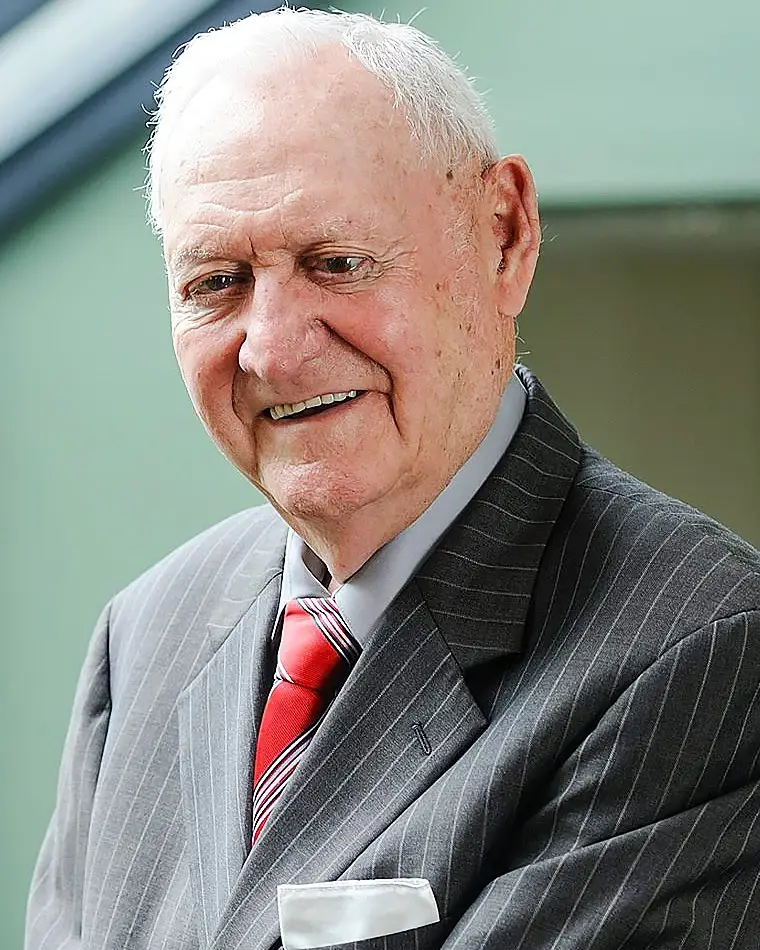
Born
June 25, 1927 · Albany, Georgia
Died
January 2, 2022 · Atlanta, Georgia
Trained under
John F. Grostic, from 1952
Founded
Atlas Orthogonality · Society of Chiropractic Orthospinology
Instrument
US Patent 4,461,286 · FDA 510(k) K951217
Taught
Life, Sherman, and Palmer colleges
Albany to Davenport
Roy Sweat came to chiropractic out of the Navy and kept one practice for sixty-nine years
Roy Warren Sweat was born on June 25, 1927 in Albany, Georgia. He finished Albany High School in 1944, volunteered for the United States Navy the same year, and served in the Pacific until 1946. In January 1947 Sweat enrolled at the Palmer School of Chiropractic in Davenport, Iowa. He graduated in January 1950.
Sweat kept the same Atlanta practice from 1953 until his death
Sweat opened his own practice in April 1953, three years out of Palmer. He moved it from Decatur to Chamblee Tucker Road in Atlanta in 1978 and never moved it again. He worked six days a week into his nineties. At his death on January 2, 2022, at the age of 94, Sweat held the oldest active chiropractic license in the state of Georgia.
The upper cervical question Sweat walked into in 1950
The atlas is the hardest segment in the body to contact accurately, and in 1950 the profession was still correcting it by hand and judging the result by feel. Sweat walked into that problem at Palmer, where B.J. Palmer's upper cervical argument held that the atlas and the axis govern the rest of the spine. Sweat accepted the premise and inherited the problem attached to it. H.I.O. Knee Chest was the first systematic answer to it, and Sweat's method descends from that line.
What Sweat studied after Palmer shows up inside Atlas Orthogonal
Videofluoroscopy training gave Sweat moving imaging at a time when upper cervical analysis ran entirely on static film, and every decision in Atlas Orthogonal is made from an image. He took that certificate at Life Chiropractic College and completed a three-year orthopedic study program at National Chiropractic College, which supplied the differential screen the method runs before it touches anyone. He was president of the Georgia Chiropractic Association from 1969 to 1970.
Ann Arbor, 1952
John F. Grostic taught Sweat that the atlas is a measurement problem
Sweat began studying under John F. Grostic in Ann Arbor, Michigan in 1952, two years after graduating. Grostic was born on October 9, 1907, graduated from the Palmer School in 1933, and practiced in Ann Arbor until his death on October 31, 1964. Grostic had built an upper cervical system on precisely aligned radiographic equipment and angular measurement of the atlas. That discipline is what Sweat carried to Atlanta.
Grostic died in 1964 and the work passed to the doctors he had trained
Grostic died on October 31, 1964, four years after naming Sweat a seminar instructor, and the teaching organization passed to the doctors he had trained. Sweat was among the few who carried it forward. Ralph R. Gregory took the same inheritance in a different direction and incorporated the National Upper Cervical Chiropractic Association on April 16, 1966. Gregory and Grostic covers the partnership both branches came from.
The Grostic measurement claim was tested on 523 of his own case records
The founder's son, John D. Grostic, and Kenneth F. DeBoer drew 523 case records at random from John F. Grostic's files and compared atlas position before and after adjustment. The study appeared in the Journal of Manipulative and Physiological Therapeutics in 1982. Mean deviation from zero ran 2.75 degrees of rotation and 2.63 degrees of laterality before the adjustment, and rotation fell to 1.43 degrees afterward. The two Grostics are routinely confused. The founder is John F. Grostic, and his son John D. Grostic published the dentate ligament cord distortion hypothesis in 1988.
Sweat adjusted the atlas by hand for two decades before he changed the delivery
Between the 1950 graduation and the instrument work of 1970, Sweat corrected the atlas the way Grostic taught it, with a hand. Twenty years of that produced a specific complaint. The analysis was reproducible and the delivery was not. Two doctors reading the same films could compute the same vector and still deliver two different corrections, because a hand adds its own variables to every contact.
Ninety degrees
Orthogonal names a target Roy Sweat could state as a number
Orthogonal is an engineering word meaning at right angles, and inside Atlas Orthogonal it names one arrangement. The center of the skull sits over the center of the lower cervical spine, both center lines run perpendicular to the floor, and the plane of the atlas runs parallel to that floor. Sweat held that any deviation from that arrangement is measurable in degrees rather than describable in words.
The atlas has no disc and no interlocking facets, which is why its position moves
The segment Sweat's analysis targets sits under a joint with no disc, and the atlas is the most freely movable bone in the spine. Nothing wedges it into place. The atlanto-axial joint below it supplies 45 to 50 percent of all rotation in the neck. Stability comes instead from the weight of the head, the shape of the articular surfaces, and the surrounding muscles and ligaments. A healthy synovial joint has a coefficient of friction near 0.005, roughly that of ice on ice. A joint with that little friction changes position under a small, correctly directed force, which is the premise Sweat's whole method rests on.
Sweat measured angles rather than distances, and the choice was deliberate
Linear measurements taken off a radiograph inherit the magnification error of the beam. Angular measurements do not. Two board-certified chiropractors marking 254 conventional orthogonal radiographic film sets agreed on the side of atlas laterality 96.1 percent of the time. The intraclass correlation was 0.95 for laterality and 0.92 for rotation. Landholm-Duvall and colleagues published those figures in the Journal of Chiropractic Medicine in 2023. The analysis Sweat inherited holds between examiners, which is the precondition for computing a vector at all.
Measurement on the atlas has a floor, and Sherman College measured it
The left and right sides of the same atlas bone differ by about a millimeter, which sets the floor under any measurement of the segment. Hart and colleagues radiographed ten natural atlas specimens in a 2009 Sherman College study and had two independent examiners analyze them. The mean bilateral difference was 0.96 millimeters, with a standard deviation of 0.67 millimeters. The authors concluded that a lateral disposition of about 1.6 millimeters should be allowed as ordinary asymmetry before a clinician calls it a misalignment. Sweat's degree-based system carries that floor with it.
Georgia Tech, 1970
Sweat took the delivery problem to physicists and had them build a machine
In 1970 Sweat brought the atlas correction to physicists and engineers at the Georgia Institute of Technology. He asked for an instrument that could deliver a computed vector with no hand in the loop. What came back was a percussion device. Seven generations of it followed, along with purpose-built radiographic equipment, marking templates, and computerized film analysis.
The patent describes an instrument that moves a wave and not a rod
Sweat's United States patent, number 4,461,286, titled Chiropractic instrument, was filed on March 15, 1982 and granted on July 24, 1984. It is the only United States patent indexed under his name. An elongated hollow housing carries a thrust pin, stepped down at its outer end into the narrow stylus that touches the patient. A compression spring drives a percussion device into the inner end of that pin. A releasable latch pin seats in one of four notches along a slot, and which notch it occupies is the only force control on the device.
to establish an impulse wave along the length of said thrust pin without imparting significant bodily movement thereto
Roy W. Sweat, US Patent 4,461,286, Chiropractic instrument, granted July 24, 1984Five ounces and four pounds
The numbers written into Sweat's patent are small on purpose
The percussion device inside the Atlas Orthogonal instrument weighs about five ounces. The rest of that mechanical instrument weighs about 1.7 pounds, and its maximum spring force is about four pounds. The later solenoid-driven model Sweat described in 1995 weighs 1.8 pounds and produces 3 to 6 pounds of thrust. Sweat called the result a percussion instrument with zero excursion, because the stylus carries a wave into the tissue and stays where it is.
Eugene Patronis of Georgia Tech wrote the physics down
Eugene T. Patronis Jr. of the School of Physics at the Georgia Institute of Technology supplied the mechanical description Sweat published in Chiropractic Products in October 1995. The plunger excites a compressional wave in the Atlas Orthogonal stylus. The speed of that wave through the metal is set by the square root of the ratio of the stylus material's Young's modulus to its density. Where the stylus meets the skin, the impedance match decides how much of the wave energy passes into the patient and how much reflects back down the rod.
The patent argues a safety case against the instruments that came before it
Sweat's filing describes prior adjusting instruments as devices whose thrust pin moves bodily into the patient, and names injury as the risk that follows. His own design puts the energy into a wave and leaves the rod where it is. Sweat filed that claim in a patent application, where an examiner tested it.
Such prior art devices may sometimes cause injury to the patient being treated because the degree and force of movement of the thrust pin may cause injury.
Roy W. Sweat, on the adjusting instruments that preceded his, US Patent 4,461,286, 1984Clearance, 1995
The Atlas Orthogonal percussion instrument was 510(k) cleared in 1995, and clearance is not approval
The Food and Drug Administration cleared the Atlas Orthogonal percussion instrument on November 21, 1995 under 510(k) number K951217. The application was received on March 17, 1995. The decision is recorded as substantially equivalent, and the reviewing panel was Physical Medicine.
What a 510(k) decision actually settles
A 510(k) is a finding of substantial equivalence to a device already legally on the market. It is a clearance rather than an approval, and the two words describe different regulatory pathways. No chiropractic adjusting instrument has ever been approved by the Food and Drug Administration.
Where K951217 sits in its category
Chiropractic adjusting instruments are filed under product code LXM, classification name Manipulator, Plunger-Like Joint. Thirty-two LXM clearances sat in the database as of August 2026. The first was the Precision Spinal Adjuster in April 1988. Sweat's instrument was the tenth, cleared one day after the Model 8000 Atlas C-1 Orthogonal Adjusting Instrument and about five months before the Integrator.
Sweat filed it himself, from his own clinic address
The Activator clearances were filed by Activator Methods International, and the Integrator by Moyco Union Broach. Sweat filed his own. Both the applicant and the correspondent on K951217 are Sweat Chiropractic Clinic at 3274 Buckeye Road NE in Atlanta, and the file names Roy W. Sweat as the contact for each. He was forty-two years into a career he ran out of one office.
Minimum force, 1988
Roy Sweat argued the minimum-force case in print and then tested his own examination
Sweat published his position on force in February 1988, under the title Minimum Force vs. Moderate Force in the Occipital-Atlanto-Axial Subluxation Complex, in The American Chiropractor. He concluded that the atlas requires minimal depth, low force, and specific angles of correction. The displacement involved in an upper cervical correction, by hand or by instrument, runs from about a sixteenth of an inch to a quarter of an inch.
Three to six pounds against 40 to 120 newtons
Manual cervical manipulation delivers several times the peak force of Sweat's instrument. Pickar's 2002 review in The Spine Journal put preload forces in cervical manipulation between 0 and roughly 50 newtons. Peak impulse forces ran from roughly 40 to 120 newtons, over impulse durations of roughly 30 to 120 milliseconds. Three to six pounds of thrust is about 13 to 27 newtons. Sweat's instrument sits below the bottom of that range because its accuracy is carried by the radiographic analysis rather than by the thrust.
Sweat put his own examination through a reliability test in the same year
Sweat, G.K. Robinson, Charles Lantz and M. Weaver published an interexaminer reliability study of scanning palpation in Digest of Chiropractic Economics in 1988. Scanning palpation is the pre-adjustment check that rates tenderness at the nerve exit points beside C1 and C2 on a 0 to 3 scale, side by side. Sweat held his own hands-on examination to the reproducibility standard he demanded of the films, and he published that test in the year he published the force argument.
The program and the board
Sweat built the institutions that carried Atlas Orthogonal past him
Sweat organized the Society of Chiropractic Orthospinology in 1977 out of the Grostic teaching organization. He established Chiropractic Atlas Orthogonality in 1980, and in 1981 created the post-doctoral certification seminar sequence that still carries the method. Board Certification in Atlas Orthogonality runs through Sherman College of Chiropractic in Spartanburg, South Carolina, which lists Atlas Orthogonal among its elective techniques and hosts the certification modules.
Sweat was an associate professor at Life, and the program reached three colleges
Sweat held an associate professorship at Life Chiropractic College in Marietta, Georgia, the school that became Life University in 1996 and is printed as his affiliation on a paper he co-authored in 2018. Atlas Orthogonality is taught at Palmer, Life and Sherman. Transmission of the method ran through the certification board more than through any college curriculum, which is why the seminar sequence outlived him intact.
Four books, thirty articles, and a paper published at ninety-three
Sweat wrote four books on the method and roughly thirty articles for the chiropractic press. The sixth edition of his Atlas Orthogonal Chiropractic Program was published in Atlanta in 2007. In 2018, at the age of ninety-one, he co-authored a case report on vascular ultrasound measurement after Atlas Orthogonal care in the Journal of Chiropractic Medicine. In 2020, at ninety-three, he co-authored a paper on craniocervical misalignment presenting as facial pain in Cranio, with Angelo Colavita and his son Matthew H. Sweat. Ierano and Richards carried the method into Explore in 2024 with a five-patient, eight-week case series.
The honors, and who holds the work now
Palmer College gave Sweat the Daniel David Palmer Scientific Award on June 9, 1995. The World Chiropractic Alliance named him Researcher of the Year in 1999. He received the William M. Harris Lifetime Achievement Award in 2003, and the B.J. Palmer Lifetime Achievement Award from the ICA Council on Upper Cervical Care in 2018. The Sweat Institute in Atlanta is still the founder's own clinic, run by Matthew H. Sweat. The R.W. Sweat Foundation funds research and teaching, and the Global Atlas Orthogonal Chiropractic Program maintains the practitioner directory and the instrument line.
The dated record
Ten dated facts about Roy W. Sweat, with the source for each
Born June 25, 1927 in Albany, Georgia. Died January 2, 2022 in Atlanta, at the age of 94. International Chiropractors Association.
Volunteered for the United States Navy in 1944 and served in the Pacific until 1946. Kentucky Association of Chiropractors.
Enrolled at the Palmer School of Chiropractic in January 1947 and graduated in January 1950. International Chiropractors Association.
Began study under John F. Grostic in Ann Arbor in 1952, and was chosen as a Grostic seminar instructor in 1960. International Chiropractors Association.
President of the Georgia Chiropractic Association, 1969 to 1970. Kentucky Association of Chiropractors.
Worked with physicists and engineers on the adjusting instrument in 1970, and moved his practice to Chamblee Tucker Road in Atlanta in 1978. Kentucky Association of Chiropractors.
Organized the Society of Chiropractic Orthospinology in 1977. Established Chiropractic Atlas Orthogonality in 1980, and created the post-doctoral certification sequence in 1981. International Chiropractors Association.
United States Patent 4,461,286, Chiropractic instrument, filed March 15, 1982 and granted July 24, 1984. United States Patent and Trademark Office.
FDA 510(k) K951217, received March 17, 1995 and cleared November 21, 1995 as substantially equivalent under product code LXM. Food and Drug Administration device database.
Daniel David Palmer Scientific Award, June 9, 1995. World Chiropractic Alliance Researcher of the Year, 1999. William M. Harris Lifetime Achievement Award, 2003. B.J. Palmer Lifetime Achievement Award, ICA Council on Upper Cervical Care, 2018. International Chiropractors Association.
Sweat and the model
Roy Sweat's contribution is that specificity is mathematics before it is muscle
Sweat moved accuracy out of the hands and into the measurement. He put every decision in the adjustment upstream of the contact, into three measured radiographs and a pair of protractor settings. Then he took the hand out of the delivery so it could not add anything back. The Unified Model of Tone reaches the same claim from the other direction. Specificity is correspondence between an input and the pattern the body is holding, and it is a property of the reading rather than of the hands.
A percussion input below the threshold of feeling still changes the body
Three to six pounds at a stylus is close to the smallest input a chiropractor can deliver on purpose. That force attenuates across an impedance boundary and moves a joint with a coefficient of friction near 0.005, through a displacement of about a sixteenth of an inch. Sweat held that it is enough. The nearest measured record comes from NUCCA, the hand-delivered branch of the same Grostic lineage. Bakris and colleagues randomized 50 patients with Stage 1 hypertension to a NUCCA correction or a sham. At eight weeks systolic pressure had fallen 17 mmHg in the treated group against 3 mmHg in the sham group. Lateral atlas displacement had moved from 1.0 degrees at baseline to 0.04 degrees.
A restoring input moves a measure toward the middle, and the pulse pressure data show it
The model's signature for a restoring input is direction. An input that restores regulation moves a measure toward the body's own middle from whichever side it started, and narrows the spread across a group. An input that pushes shifts everyone the same way. Kessinger and colleagues followed 130 patients across five clinics through six weeks of upper cervical care, sorted by starting pulse pressure. The group starting above 49 mmHg fell 8.9 mmHg, at an effect size of 0.8. The low and medium groups did not change significantly. That is the direction signature the model predicts, and a pushing input would have moved all three groups together. High Blood Pressure and the Nervous System covers the regulation those pressure readings measure.
The variable underneath the geometry is tension
Sweat aimed at the position of a bone. The model holds that position is the readout and tension is the variable. Alf Breig established that the spinal cord is a tensioned structure, and that raised tension carries the primary neurophysiological consequence rather than compression. A 2026 finite element study put that claim in Atlas Orthogonal's own units. Verderame and colleagues took the axial spinous rotation, atlas frontal plane and cervical spine angles from four pre-correction and post-correction radiographic sets, then ran them through a validated model of C0 to C7. Alignment correction produced reductions in spinal cord stress of 15 to 35 percent and in strain of 18 to 40 percent, and larger rotational corrections produced larger reductions. The degrees Sweat marked on film track the tension state of the cord and its membranes.
The suboccipital anatomy is why a small upper cervical input reaches the whole system
The tissue Sweat's stylus contacts reports position rather than producing force. Kulkarni, Chandy and Babu counted muscle spindles in the suboccipital muscles of stillborn human fetuses in 2001. They reported 190 spindles per gram in obliquus capitis superior and 242 per gram in obliquus capitis inferior. No tendon organs were found. Those receptors project into the balance and eye movement centers of the brainstem. Hack and colleagues described a connective tissue bridge from the rectus capitis posterior minor to the dorsal spinal dura at the atlanto-occipital junction in 1995, present in all eleven cadaveric specimens. The contact Sweat made below the earlobe lands on a dense proprioceptive field with a mechanical line into the dura. Proprioception and Interoception covers the receptor traffic that contact is aimed at.
Where the model goes past what Sweat held
Sweat held that the atlas governs what happens below it. He built seven instrument generations and a certification board on that proposition and never widened it. The model holds that there is no single lynchpin. A body ordinarily carries several points of critical tension at once. At each one, local tone is stuck and no longer updates against what the rest of the body reports. Each carries a different capacity to reorganize the whole, and that capacity shifts with the system's state from one week to the next. That plural reading explains why the atlas, the sacrum and one restricted segment can all be genuine places to reach the same nervous system. Tone held within its healthy range is health, because the range preserves the ability to adapt. Tone that drifts or distorts outside it is what shows up as illness.
Where Roy Sweat sits in this library
Atlas Orthogonal carries the three film views, the listing, the instrument settings and the force numbers in working detail. Gregory and Grostic covers the lineage Sweat trained in and the split that produced three orthogonal methods. NUCCA reads the same three films and answers them with a hand, which isolates the instrument as the only real variable between the two. Activator Methods and Directional Non-Force Technique reached the same low end of the force axis without radiographs. B.J. Palmer made the upper cervical argument first and hardest. The Nervous System covers the suboccipital spindles, the brainstem nuclei and the dural mechanics this contact reaches. Tone defines the variable every one of these techniques is working, and the index of 33 techniques places Atlas Orthogonal among the upper cervical and instrument-based methods.
Questions people ask
Common questions about Roy W. Sweat
What did Roy Sweat contribute to the understanding of tone?
Sweat contributed the claim that accuracy belongs to the measurement rather than to the hands. From 1970 he built seven generations of an instrument that fires along a line computed from three radiographs, so the doctor's skill is spent on marking and positioning instead of on the contact. The Unified Model of Tone holds that specificity is correspondence between an input and the pattern the body is holding, and that assessment rather than delivery is where accuracy lives. Sweat built the clinical machine for that position.
Who was Roy W. Sweat?
Roy Warren Sweat was an American chiropractor, born in Albany, Georgia on June 25, 1927 and died in Atlanta on January 2, 2022 at the age of 94. He graduated from the Palmer School of Chiropractic in January 1950, studied under John F. Grostic from 1952, and opened an Atlanta practice in April 1953 that he kept for sixty-nine years. He founded Atlas Orthogonal and patented the percussion instrument it uses.
Did Roy Sweat invent the Atlas Orthogonal instrument, and is it FDA approved?
Sweat developed the instrument with physicists and engineers in 1970 and was granted United States Patent 4,461,286, filed March 15, 1982 and issued July 24, 1984. The Food and Drug Administration cleared the Atlas Orthogonal percussion instrument on November 21, 1995 under 510(k) number K951217, with Sweat Chiropractic Clinic as the applicant. A 510(k) is a clearance by substantial equivalence, not an approval. No chiropractic adjusting instrument has ever been FDA approved.
How did John Grostic influence Roy Sweat?
Sweat began studying under John F. Grostic in Ann Arbor, Michigan in 1952, and Grostic chose him as a seminar instructor in 1960. Grostic had built an upper cervical system on aligned radiographic equipment and angular measurement of the atlas, and that measurement discipline is what Sweat carried to Atlanta. Grostic died on October 31, 1964. Sweat organized the Society of Chiropractic Orthospinology in 1977, and Ralph Gregory took the same inheritance into NUCCA in 1966.
How much force does the Atlas Orthogonal instrument deliver?
The patent sets maximum spring force at about four pounds, and the solenoid-driven model Sweat described in 1995 produces 3 to 6 pounds of thrust, which is roughly 13 to 27 newtons. Pickar's 2002 review put peak forces in manual cervical manipulation between roughly 40 and 120 newtons. The stylus barely travels. It carries a compressional wave into the tissue, which is why Sweat called it a percussion instrument with zero excursion.
Why did Roy Sweat replace the hand with an instrument?
Sweat adjusted the atlas by hand for two decades after graduating in 1950, working from Grostic's radiographic analysis. The analysis was reproducible and the delivery was not, because a hand adds its own variables to every contact. In 1970 he had physicists and engineers build a machine that fires along a line set by protractors from the film. His patent also makes a safety argument, describing instruments that drive the thrust pin bodily as devices that can injure a patient.
Sources
Sources for this page
- International Chiropractors Association. Remembering Dr. Roy Sweat, Upper Cervical Legend. chiropractic.org. The dates, the Navy service, the Grostic study, the seven instrument models and the awards.
- Kentucky Association of Chiropractors. Obituary: Dr. Roy Sweat, DC, BCAO. January 11, 2022. thekac.org. The Georgia Chiropractic Association presidency, the 1978 move to Chamblee Tucker Road and the later credentials.
- Sweat RW. Chiropractic instrument. United States Patent 4,461,286. Filed March 15, 1982, granted July 24, 1984. Full text. The four-notch latch, the five-ounce percussion device and the impulse wave claim.
- United States Food and Drug Administration. 510(k) Premarket Notification K951217, Atlas Orthogonal Percussion Instrument. FDA device database. Applicant Sweat Chiropractic Clinic, contact Roy W. Sweat. Cleared November 21, 1995 as substantially equivalent under product code LXM.
- Grostic JD, DeBoer KF. Roentgenographic measurement of atlas laterality and rotation: a retrospective pre- and post-manipulation study. J Manipulative Physiol Ther. 1982;5(2):63-71. PMID 7119594. 523 case records from John F. Grostic's own files.
- Landholm-Duvall J, Hasick DG, Ndetan H, Hart JF, Dickholtz M Jr, Lapenski CP. Inter-Examiner Agreement of the National Upper Cervical Chiropractic Association Analysis of the Atlas Subluxation Complex in a 3-View Upper Cervical Radiographic Series. J Chiropr Med. 2023;22(3):189-196. PMID 37645000. 254 film sets, 96.1 percent agreement.
- Hart J, Christopher M, Boone R. Asymmetry in atlas bone specimens: a pilot study using radiographic analysis. J Chiropr Med. 2009;8(2):72-6. PMID 19646389. Ten atlas specimens, mean bilateral difference 0.96 millimeters.
- Pickar JG. Neurophysiological effects of spinal manipulation. Spine J. 2002;2(5):357-71. PMID 14589467. The measured force ranges for manual cervical manipulation.
- Bakris G, Dickholtz M Sr, Meyer PM, et al. Atlas vertebra realignment and achievement of arterial pressure goal in hypertensive patients: a pilot study. J Hum Hypertens. 2007;21(5):347-52. PMID 17252032. 50 patients, sham controlled, systolic fall of 17 mmHg against 3 mmHg.
- Kessinger R, Qualls T, Hart J, Dallies H, Anderson M, Wayland J, Bradshaw L. Pulse pressure findings following upper cervical care: a practice-based observational study. J Can Chiropr Assoc. 2019;63(1):51-58. PMID 31057178. 130 patients, the high group falling 8.9 mmHg.
- Verderame J, Arslan MS, Mukhtar F, Abbas Z. Finite element analysis of cervicomedullary stress and strain in atlas orthogonal correction using radiographic rotational inputs: A multi-case study. J Bodyw Mov Ther. 2026;47:260-265. PMID 42264803. Cord stress down 15 to 35 percent.
- Kulkarni V, Chandy MJ, Babu KS. Quantitative study of muscle spindles in suboccipital muscles of human foetuses. Neurol India. 2001;49(4):355-9. PMID 11799407. Spindle densities measured in stillborn fetal specimens.
- Hack GD, Koritzer RT, Robinson WL, Hallgren RC, Greenman PE. Anatomic relation between the rectus capitis posterior minor muscle and the dura mater. Spine. 1995;20(23):2484-6. PMID 8610241. The bridge was found in all eleven specimens.
- Rectenwald RJ, DeSimone CM, Sweat RW. Vascular Ultrasound Measurements After Atlas Orthogonal Chiropractic Care in a Patient With Bow Hunter Syndrome. J Chiropr Med. 2018;17(4):231-236. PMID 30846915. Sweat as co-author at ninety-one, carrying his Life University affiliation.
- Vita LR, Colavita A, Sweat RW, Sweat MH, Vitez C. Craniocervical Misalignment Masquerading as Facial Pain: Options for Diagnosis and Management. Cranio. 2020;38(6):351-354. PMID 33044901. Sweat's last indexed paper, published at ninety-three.
- Ierano JJ, Richards DM. Atlas orthogonal chiropractic management of trigeminal neuralgia: A series of case reports. Explore (NY). 2024;20(1):70-78. PMID 37344335. Five patients, eight weeks, the method in the indexed literature.
- Sherman College of Chiropractic. Chiropractic Techniques at Sherman College. sherman.edu. Atlas Orthogonal is listed among the elective techniques, and the college hosts the certification modules.
- Sweat RW. Minimum Force vs. Moderate Force in the Occipital-Atlanto-Axial Subluxation Complex. The American Chiropractor, February 1988:22-24. Sweat's own statement of the minimum-force position.
- Sweat RW, Robinson GK, Lantz C, Weaver M. Scanning Palpation of the Cervical Spine Interexaminer Reliability Study. Digest of Chiropractic Economics. 1988;30(4):14-18. Sweat testing his own pre-adjustment examination.
- Sweat R, editor. Atlas Orthogonal Chiropractic Program. 6th ed. Atlanta, GA; 2007. The method in the founder's own text.
This page is history and education. It is not medical advice, and nothing here is a promise of outcome. Consult a licensed practitioner about your own condition.