
Our Approach · The Legends · Era III
Era III · 1909 to 1995
J. Clay Thompson
The Mechanic
J. Clay Thompson (1909 to 1995) invented the chiropractic drop table. Filing as Joseph Clay Thompson of Davenport, Iowa, he patented an adjusting method in 1955 and a segmented full spine table whose sections fall a fraction of an inch under the thrust. He paired the furniture with the Derifield leg check, a posture reading taken at the ankles. The Unified Model of Tone reads both as one claim: inertia can replace force, and a leg length that moves under positional stress is tone reporting itself.
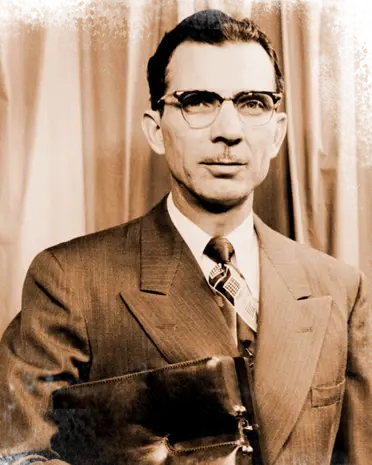
Born
1909 · Hartville, Wyoming
Died
1995 · age 86
Patented
US 2,727,510 · Method for Chiropractic Adjustment, 1955
Honored
Chiropractor of the Year, 1958
Machine shop, then chiropractic
Thompson learned how machines transmit force before he learned anatomy
Joseph Clay Thompson was born in 1909 at Hartville, Wyoming, and grew up in the Illinois river town of Keithsburg. He worked a machine shop and a drug store, studied violin at the Chicago Conservatory of Music, and completed engineering coursework before chiropractic entered the picture. That order explains the rest of his career. Thompson arrived in the profession already able to design a mechanism. Fourteen United States patents would follow.
Illness at twenty-six sent Thompson to a chiropractor, and then to Palmer
At twenty-six Thompson took a blow to the head and developed acute diabetes mellitus, with blood sugar measured over 500. He came under the care of Dr. James Delk in Des Moines and recovered. He entered the Palmer School of Chiropractic in 1945, in his thirties, and the illness is why he went. He joined the Palmer faculty in 1947 and stayed until 1961, heading research for ten of those years, and later ran the B.J. Palmer Clinic.
Thompson entered a profession that adjusted on rigid furniture
The Palmer School of the middle 1940s taught H.I.O., the upper cervical system B.J. Palmer had spent two decades refining. Students delivered its toggle recoil on a side posture table fitted with a rigid stationary headpiece. Everything the thrust did not put into the patient came back through the doctor's arms. Thompson noticed that arithmetic in his first year of practice, and no part of his later work makes sense without it.
Why Thompson built the drop
Thompson built the drop headpiece because the recoil came back into his own body
Thompson never weighed much more than 135 pounds. His granddaughter, Dr. Beth Zogg, gives the mechanical account. On a toggle recoil delivered against that fixed headpiece, Thompson felt the force return into his own frame. He concluded there had to be somewhere else for it to go. He built a headpiece that yields a short distance under the thrust and then stops. The drop table is that one decision, extended to the whole spine.
The toggle recoil asks a great deal of a small operator
The thrust Thompson was performing has since been instrumented, and the numbers show how much of it was operator. Graham and Clausen recorded fourteen practitioners delivering toggle recoil thrusts on a simulation device, three trials each, and published the force profiles in Manual Therapy. Peak force ranged from 18.2 to 246 newtons, with a mean of 111.2. Time to peak force ran from 20 to 100 milliseconds. Variability reached 50 percent inside a single practitioner and passed 100 percent between practitioners (Graham, 2010).
Thompson's own patent describes the recoil, which is why the family account holds
Thompson's own patent application makes the recoil argument in his words. He filed it on January 30, 1953, and he wrote in the vocabulary of the school that trained him. The document argues that the operator supplies speed, the living body answers it, and the answer is what moves the joint. A headpiece that locks at the bottom of its travel exists to keep the furniture out of that answer.
It is well recognized that introducing invasionary speed to live man and he resists with recoil speed, which speedy resistance adjusts the subluxation.
Joseph Clay Thompson, US Patent 2,727,510, Method for Chiropractic Adjustment, filed 1953, granted 1955United States Patent 2,727,510
The 1955 patent claims the adjusting method itself
The 1955 grant is a process patent, because Thompson claimed the procedure itself. US Patent 2,727,510, titled Method for Chiropractic Adjustment, was filed on January 30, 1953 and granted on December 20, 1955 to Joseph Clay Thompson of Davenport, Iowa. Its opening line places it precisely: the invention improves the healing art as applied by the chiropractic profession in adjusting subluxations, more particularly in the upper cervical region. The stated targets are the occiput, atlas, axis, and third cervical vertebra.
The claimed benefit is less pain and fewer visits
The patent lists its objects in order, and Thompson put pain first. The first is a method of adjustment for that region which lessens or avoids the pain a patient frequently suffers from a vigorous application of force. Another is a method that enhances the effect of recoil, reduces excessive recoil of the parts involved, and cuts the number of adjustments most cases require. A third is a headpiece whose travel stops at a set point after an adjusted length of movement.
Momentum is written into the 1953 filing
The 1953 filing states the inertia argument four years before the first full spine table sold. Thompson wrote that the atlas or axis is caused to travel some distance and to accumulate a certain amount of momentum before the top of the headrest meets its base and the movement stops. The thrust starts the segment moving. The segment's own momentum carries it. The mechanism ends the excursion at a point the operator set in advance. The hardware had already been granted separately as US Patent 2,684,064, Adjustable Headrest, filed on November 10, 1952 and granted on July 20, 1954.
The headpiece locks so it cannot obstruct the recoil
Thompson specified that the headrest locks in its lowermost position the instant the downward movement stops. Locked, it cannot interfere with or obstruct the natural recoil of the parts. That recoil takes place when the operator's hands are instantly removed at the conclusion of a swift thrust. The furniture yields during the thrust and then holds still. Thompson wanted the tissue's answer unopposed.
From headpiece to full spine table
The first full spine Thompson table sold in 1957
B.J. Palmer put the drop headpiece on a platform at the 1952 Palmer Homecoming and demonstrated it himself, after Thompson adjusted him on it. The first full spine Thompson table sold in 1957, and the first run of eleven to twelve tables was assembled in East Moline, Illinois. The segmented drop table is now standard equipment across the profession, and the Thompson Terminal Point technique is taught on it worldwide.
US 2,926,660 calibrates each section to the person on it
Thompson filed the full spine table on April 11, 1956, and it was granted on March 1, 1960 as US Patent 2,926,660. The design places one or more movable transverse sections, roughly eight inches wide, between stationary head and foot sections. A compression spring and a cam set the holding pressure. The patent instructs that the gauge should carry a pressure of about ten pounds more than the weight of the patient, which makes the calibration a per patient step.
The original travel was three-quarters of an inch
A raised section sits up to approximately three-quarters of an inch above the adjacent edges of the table. That height is the whole excursion available to the thrust. Thompson's stated purpose for the limit is in the same document. The process reduces or eliminates the pain that sometimes accompanies an adjustment. It also limits the amount and space of the adjusting movement, so the spine is left in a more normal position.
Kenneth Nipp of Moline appears on the 1959 headrest patent
US Patent 2,898,169, Headrests for Chiropractic Tables, was filed on September 19, 1958 and granted on August 4, 1959 to Thompson with Kenneth William Nipp of Moline, Illinois. The Quad Cities supplied the manufacturing for the early tables. Thompson designed the mechanism in Davenport, and Illinois built it.
Thompson had national technique standing by 1954
Joseph Keating's chronology of B.J. Palmer and the Palmer School records Thompson among the figures pictured in an all-technique symposium in the ICA International Review of Chiropractic in July 1954. He appears there with Carl Cleveland Jr., William N. Coggins, Robert Hender, and five others. The date sits between the January 1953 filing and the December 1955 grant, so Thompson was already a national technique name while his central patent was still pending.
B.J. Palmer wrote about the Palmer-Thompson table in 1957
Palmer set out the evolution of adjusting tables in History in the Making, volume thirty-five of the green books, published in 1957. He gave the Palmer-Thompson Adjustment table a place in that line and said so in print, five years after he first put the headpiece on a platform at Homecoming. Palmer called it the most progressive step available for adjusting a subluxation accurately.
As of this time, after working with this table and seeing what it makes possible, we are convinced it is the most progressive step to more accurately adjust any subluxation.
B.J. Palmer on the Palmer-Thompson Adjustment table, History in the Making, 1957Fourteen patents on the public record
Five of Thompson's fourteen patents are imaging and measurement instruments
Thompson patented the analysis as well as the delivery. Alongside the headrests and tables, the record holds two spinograph inventions. Spinograph Method and Apparatus was granted on December 5, 1950, and Spinograph Apparatus on January 12, 1954. An Instrument Reading Training Device followed in 1952. An X-Ray Timing Apparatus was granted on December 18, 1962, and an Apparatus to Aid in Determining Abnormal Positions of Spinal Vertebrae on March 29, 1960. Fourteen United States patents are indexed to Joseph Clay Thompson of Davenport, Iowa, running from the 1950 spinograph to a chiropractic table granted in 1967. The Thompson Technique Foundation counts 23 patents on chiropractic equipment.
The imaging patents answer the same question as the table
Spinography was the profession's measurement problem in the 1940s, and Thompson attacked it as a hardware problem. A spinograph is a full spine radiograph taken to locate a subluxation, so its value depends on the patient standing the same way twice and the exposure repeating. Thompson patented apparatus for positioning the patient, apparatus for timing the exposure, and a training device for reading the instrument. Analysis and delivery were one project to him.
The tables kept improving for a decade after the first sale
Two later tables carry Thompson's name in the patent record. US Patent 3,092,102 was filed on February 16, 1960 and granted on June 4, 1963. US Patent 3,343,531 was filed on October 18, 1965 and granted on September 26, 1967, continuing an application abandoned that year. The last of those applications went in twelve years after the method patent. Thompson kept revising the mechanism two decades into his career.
Thompson's Derifield leg check
Thompson's analysis is the Derifield leg check, and it is the part of his work most used today
The table gets the attention, and the analysis is the larger contribution. Thompson took the pelvic leg check developed by Dr. Romer Derifield of Detroit and formalized it into a fixed routine that runs before any contact is chosen. The doctor takes both ankles at the foot of the table, seats the shoes, removes ankle motion, and sights the gap between the soles down the midline. The full protocol sits on the Thompson Terminal Point page.
Knee flexion decides positive from negative Derifield
The reading is taken twice, legs extended and knees at 90 degrees, and the comparison classifies the finding. A leg short in extension that stays short or balances on flexion is a negative Derifield, confirmed against a set of tender trigger points and listed as an anterior inferior sacrum. A leg short in extension that goes long on flexion is a positive Derifield, confirmed by leg lag and sartorius tenderness, and listed as a PI ilium. Two findings, two different corrections.
Head rotation sorts the cervical spine into named syndromes
Thompson's cervical screen turns the patient's head fully to each side and reads the legs after each turn. A short leg that balances on rotation to one side only, with a tender nodule opposite that rotation, is a unilateral cervical syndrome. Balancing both ways with nodules at two different segments is a double cervical lock. Legs level in extension that shorten toward the side the head turns mark a bilateral cervical syndrome. The screen takes under a minute and requires no instrument.
The Derifield leg check must be read within 20 to 30 seconds
Thompson instructors put a clock on the leg check, and the reading must be taken within 20 to 30 seconds of the patient settling. Past that window the muscles relax, the postural output shifts, and the finding stops reproducing. The rule treats the reading as a live state. That is also why the check is retaken after every correction, and why the same contact is assessment and treatment in one motion.
Thompson's methods under measurement
The Derifield leg check was tested outside Thompson practice and held
Shambaugh, Sclafani, and Fanselow tested the Derifield-Thompson procedure on 26 subjects examined in five successive rooms. Writing in the Journal of Manipulative and Physiological Therapeutics in 1988, they reported that clinicians measured leg length inequality reliably to under 3 millimeters, both between and within observers (Shambaugh, 1988). The same study detected the change in leg length produced by shifting head position, which is the cervical screen working under measurement.
The Thompson thrust itself has a measured signature
Hessell, Herzog, Conway, and McEwen recorded the forces applied during Thompson technique adjustments on six patients. Their 1990 report ran in the Journal of Manipulative and Physiological Therapeutics. Every adjustment showed a preload force followed by a larger thrust. Peak force varied widely across doctors and patients. The location of the peak held steady, sitting consistently slightly medial to the posterior superior iliac spines. The aim reproduced even where the magnitude did not (Hessell, 1990).
The drop mechanism leaves a force signature of its own
DeVocht and colleagues at the Palmer Center for Chiropractic Research put a load cell inside a toggle recoil training device and measured 60 students, 2 instructors, and 77 field practitioners. Their 2013 report in that journal found a dual-peak force-time profile in thrusts delivered into a dropping mechanism, a shape they had not seen described in other forms of spinal manipulation. Students lowered their peak loads across the course and slowed down as they gained control (DeVocht, 2013).
The measured spread is the problem Thompson set out to remove
Three findings line up behind one complaint. Toggle recoil force varies by more than 100 percent between practitioners. Field doctors in the 2013 study delivered higher peak loads and moved faster than students or instructors. Peak force in Thompson adjustments varied widely across doctors while the contact point held steady. The operator supplies the variable that scatters, and the analysis supplies the one that holds. Thompson's furniture takes the scattering variable off the operator and hands it to a spring.
Teaching, and the line after him
Thompson taught the system for four decades and it outlived him inside a required course
Thompson taught in Europe, Australia, New Zealand, South Africa, Japan, Korea, Canada, and Jamaica. He shaped continuing education programs at Life, Cleveland, and the Canadian Memorial Chiropractic College. He died in 1995 at the age of 86.
The profession named Thompson Chiropractor of the Year in 1958
Three honors mark the arc of Thompson's standing. He was named Chiropractor of the Year in 1958, one year after the first full spine table sold. He took the D.D. Scientific Award in 1967, the year his last table patent was granted. Life Chiropractic College gave him its Science Award in 1983, when Thompson was 74 and the drop table had been in production for a quarter century. The recognition tracked the equipment.
The teaching line runs through Beth Zogg and John Minardi
Dr. Beth Zogg, Thompson's granddaughter, graduated from Life University in 2004, practices in Iowa, and teaches the technique through continuing education. She runs an interview series recording the accounts of doctors Thompson certified himself, one of whom sat for it at 94. Dr. John Minardi founded the Thompson Technique Seminar Series and wrote The Complete Thompson Textbook: Minardi Integrated Systems. The Thompson Technique Foundation maintains the history and the certification line.
Life University teaches Thompson technique as a required course
Course TECH 4822 at Life University runs an eleven week quarter of 21 class meetings. Lecture and laboratory examinations must each be passed at 70 percent. Week one covers table safety and the prone leg check. Week nine reaches seated lumbars, spondylolisthesis, anterior dorsals, and facet side slips. A technique invented by one practitioner in the 1950s now arrives at students as a graded requirement.
Two Thompsons, one campus
A different Thompson wrote the profession's spinography text
The 1923 Text on Chiropractic Spinography is regularly attached to the wrong man. Its title page names E. A. Thompson, D.C., Ph.C., Professor of Spinography in the Palmer School of Chiropractic, and the fourth edition was copyrighted in Davenport, Iowa in 1923. Ernest Archibald Thompson was born in 1891 and graduated from the Palmer School in 1914.
Ernest Thompson left Palmer twenty years before J. Clay Thompson arrived
Ernest Thompson ran the Palmer spinograph department from April 1918 and published four editions of his text between 1918 and 1923. He resigned from the faculty effective October 1, 1925 and opened an x-ray laboratory in Baltimore. J. Clay Thompson was fourteen years old when the fourth edition appeared, and he did not enroll at the Palmer School until 1945. The two men share a surname and a campus.
The dated record
Twelve dated facts about J. Clay Thompson, with the source for each
Thompson's career has a documentary spine, and every date below is carried by a patent, a journal, or a printed title page. He was born in 1909 at Hartville, Wyoming. He entered the Palmer School of Chiropractic in 1945. He joined the Palmer faculty in 1947 and served until 1961, heading research for ten of those years.
Thompson's patent dates run from 1949 to 1967
Thompson filed his first spinograph application on January 24, 1949, and it was granted on December 5, 1950 as US 2,532,967. The Adjustable Headrest was granted on July 20, 1954 as US 2,684,064. The method patent, US 2,727,510, was filed on January 30, 1953 and granted on December 20, 1955. The full spine table was filed on April 11, 1956 and granted on March 1, 1960 as US 2,926,660. The last table patent, US 3,343,531, was granted on September 26, 1967.
The Thompson dates the profession remembers
B.J. Palmer demonstrated the drop headpiece at the 1952 Palmer Homecoming. The first full spine Thompson table sold in 1957, and the first run of eleven to twelve tables was assembled in East Moline, Illinois. Thompson was named Chiropractor of the Year in 1958, took the D.D. Scientific Award in 1967, and received the Life Chiropractic College Science Award in 1983. He died in 1995 at the age of 86. The segmented drop table is now standard equipment across the profession.
Inertia instead of force
Thompson split aim from amplitude, and the Unified Model of Tone runs on the same split
Thompson separated two things the profession had treated as one. The analysis decides where the input goes. The table decides how much of it arrives. The Unified Model of Tone states the same separation as a general principle. Specificity is correspondence between the input and the pattern the body is holding. Amplitude is a second axis that runs independently of it. Thompson reached that conclusion from the workshop and built it into furniture.
A weighed drop piece is an amplitude control with the correspondence left intact
The pediatric adaptation taught through the International Chiropractic Pediatric Association sets the cervical and dorsal sections to release at approximately eight ounces. A section set that light and a section set for a 300 pound adult deliver the same input at two amplitudes, aimed by the same reading. The model holds that force beyond what the system needs degrades the message, because tissue already at the limit of its capacity reads added load as further demand. Thompson's calibration step is that claim expressed in springs. Input quality is the foundation of tone his table acts on.
A leg length that changes with head rotation is cord tension read in real time
No mechanical linkage moves a femur when a patient turns the head. What changes is the descending postural command, and the leg follows it inside a few seconds. Distortion at a spinal joint alters proprioception from muscle, tendon organs, capsule, and disc. That signal ascends to the cerebellum and the sensory cortex. The mismatch against the stored pattern drives the tectospinal, rubrospinal, reticulospinal, and vestibulospinal tracts onto postural muscle. Thompson's screen is the cheapest bedside reading of coupling in the profession.
Thompson's tests sit inside the model's own analysis
The Derifield analysis and the cervical syndrome screen both run inside the assessment this practice uses today. Both report the state the model calls tone: the integrated organization of mechanical tension, neural excitability, autonomic regulation, and sensory gain. The 20 to 30 second window is the model's own principle stated as a laboratory rule. Reading tone is itself an input, so registration changes what registration reports.
Where the model goes past what Thompson held
Thompson routed every leg check finding to a named bony listing in a fixed order, and held that the correction completes at the moment the piece reaches the bottom of its travel. The model holds that there is rarely a single lynchpin. A body ordinarily carries several points of critical tension at once, and which one will reorganize the whole shifts from week to week. That is why the sacrum, the atlas, and the first rib can each be a genuine place to work on the same body. It is also why Thompson retook the leg check after every correction.
Where Thompson sits in this library
Thompson Terminal Point carries the full analysis, the setups, and the measured force literature. H.I.O. Knee Chest is the technique Thompson was performing when he decided the recoil had to go elsewhere. Clarence Gonstead is the other full spine system that refuses to thrust until independent findings agree. Pierce-Stillwagon descends directly from the drop table line. D.D. Palmer named the variable that Thompson's leg check reads at the ankles.
Common questions
Common questions about J. Clay Thompson
Who was J. Clay Thompson?
Joseph Clay Thompson was an American chiropractor and inventor, born in 1909 at Hartville, Wyoming and raised in Keithsburg, Illinois. He worked a machine shop and a drug store and studied violin at the Chicago Conservatory before entering the Palmer School of Chiropractic in 1945. He served on the Palmer faculty from 1947 to 1961 and headed research for ten of those years. He invented the chiropractic drop headpiece and the segmented full spine drop table, and died in 1995 at the age of 86.
What did J. Clay Thompson invent?
Thompson invented the drop mechanism used in chiropractic adjusting. He built a headpiece that falls a short distance under the thrust and locks at the bottom of its travel. He then extended the idea to a full spine table divided into cervical, dorsal, lumbar, and pelvic sections. Each section is tensioned to the patient before the thrust and gives way the instant it is overloaded. The first full spine Thompson table sold in 1957. He also patented spinograph and x-ray timing equipment.
How many patents did J. Clay Thompson hold?
Fourteen United States patents are indexed to Joseph Clay Thompson of Davenport, Iowa, running from a spinograph apparatus granted in 1950 to a chiropractic table granted in 1967. The one that carries his reputation is US 2,727,510, Method for Chiropractic Adjustment, filed on January 30, 1953 and granted on December 20, 1955, which claims the adjusting process itself rather than a machine.
What is the Derifield leg check?
The Derifield leg check is the analysis Thompson formalized from the work of Dr. Romer Derifield of Detroit. The doctor takes both ankles with the patient prone, seats the shoes, and compares the soles with the legs extended and again with the knees at 90 degrees. What flexion does to the short leg sorts the finding into a positive or negative Derifield, each with its own confirming tender points and its own correction. Turning the head then screens the cervical spine the same way.
What did J. Clay Thompson contribute to the understanding of tone?
Thompson built the separation the model runs on. His springs set how much force arrives and his leg check sets where it is aimed, so the two can be dialed independently. He also demonstrated that turning a patient's head changes an apparent leg length within seconds, which makes the short leg a postural output of the nervous system. Both tests still run inside this practice's assessment, and both are read as tone.
Did J. Clay Thompson write the 1923 chiropractic spinography text?
No. Chiropractic Spinography was written by E. A. Thompson, Professor of Spinography at the Palmer School of Chiropractic, whose fourth edition was copyrighted in Davenport in 1923. Ernest Archibald Thompson was born in 1891 and J. Clay Thompson in 1909, so J. Clay Thompson was fourteen when that edition appeared. He did not enroll at Palmer until 1945. The two men share a surname and a campus. Attribution of the spinography text to J. Clay Thompson is a persistent error.
Sources
Sources for this page
- Thompson JC. Method for Chiropractic Adjustment. US Patent 2,727,510. Filed January 30, 1953; granted December 20, 1955. US 2,727,510. The process patent, and the source of every Thompson quotation on this page.
- Thompson JC. Chiropractic Table. US Patent 2,926,660. Filed April 11, 1956; granted March 1, 1960. US 2,926,660. Sections about eight inches wide, three-quarters of an inch of travel, gauge set about ten pounds above the weight of the patient.
- Thompson JC, Nipp KW. Headrests for Chiropractic Tables. US Patent 2,898,169. Filed September 19, 1958; granted August 4, 1959. US 2,898,169. The Moline collaboration.
- Thompson JC. Spinograph Method and Apparatus. US Patent 2,532,967. Filed January 24, 1949; granted December 5, 1950. US 2,532,967.
- Thompson JC. Adjustable Headrest. US Patent 2,684,064. Filed November 10, 1952; granted July 20, 1954. US 2,684,064.
- Thompson JC. Chiropractic Table. US Patent 3,092,102. Filed February 16, 1960; granted June 4, 1963. US 3,092,102.
- Thompson JC. Spinograph and radiography patents: US 2,666,143 (1954), US 2,583,398 (1952), US 2,930,133 (1960), and US 3,069,549 (1962).
- Thompson JC. Chiropractic Table. US Patent 3,343,531. Filed October 18, 1965; granted September 26, 1967. US 3,343,531. The last of the tables.
- Shambaugh P, Sclafani L, Fanselow D. Reliability of the Derifield-Thompson test for leg length inequality, and use of the test to demonstrate cervical adjusting efficacy. J Manipulative Physiol Ther. 1988;11(5):396-9. PMID 3235927. 26 subjects, five examination rooms, reliable to under 3 millimeters.
- Hessell BW, Herzog W, Conway PJ, McEwen MC. Experimental measurement of the force exerted during spinal manipulation using the Thompson technique. J Manipulative Physiol Ther. 1990;13(8):448-53. PMID 2146356. Six patients, preload then thrust, peak location consistently medial to the posterior superior iliac spines.
- Graham BA, Clausen P, Bolton PS. A descriptive study of the force and displacement profiles of the toggle-recoil spinal manipulative procedure (adjustment) as performed by chiropractors. Man Ther. 2010;15(1):74-9. PMID 19679503. Fourteen practitioners, peak force 18.2 to 246 newtons, mean 111.2.
- DeVocht JW, Owens EF, Gudavalli MR, Strazewski J, Bhogal R, Xia T. Force-time profile differences in the delivery of simulated toggle-recoil spinal manipulation by students, instructors, and field doctors of chiropractic. J Manipulative Physiol Ther. 2013;36(6):342-8. PMID 23830714. The dual-peak profile produced by thrusting into a drop mechanism.
- Thompson EA. Text on Chiropractic Spinography. 4th ed. Chicago: W. B. Conkey Co.; 1923. LCCN 23-12359. Digitized by the U.S. National Library of Medicine. The spinography text by the other Thompson.
- Keating JC Jr. Notes on B.J. Palmer and the Palmer School: a chronology. National Institute of Chiropractic Research. Records J. Clay Thompson among the figures in the all-technique symposium reported in the ICA International Review of Chiropractic 9(1), July 1954, pages 4 to 5.
- Palmer BJ. History in the Making. Volume XXXV of the Palmer green books. Davenport, Iowa: Palmer School of Chiropractic; 1957. Palmer College Library. Palmer's assessment of the Palmer-Thompson Adjustment table.
Enrichment build 2026-08-13.