
Our Approach · The Legends · Era II
Era II · 1896 to 1982
Carl S. Cleveland Sr.
College Builder
Carl S. Cleveland Sr. (1896 to 1982) founded the Central College of Chiropractic in Kansas City in 1922 with his wife Ruth R. Cleveland and Perl B. Griffin. Students renamed it Cleveland Chiropractic College in 1924, and three generations of the family have led it since. It operates today as Cleveland University-Kansas City. Cleveland invented no adjusting method. He built the school that carried the nervous system argument forward, which is the transmission problem the Unified Model of Tone inherits.
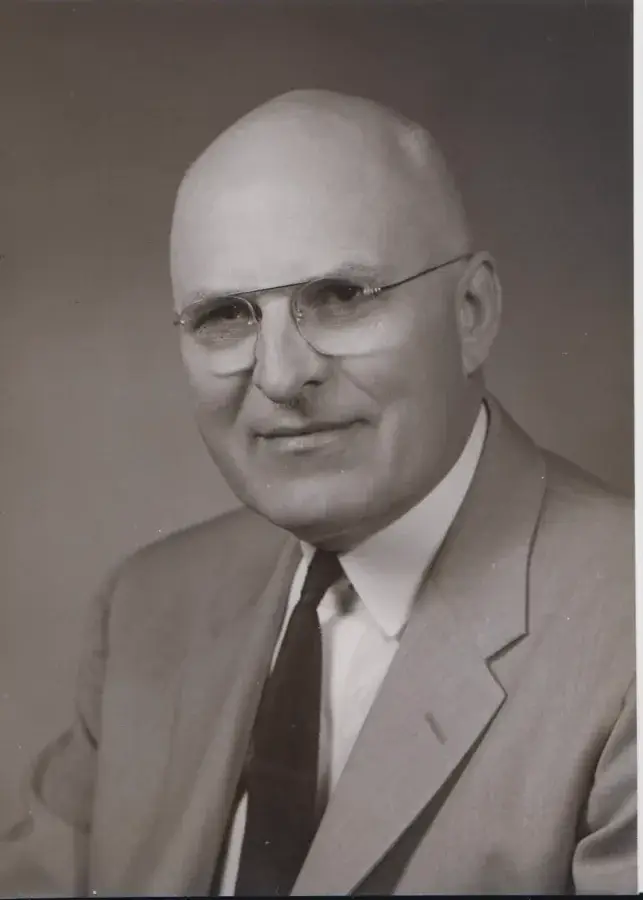
Born
1896 · Milo, Iowa
Died
September 1982
Trained
Palmer School of Chiropractic, June 22, 1917
Founded
Central College of Chiropractic, 1922
Led
President in Kansas City, 1922 to 1967
Second campus
Cleveland Chiropractic College of Los Angeles, 1955
Milo, Iowa to Davenport
Carl S. Cleveland Sr. trained at the Palmer School and graduated in June 1917
Carl S. Cleveland Sr. was born in 1896 in Milo, Iowa, to Thomas Bledsoe Cleveland and Margaret Birney Greenfield Cleveland. He enrolled at the Palmer School of Chiropractic in Davenport, Iowa, and graduated on June 22, 1917. His first office opened that same year in Webster City, Iowa. Every institution he built afterward ran through a classroom.
Cleveland bought the Palmer spinography course in 1916
B.J. Palmer split the spinography and X-ray instruction off from the regular Palmer course on May 1, 1916 and sold it separately for twenty five dollars. The Fountain Head News printed the list of students who enrolled before the price doubled that July. Ruth Ashworth is number two on that list. Carl S. Cleveland is number eight. Both of them paid for imaging training before either of them held a diploma.
The Clevelands married at the Palmer home in Davenport in 1917
Carl Cleveland and Ruth Ashworth married in 1917 at the home of B.J. and Mabel Palmer. A Lincoln Star notice recorded that Dr. John Craven read the service, that Mabel Palmer acted as matron of honor, and that B.J. Palmer attended the groom. Ruth's mother traveled from Nebraska for the wedding. The marriage joined two chiropractic families in the second decade of the profession.
The family moved to Kansas City in 1919
Carl and Ruth Cleveland practiced briefly in Iowa, where their son Carl S. Cleveland Jr. was born in 1918. The family moved to Kansas City, Missouri the following year and took up residence at 436 Prospect Avenue. Ruth Cleveland completed her own Palmer degree on April 30, 1919. The Prospect Avenue address became a chiropractic college three years later.
Ruth R. Cleveland
Ruth R. Cleveland co-founded the Kansas City college and taught in it for nearly twenty years
Every account the institution publishes about itself names Ruth Rose Ashworth Cleveland a founder. She was born on January 29, 1895 in Wisner, Nebraska. She graduated from the Palmer School of Chiropractic in April 1919 and worked inside the college from its opening in 1922 until the early 1940s.
Ruth Cleveland grew up inside the first generation of the profession
Sylva L. Ashworth, Ruth's mother, graduated from Palmer in 1910 and built one of the busiest chiropractic practices in Nebraska. Ashworth sat on the Nebraska Board of Chiropractic Examiners and became president of the Universal Chiropractors' Association in 1926. She took two of her children with her to Davenport when she went to school in 1909. Ruth Cleveland's chiropractic education began well before she enrolled in a school.
The college names three founders and she is one of them
Cleveland University-Kansas City lists its founders as Dr. C.S. Cleveland Sr., Dr. Ruth R. Cleveland and Dr. Perl B. Griffin. All three were Palmer graduates. The 2010 college catalog gives the same three names in the same order. Her standing as a founder is institutional record rather than family tradition.
The Kansas City library carries her name
The College Blue Book lists the Kansas City campus library at roughly 14,000 books, 36,500 microform titles and 268 serials, under the name the Ruth R. Cleveland Memorial Library. A school with two Clevelands to choose from named its library after her.
Ruth Cleveland returned to Nebraska in 1940 and practiced with her mother
The Lincoln Sunday Journal and Star ran an item on August 25, 1940 headed "Mother and Daughter, Chiropractors," reporting that Dr. Ruth Cleveland had joined Dr. Ashworth in practice in Lincoln. Her later career left almost no published trace. Judy Nash reconstructed it from personal letters for Chiropractic History in 1999 and put her life at eighty years. Sylva Ashworth moved to Kansas City in 1954 to live with her daughter and died there on June 4, 1958.
436 Prospect Avenue, 1922
The Central College of Chiropractic opened in the Cleveland family home in 1922 with three students
Carl Cleveland, Ruth Cleveland and Perl B. Griffin opened the Central College of Chiropractic at 436 Prospect Avenue in Kansas City in 1922. The State of Missouri chartered it as a nonprofit organization that same year. Three students enrolled in the first class. The college graduated its first doctor of chiropractic in 1924 and has operated continuously ever since.
Perl B. Griffin was the third founder and Cleveland's brother in law
Perl B. Griffin graduated from the Palmer School of Chiropractic in September 1917, three months after Cleveland. Joseph Keating's archival notes identify Griffin as C.S. Cleveland's brother in law and as a co-founder of the Kansas City college. R.C. Jackson joined the three founders on the early faculty. Four people made up the teaching staff.
Students renamed the school Cleveland Chiropractic College in 1924
The school opened under the name Central College of Chiropractic and kept it for two years. The students asked for the change, and in 1924 it became Cleveland Chiropractic College. The Missouri incorporation papers for the original name were issued in November 1923. The college moved to 1417 Linwood Boulevard in March 1924.
The first curriculum ran twenty seven months and included dissection
Dissection and radiography were in the Kansas City program from the first class, inside a course that ran twenty seven months. Missouri's 1927 statute later set twenty seven months as the requirement to sit the state board. A college teaching cadaver dissection and radiography in 1922 was making a claim about what a chiropractor needs to know.
Cleveland led the Kansas City college for forty five years
Cleveland served as president of the Kansas City college from its founding in 1922 until 1967, when his son took the office. He remained president of the Los Angeles college until 1982. Dynamic Chiropractic counted sixty years as a chiropractic college president when he retired in 1982. No one else in this section held a college presidency that long.
Founded before the law allowed it
Cleveland opened his college five years before Missouri legalized chiropractic practice
Missouri's first chiropractic statute passed in 1927, five years after the Central College of Chiropractic opened. It created a state board. Applicants had to hold the equivalent of a high school education, complete twenty seven months of chiropractic training, and pay a ten dollar license fee. For the college's first five years, every graduate walked into a state where the practice had no legal standing.
Cleveland funded the families of jailed chiropractors
Chiropractors across the country were being arrested and charged with practicing medicine without a license through the 1920s. Cleveland raised money to feed the families of jailed doctors and supplied them with portable tables so they could keep adjusting patients from inside the jails. Dynamic Chiropractic reports that he also hired brass bands to play outside the jails to publicize the arrests. A Cleveland College photograph from about 1921 shows Dr. Fred Courtney adjusting a patient in his cell.
The jailings ran nationwide through the 1920s
By 1931 the profession estimated it had absorbed roughly 15,000 prosecutions, against a population of no more than about 12,000 practicing chiropractors. D.D. Palmer served the first sentence in 1906. Willard Carver was convicted and jailed in Oklahoma. Herbert Reaver went to jail four times in Ohio. Cleveland's answer to that campaign was to keep producing graduates.
A school is harder to prosecute than a practitioner
An arrest removes one chiropractor from practice for the length of a sentence. A college that graduates a class every year replaces them faster than the courts can remove them. The college graduated a class a year through the whole of that period. Missouri passed its first chiropractic statute in 1927.
Two Associations represent more people than one can ever hope to represent. I believe it is better for Chiropractic to have two than one, one a check on the other, and yet working side by side for Chiropractic.
C.S. Cleveland, D.C., letter to Sylva L. Ashworth, D.C., August 10, 1926, Cleveland Chiropractic College archives, Kansas CityUnity in essentials
Cleveland argued for a unified profession while the leadership around him argued for purity
Cleveland stayed aligned with B.J. Palmer and the Chiropractic Health Bureau, the body that became the International Chiropractors Association, through the neurocalometer split of 1924. Joseph Keating and Carl S. Cleveland III record that he followed a less strident and less extreme course inside straight chiropractic than his Davenport mentor did. That moderation is the reason his school outlived the quarrel.
He published the unity argument in 1933
Cleveland's article "Unity in essentials, liberty in non-essentials, pleads this leader!" ran in The Chiropractic Journal of the National Chiropractic Association in July 1933. The title is the whole position. Agree on the core, allow difference on the rest, and keep the profession in one room. He had written the same argument privately to Sylva Ashworth seven years earlier.
The International Chiropractic Congress made him head of its school leaders
Cleveland's moderate position found favor in the unification effort centered on the International Chiropractic Congress. He served from 1931 to 1933 as president of the Congress division for school leaders. That put the head of a young Kansas City college in charge of the room where curriculum standards were argued. The role is documented in the Journal of Manipulative and Physiological Therapeutics.
Cleveland taught full spine analysis and kept diagnosis in the curriculum
The Cleveland college carried a full spine approach to technique and always included diagnostic instruction. Students learned to analyze and adjust the entire column rather than one region of it. The Palmer School was narrowing toward the upper cervical in the same years, which makes the Cleveland position a deliberate analytical claim. It still identifies a Cleveland graduate.
Sylva Ashworth certified the college in writing
Ashworth signed a statement, kept in the Cleveland papers and dated to about 1925, ranking the school second only to the Palmer School of Chiropractic. She signed it as president of the Nebraska State Board of Chiropractic Examiners and vice president of the Universal Chiropractors' Association. A sitting state board president was putting her name behind a three year old college.
This is to certify that I consider the Cleveland Chiropractic College, one of the best in the country. Second only to the P.S.C.
Sylva L. Ashworth, D.C., signed statement, circa 1925, Cleveland Chiropractic College archives, Kansas CityDepression, Troost Avenue, and a second campus
The college survived the Depression and expanded to two campuses on opposite coasts
Cleveland Chiropractic College moved to 37th Street and Troost Avenue in 1929 and stayed on that site for nearly fifty years. Keating and Cleveland describe the college's fight for economic survival through the Depression as the measure of its founders' commitment. Enrollment at every chiropractic school in the country collapsed in those years. The Kansas City school did not close.
A children's clinic opened on Troost Avenue in 1952
The board of trustees of the Cleveland Chiropractic College Crippled Children's Clinic and Hospital met for the first time in 1952 at 3724 Troost Avenue. Carl S. Cleveland Sr. and Carl S. Cleveland Jr. both sat on it, alongside J.R. Gilman and B.O. Boring. Mildred Cleveland directed the children's clinic for many years afterward.
Cleveland took over the Ratledge college in Los Angeles
Tullius Ratledge founded his chiropractic school in Guthrie, Oklahoma in 1908 and moved it to Los Angeles in 1911. Ratledge was himself jailed for practicing chiropractic. In 1951 he transferred management of the Los Angeles college to Cleveland, and in 1955 the school was rechartered as Cleveland Chiropractic College of Los Angeles. One of the oldest teaching lines on the West Coast passed into the Cleveland system.
Two campuses taught one curriculum
The Los Angeles campus moved to North Vermont Avenue in 1976 and ran until 2011, when its operations consolidated into Kansas City. For more than half a century the same full spine curriculum was taught in Missouri and in California. Cleveland Sr. presided over the Los Angeles school until 1982. He died in September of that year.
Three generations at the head of one school
Three generations of Clevelands have led the college and five generations of the family have practiced
Carl S. Cleveland Sr. led the Kansas City college from 1922 to 1967. Carl S. Cleveland Jr. led it from 1967 to 1981 and then led the Los Angeles college from 1982 to 1992. Carl S. Cleveland III became president in Kansas City in 1982 and has led the combined institution since the two campuses merged into one system in 1991. No other family in chiropractic holds a comparable record.
Carl S. Cleveland Jr. graduated from his parents' college in 1942
Carl S. Cleveland Jr. was born in 1918 and took a bachelor of science in physiology from the University of Nebraska before entering the family school. He graduated from Cleveland Chiropractic College in Kansas City in 1942. He hosted a televised patient education series called "So You May Know" from 1955, carried on KCMO in Kansas City and KCOP in Los Angeles. He served as chancellor of the two campus system until his death on July 23, 1995.
Mildred Allison Cleveland ran the clinic for more than thirty years
Mildred Allison married Carl S. Cleveland Jr. in 1939 and graduated from the Kansas City college in 1954. She served the college as administrator, faculty member and director of the children's clinic for more than three decades. Judy Nash published the only full account of her career in Chiropractic History in 1998. Two generations of Cleveland women held teaching and clinical posts inside the school.
The counting runs to five generations of chiropractors
Sylva Ashworth graduated from Palmer in 1910. Carl Cleveland Sr. graduated in 1917 and Ruth Cleveland in 1919. Carl Jr. graduated in 1942, Carl III in 1975, and Ashley Cleveland and Carl S. Cleveland IV in 1995 and 2010. Five consecutive generations of one family have practiced chiropractic.
The school is now Cleveland University-Kansas City
The Kansas City campus moved to a thirty four acre site in Overland Park, Kansas in 2008. The institution added undergraduate and graduate degrees and became Cleveland University-Kansas City in 2015. It holds institutional accreditation from the Higher Learning Commission and programmatic accreditation from the Council on Chiropractic Education. The college marked its centennial in 2022.
Transmission and the tone through-line
Cleveland's contribution was transmission, because a method dies with the person who has it
An idea about the nervous system reaches a patient only through a practitioner, and practitioners are made in schools. Cleveland contributed no adjusting method of his own. He built the thing that copies a method into new hands, ran it for forty five years, and handed it to his son. The Unified Model of Tone takes transmission seriously for the same reason he did.
Full spine analysis is a claim about where tension is held
The Cleveland curriculum analyzed and adjusted the whole column rather than one segment. The dura anchors at the foramen magnum, in the cervical spine and at the sacrum, and it carries tension along the entire length of the cord. A distortion held at one end changes the mechanical environment at the other, which is why a regional analysis can miss the site that matters.
There is no single lynchpin, so the analysis has to be wide
A body ordinarily holds several points of critical tension at once, and which one the system is ready to release shifts from week to week. That is the model's position, and full spine analysis is the practical form of it. Reading the whole column is what makes it possible to tell a compensation from a root. Input quality then decides whether the contact that follows reorganizes the system or simply loads it further.
A curriculum is a constraint that outlives its author
Constraint names the standing conditions a system has to work inside. Structure never switches off, and neither does a curriculum. What a school teaches students to look for decides what those doctors can see for forty years of practice. The person who wrote the syllabus is usually dead by then.
Transmission is a statement about time course
A college changes a field slowly and then permanently, because every graduate practices for decades after commencement. Cleveland's first class held three students in 1922, and the institution has run without a break for more than a century. Time course names the same property inside a body. The change that counts is the one that holds after the input stops.
What five generations of Clevelands were adjusting
Tone is the organized state of the nervous system and the tissues under its control. It is readable in heart rate variability, in reflex responsiveness, and in how long a system takes to return to baseline after a demand. Five generations of Clevelands taught students to put hands on a spine and change it. The model gives that variable a name and a way to measure it.
Cleveland among the legends
How Carl S. Cleveland Sr. relates to the rest of the library
Carl S. Cleveland Sr. sits downstream of D.D. Palmer, who named tone as the variable in 1910, and of B.J. Palmer, who taught him and stood up at his wedding. Mabel Palmer taught the anatomy his full spine curriculum rests on. Solon Langworthy made the first argument for the spine as one mechanical column. Willard Carver founded seven schools and was jailed for the practice Cleveland raised money to defend. Joseph Janse ran the same argument about rigor from the other wing of the profession. Sid Williams repeated the institution building move fifty years later in Georgia. The methods those schools carry are cataloged across the technique library, and the full hall of legends traces the line whole.
Common questions
Questions about Carl S. Cleveland Sr. and Cleveland Chiropractic College
Who was Carl S. Cleveland Sr.?
Carl S. Cleveland Sr. (1896 to 1982) was an American chiropractor and chiropractic educator who founded the Central College of Chiropractic in Kansas City, Missouri in 1922 with his wife Ruth R. Cleveland and Perl B. Griffin. He graduated from the Palmer School of Chiropractic on June 22, 1917. The school was renamed Cleveland Chiropractic College in 1924. He led it until 1967 and remained president of its Los Angeles campus until 1982.
When was Cleveland Chiropractic College founded?
The college opened in 1922 at 436 Prospect Avenue in Kansas City, Missouri, in the Cleveland family residence, and was chartered by the State of Missouri as a nonprofit. It opened under the name Central College of Chiropractic with three students and graduated its first doctor of chiropractic in 1924. Students petitioned for the name change to Cleveland Chiropractic College that same year. It became Cleveland University-Kansas City in 2015.
Who was Ruth R. Cleveland?
Ruth Rose Ashworth Cleveland (born January 29, 1895 in Wisner, Nebraska) was a co-founder of Cleveland Chiropractic College and a Palmer graduate in her own right, taking her degree on April 30, 1919. She was the daughter of Sylva L. Ashworth, one of the first women in the profession. She worked inside the Kansas City college until the early 1940s, then practiced with her mother in Lincoln. The campus library was named for her.
How many generations of the Cleveland family have run the college?
Three generations have led it. Carl S. Cleveland Sr. was president in Kansas City from 1922 to 1967, Carl S. Cleveland Jr. from 1967 to 1981, and Carl S. Cleveland III from 1982 onward, including the combined two campus system after 1991. Counting practitioners rather than presidents, the family line runs five generations, from Sylva Ashworth's Palmer degree in 1910 to Carl S. Cleveland IV in 2010.
What did Cleveland do for chiropractors who were jailed?
Chiropractors were routinely arrested for practicing medicine without a license through the 1920s, and Missouri passed no chiropractic law until 1927. Cleveland raised money to feed the families of jailed doctors and supplied portable tables so they could keep adjusting patients from their cells. Dynamic Chiropractic reports that he hired brass bands to play outside the jails to publicize the arrests. By 1931 the profession counted roughly 15,000 prosecutions nationally.
What did Carl S. Cleveland Sr. contribute to the understanding of tone?
Cleveland contributed transmission rather than analysis. He built and ran for sixty years the school that copied a method about the nervous system into new hands, and two more generations kept it running. His curriculum committed to full spine analysis, which matches the model's claim that tension travels the whole dural column and that no single site is the lynchpin. The Unified Model of Tone states that claim in measurable terms.
Sources
References
- Keating JC, Cleveland CS. Cleveland chiropractic: the early years, 1917-1933. J Manipulative Physiol Ther. 1996;19(5):324-43.
- Nash J. Ruth Rose Ashworth-Cleveland: a pioneer's journey as seen through personal letters. Chiropr Hist. 1999;19(1):33-44.
- Nash J. Dr. Millie Cleveland: chiropractic achiever. Chiropr Hist. 1998;18(1):47-51.
- Keating JC, Cleveland CS. Sylva L. Ashworth, D.C., the "Grand old lady of chiropractic". Chiropr Hist. 1992;12(2):15-23.
- Keating JC. Sylva L. Ashworth, D.C., the Grand Old Lady of Chiropractic. National Institute of Chiropractic Research chronology. Source of the 1916 Fountain Head News spinography enrollment list and the 1917 Lincoln Star wedding notice. Also the source of the August 10, 1926 Cleveland letter, the circa 1925 Ashworth certification, and the August 25, 1940 Lincoln Sunday Journal and Star item.
- Cleveland CS Sr. Unity in essentials, liberty in non-essentials, pleads this leader! The Chiropractic Journal (National Chiropractic Association). 1933 July;1(7):9.
- Cleveland University-Kansas City. The Cleveland Story. Institutional history, founders, and the Ratledge transfer.
- Cleveland University-Kansas City. Our Journey in Time. Centennial timeline, 1874 to 2022, source of the Missouri 1927 statute terms and the Cleveland family dates.
- Cleveland Chiropractic College. Catalog 2010-2011, pages 1 to 3. Founders, 1929 Troost move, Ratledge chronology, and the 1991 multicampus merger.
- Dynamic Chiropractic Staff. Five Generations of Chiropractic. Dynamic Chiropractic, July 1995. Source of the jail relief work, the brass bands, and the presidency dates.
- Dynamic Chiropractic Staff. A Moment of Silence for Carl S. Cleveland Jr.. Dynamic Chiropractic, September 1995.
- Kent C. Paying the Price: Going to Jail for Chiropractic. Dynamic Chiropractic. Source of the 15,000 prosecutions figure, citing Keating, Cleveland and Menke, Chiropractic History: a Primer (2004).
- Kimbrough ML. Jailed chiropractors: those who blazed the trail. Chiropr Hist. 1998;18(1):79-100.
- Wikipedia. Cleveland University-Kansas City. Name changes and current accreditation.
This page is education and history, not medical advice. Dates, names and quotations are taken from the institution's own published record, from indexed scholarship in Chiropractic History and the Journal of Manipulative and Physiological Therapeutics, and from Joseph C. Keating Jr.'s archival chronologies, with each source named in the references.