
Our Approach · The Legends · Era V
Era V · 1933 to 2014
Jim Sigafoose
The Itinerant
James Sigafoose (1933 to 2014) graduated from National College of Chiropractic in 1959 and practiced in New Freedom, Pennsylvania. The office recorded more than 2,000 patient visits a week. He became a founding trustee of Life Chiropractic College in 1974 and taught from seminar platforms on five continents for half a century. His subject was the state the practitioner brings to the table. The Unified Model of Tone states that claim in measurable terms.
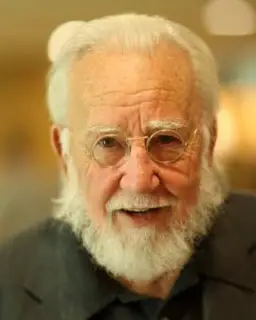
Born
Aug 29, 1933 · Winchester
Died
July 3, 2014 · age 80
Trained
National College of Chiropractic · 1959
Practice
New Freedom, Pennsylvania · from 1959
Founding trustee
Life Chiropractic College · 1974
Seminars
The Gatherings · from 1989 · five continents
Award
ICA Herbert Ross Reaver Award · 2014
The record he left
James Sigafoose founded no technique, and the record of his teaching is mostly spoken
Sigafoose is among the most quoted names in modern chiropractic and among the least documented. He held no patent. He wrote no textbook that entered the profession's teaching canon. He attached his name to no adjusting method. For fifty years he worked from a platform, and most of what he said there was never written down.
What survives in print is enough to place him. Sigafoose graduated from National College of Chiropractic in 1959. He built a practice in New Freedom, Pennsylvania that recorded more than 2,000 patient visits a week. He became a founding trustee of Life Chiropractic College in 1974 and taught on five continents until the year he died.
What the documented record covers
Dated facts about Sigafoose come from three kinds of source. Indexed obituaries carry his birth, schooling, military service, marriage and death. Association statements carry his awards and his offices. A long memorial written by Gerard Clum, DC, in Dynamic Chiropractic in October 2014 carries the practice figures and the sequence of the turn in his career. Clum led Life Chiropractic College West for thirty years and knew the events at first hand.
Why so few Sigafoose lines are quotable
Sigafoose produced audio and video teaching material used by chiropractors worldwide, according to the statement the International Chiropractors Association issued on his death in July 2014. Almost none of the seminar record was transcribed and published. Lines attributed to him circulate widely in practice coaching with no located source. Two statements survive in print with an attribution attached: the mantra the ICA published in 2014, and the description of his platform method recorded by Clum.
Dundalk to Chicago
Sigafoose reached chiropractic through the Army, graduating from National College of Chiropractic in 1959
Sigafoose was born on August 29, 1933, in Winchester, the son of Harry and Kitty Sigafoose. He grew up on the Chesapeake Bay in the Baltimore area. He graduated from Dundalk High School in 1951 and was drafted into the United States Army, where he trained as a sharpshooter and served in the Military Police until his honorable discharge in 1954. He married Patsy on December 4, 1954, and the marriage lasted sixty years.
National College of Chiropractic, 1955 to 1959
The Sigafooses left Baltimore for Chicago in 1955, where he enrolled at the National College of Chiropractic. Three children were born while he was a student: Chriss, Tina and Kieth. He graduated in 1959. Clum records that Sigafoose left National convinced that chiropractic treated mechanical pain of mechanical origin. In his own description of those years he was a musculoskeletal specialist.
Saegertown, then New Freedom
Sigafoose practiced briefly in Saegertown, Pennsylvania, then moved his family back toward Baltimore and settled in New Freedom. The first years were lean. Clum puts the practice at roughly 25 patient visits a week through the middle 1960s. Clum describes Sigafoose in those years as unhappy and unfulfilled in the work.
Atlanta, 1968
A 1968 seminar changed what Sigafoose believed an adjustment was, and his practice volume followed within three months
The turn in Sigafoose's career is the best documented event in his life, because he retold it from the platform for the next forty-six years. A death preceded it. His son Dean died in early childhood of bacterial meningitis. Sigafoose had never considered adjusting the sick infant, because a sick infant sat outside what he then believed chiropractic was for. Clum records that Sigafoose carried the question for the rest of his life.
Harrisburg, and hearing Sid Williams
A Palmer graduate named Clark Rich, DC, practiced in the coal country at Clearfield, Pennsylvania. Rich pressed Sigafoose to travel to Harrisburg and hear a young Atlanta chiropractor named Sid Williams. Sigafoose went and left angry, because Williams had attacked the premise his practice was built on. He went back a second time. In 1968 he attended a Life Dynamic Essentials meeting at the Atlanta Airport Hilton, and the old practice ended there.
What he took out of the office
Sigafoose drove back to New Freedom and cleared out the therapy machines and the gowns. The change was in what he thought the adjustment did. He now held that an adjustment removed interference with the body's own regulation. On that account the procedure belonged to the sick infant exactly as much as to the injured adult.
Twenty-five visits a week to more than two thousand
The practice went from about 25 visits a week to hundreds inside three months, according to Clum. The office outgrew its building. The clinic that replaced it seated 300 people in the waiting room, and for years the practice recorded more than 2,000 patient visits a week. Patients arrived from the county, from other states and from other countries. Those figures are why the profession started watching him.
Removing barriers
Sigafoose grew the practice by removing the cost of finding out, and the profession divided over his methods
Sigafoose followed Sid Williams in treating access as the main obstacle to chiropractic. He offered x-ray services to his community at no charge. He spoke to any room that would hold a meeting.
The chicken dinner lectures
His best known device was the free chicken dinner lecture, a public meal at which he explained chiropractic to people who had never had it explained. Clum names these gatherings the country ancestor of what other professions later called the lunch and learn. The mechanism was plain. Sigafoose removed the price of a first conversation, then spoke without qualification about what he believed the nervous system did.
The divided reaction
Clum, writing in 2014, records that many chiropractors set out to copy Sigafoose while others worked to restrict and curtail his activities. He was a figure of the practice management era, and the volume practice in New Freedom became one of the models that era argued about. Sigafoose never defended it in print. He taught it from the platform and left the figures where they stood.
In 1970 Williams and D.D. Humber, DC, gave him the name Sigafoose the Great from the Life Dynamic Essentials stage in Atlanta. It followed him for the next forty-four years.
Dynamic Essentials
Sigafoose became the leading voice of the Dynamic Essentials platform and a founding trustee of Life Chiropractic College
Sid Williams founded the Dynamic Essentials meetings in November 1964. Sigafoose first spoke at them in the late 1960s. Clum records that by the 1970s his session drew an audience rivaling Williams' own opening address on the Thursday afternoon.
Ormond Beach, spring 1974
In the spring of 1974 Patsy Sigafoose organized a trip to Ormond Beach, Florida at Williams' request, bringing together the doctors closest to him. The conversation there produced the plan for a new chiropractic college. Jim and Patsy Sigafoose were inside those discussions, and Sigafoose became a founding trustee of the school that resulted.
What Life became
Life Chiropractic College was chartered on September 12, 1974, and opened to 22 students in January 1975. It grew into the largest chiropractic college in the world and is now Life University. Sigafoose's own children later graduated from it. Clum records that no family has sent more brothers and sisters through the school.
To serve for the sake of serving, to give for the sake of giving, and to love for the sake of loving.
James Sigafoose, his stated mantra, published by the International Chiropractors Association, July 2014The Gatherings
From 1989 Sigafoose taught in small rooms on five continents under the name The Gatherings
Sigafoose moved to Venice, Florida in 1980. His practice emphasis fell away through the 1980s as demand for his teaching rose. In 1989 he began convening meetings of his own, small and medium groups of chiropractors who came to be taught directly rather than to buy a system. Clum records dozens of cities across five continents.
What he taught from
Sigafoose read and reread B.J. Palmer's Green Books across his whole career, taking more out of them on each pass. He drew on Christianity and on Native American tradition, and Clum records that he treated both as compatible with Palmer's writing. He read history, and the Second World War in particular. He held few offices and stayed out of association politics.
The mission trips
Sigafoose ran mission trips to Panama and Haiti, adjusting people with no access to care. The cases he saw on those trips became the material of his talks. Those trips are the practical form of the position he taught from 1968 onward: the adjustment belongs to everyone, and the practitioner's work is to deliver it rather than to qualify it.
How he opened a talk
Clum describes the method Sigafoose used at the front of a room. He would begin with no notes and no plan, tell the audience he was waiting for the message, and then speak for an hour. Read as showmanship the habit explains nothing. Read as method it describes a teacher who refused to run a script before he had read the room he was standing in.
Six chiropractors
Six of the seven Sigafoose children became chiropractors
Jim and Patsy Sigafoose had seven children. Chriss, Tina and Kieth were born while he was a student at National College. The twins Dean and Daun followed in 1960, Selina in 1965 and Carey in 1967. Dean died in childhood. Chriss died years later of complications of colon cancer. The remaining six all became Doctors of Chiropractic, and most graduated from Life. Selina married Kevin Jackson, DC, a Life graduate from Canada.
The ICA recorded in July 2014 that a son-in-law, a nephew and a daughter-in-law were chiropractors as well. At the June 2014 ICA banquet where Sigafoose was honored, Selina Sigafoose Jackson was inducted into the Fellows of the association.
June and July 2014
Sigafoose gave his last keynote in June 2014 and received the ICA Herbert Ross Reaver Award at the same meeting
In June 2014 Sigafoose delivered the keynote address at the annual meeting of the International Chiropractors Association in Overland Park, Kansas, on the campus of Cleveland Chiropractic College. The ICA Board of Directors had selected him unanimously as the 2014 recipient of the Dr. Herbert Ross Reaver Award, and he was honored at the convention banquet.
The award and the man it is named for
The Reaver Award carries the name of Herbert Ross Reaver, DC, who was arrested and jailed repeatedly in Ohio for practicing chiropractic before the state licensed the profession. The ICA gives the award for courage and sacrifice on behalf of chiropractic. Sigafoose received it for half a century of teaching.
July 3, 2014
Less than a week after the keynote Sigafoose suffered an anterior cerebral artery stroke. He died at home on July 3, 2014, at the age of 80, with Patsy and their children beside him. Michael S. McLean, DC, then president of the ICA, issued the association's statement the same week.
He was a mentor and inspiration to countless thousands of chiropractors around the world, myself included.
Michael S. McLean, DC, president of the International Chiropractors Association, statement on the death of James Sigafoose, July 2014The practitioner as a variable
Sigafoose taught that the practitioner's certainty changes the adjustment, and the model names the mechanism correspondence
The technique founders in the Legends section all worked on the input. Gonstead worked on the listing, Fuhr on the speed, Grostic on the vector. Sigafoose worked on the practitioner. His whole subject was the state a doctor is in when the contact is made, and his claim was that a doctor who does not believe the adjustment matters will not deliver one that does. Stated that way it sounds like exhortation. Stated in the terms of the Unified Model of Tone it is a physiological claim with a measurement attached.
What the expectancy research measures
The practitioner's state is a measured variable in the pain literature. Gracely and colleagues reported in the Lancet in 1985 that what the treating clinicians expected altered the analgesia patients got from a placebo. Chen and colleagues, working with three independent samples in 2019, manipulated only the provider's belief about which cream was active. Patient pain ratings, skin conductance responses and facial expression behavior all moved with the provider's belief, and the providers' own facial behavior changed with it too.
Howe, Goyer and Crum ran the sharper version in 2017. They induced a real allergic reaction with a histamine skin prick, applied an inert cream, and set the expectation either up or down. The effect of that expectation on the allergic response grew when the provider acted warmer and more competent, and it was cancelled when the provider acted colder and less competent. The practitioner's manner decided whether the expectation reached the skin at all.
What the pooled numbers actually say
Kelley and colleagues pooled 13 randomized trials in 2014 in which the patient and clinician relationship was manipulated directly and the outcome was objective or validated. The pooled effect was small and statistically significant, at d = 0.11 with p = 0.02, with individual trial effects running from d = -0.23 to d = 0.66. A spread that wide across thirteen trials is the finding, and the model has a specific account of it. The same input produces different outcomes because it lands on different tone.
What the manual therapy literature already concedes
Bialosky and colleagues made the same argument inside manual therapy. In 2010 they identified patient expectation as an influential factor in musculoskeletal outcomes that clinicians routinely fail to account for. In 2011 the same group argued that what gets filed under placebo is an active hypoalgesic mechanism present in every manual intervention, shaped by expectation, mood and conditioning. The model files it differently. Nothing in the encounter is inert, so the word placebo has no work to do. Expectation and contact are two channels of one input arriving at one tone.
Correspondence is the active ingredient, and certainty is how a practitioner arrives at it
In the model the effect of an input is set by how well it corresponds to the place and the moment the system can use. A body ordinarily holds several points of critical tension at once, and which one it is ready to release shifts from week to week. There is no single hidden lynchpin to discover. A leverage point is a place where a small input moves the whole system. The clinical work is deciding which real leverage point this body can use today, and that decision is the thing Sigafoose was training. Force applied to a compensation deepens the defense it meets. Input quality is correspondence before it is amplitude.
Certainty shows up in the mechanics of the contact rather than in the manner around it. A practitioner who has decided delivers a shorter setup, an undivided contact and a single clean vector. A practitioner who has not decided delivers hesitation, and hesitation is a different mechanical and sensory event arriving at the patient's nervous system. The receptor stream reports both. So does the predictive machinery that decides what the body does next with the signal.
Reading readiness rather than running a routine
Clum's description of Sigafoose at the front of a room is the same discipline in its public form. He would not open a talk with prepared content because he had not yet read the state of the room. The model makes the same demand at the table. Read the system's present state, then match the input to it. Tone is that state, and it is readable before the outcome is known through the variability of a rhythm, the coupling between two rhythms, and the speed of return after a demand.
The limit of the claim
The claim has a boundary and the model states it plainly. Practitioner certainty is one input among several, and it cannot substitute for a correct contact. What it does is decide whether the contact arrives as an organizing signal or as one more demand on a system already at its limit. That is why the practitioner effect averages to d = 0.11 across a trial population and looks decisive inside a single room. Averaging two opposite responses returns a mean that describes neither of them.
The profession's own vocabulary for this is old. Sigafoose called it conviction. The model calls it correspondence, and the discipline of matching input to readiness is carried forward in Tonal Chiropractic, which pools the analysis of the techniques the other legends built.
Where he sits
Sigafoose belongs to the transmission line of the profession rather than to its technique line
The Legends section holds two kinds of figure. Most of them built an instrument. A smaller group built the means by which ideas moved, and Sigafoose is the clearest case of the second kind in the twentieth century.
The people his work runs through
Sid Williams built the platform Sigafoose spoke from and the college they chartered together in 1974. Reggie Gold argued the position Sigafoose taught from the practice floor, that the adjustment is not a treatment for a condition. Fred Barge put the same position into print without apology. B.J. Palmer wrote the Green Books that Sigafoose read for fifty years. Herbert Reaver went to jail so that the platform existed at all.
The library pages his claim touches
Sigafoose's claim about the practitioner reaches three foundations of this library. Input quality holds the correspondence rule that makes practitioner state part of the input. Prediction holds the machinery that turns an expected signal into a different physiological event from an unexpected one. Why recovery differs holds the reason the same certainty produces different outcomes in different bodies. The Unified Model of Tone is where the three meet.
Questions people ask
Common questions about Jim Sigafoose
Who was Jim Sigafoose?
James Sigafoose, DC (1933 to 2014) was an American chiropractor and seminar teacher. He graduated from National College of Chiropractic in 1959 and practiced in New Freedom, Pennsylvania, where his office recorded more than 2,000 patient visits a week. He became a founding trustee of Life Chiropractic College in 1974 and taught chiropractors on five continents for fifty years. He died on July 3, 2014, at the age of 80.
Did Jim Sigafoose invent a chiropractic technique?
No. Sigafoose founded no named adjusting method, held no patent and produced no proprietary system. His influence ran through teaching rather than through instrumentation. That places him with the transmission figures of the profession rather than with the technique founders, and it explains why his name appears in thousands of practices with no method attached to it.
What did Jim Sigafoose contribute to the understanding of tone?
Sigafoose identified the practitioner's own certainty as a clinical variable. The Unified Model of Tone restates that as correspondence. The effect of an adjustment is set by how well it matches the leverage point the body is ready to use. A practitioner who has decided delivers a different input from one who has not. Certainty is a property of the input, measurable in the setup, the contact and the vector.
What was Jim Sigafoose's connection to Life Chiropractic College?
Sigafoose was inside the discussions at Ormond Beach, Florida in the spring of 1974 that produced the plan for the school, and he became a founding trustee. Life Chiropractic College was chartered on September 12, 1974, and opened with 22 students in January 1975. It is now Life University, the largest chiropractic institution in the world. Several of his children graduated from it.
What were The Gatherings?
The Gatherings were the seminars Sigafoose began convening in 1989, after he had moved to Venice, Florida. They were small and medium sized meetings of chiropractors held in dozens of cities across five continents. Attendees came to be taught directly rather than to buy a practice system. The format ran until the last years of his life and is the main vehicle of his international influence.
Are the quotations attributed to Jim Sigafoose reliable?
Most are not traceable. Sigafoose taught from platforms for fifty years and very little of that record was transcribed and published, so many lines credited to him circulate with no located source. Two statements do carry a source. The International Chiropractors Association published his mantra in July 2014, and Gerard Clum, DC, recorded his platform method in Dynamic Chiropractic in October 2014. Those two are the reliable ones.
Sources
Sources for this page
- Clum GW. The Life and Legacy of James Sigafoose, DC (1933-2014). Dynamic Chiropractic. October 2014. dynamicchiropractic.com
- International Chiropractors Association. ICA and chiropractic community mourn the passing of James Sigafoose. Chiropractic Economics. July 2014. chiroeco.com
- Obituary, Dr. James M. Sigafoose, 1933 to 2014. The Evening Sun, Hanover, Pennsylvania. July 2014. legacy.com
- Life University. History of Life. Charter date and first class. life.edu
- Dynamic Essentials. About DE. Founding of the Dynamic Essentials meetings by Sid E. Williams. lifede.com
- Gracely RH, Dubner R, Deeter WR, Wolskee PJ. Clinicians' expectations influence placebo analgesia. Lancet. 1985;1(8419):43. PubMed 2856960
- Chen PA, Cheong JH, Jolly E, Elhence H, Wager TD, Chang LJ. Socially transmitted placebo effects. Nature Human Behaviour. 2019;3(12):1295-1305. PubMed 31636406
- Howe LC, Goyer JP, Crum AJ. Exploring the influence of physician characteristics on placebo response. Health Psychology. 2017;36(11):1074-1082. PubMed 28277699
- Kelley JM, Kraft-Todd G, Schapira L, Kossowsky J, Riess H. The influence of the patient-clinician relationship on healthcare outcomes. PLoS One. 2014;9(4):e94207. PubMed 24718585
- Bialosky JE, Bishop MD, Cleland JA. Individual expectation, an overlooked but pertinent factor in the treatment of musculoskeletal pain. Physical Therapy. 2010;90(9):1345-1355. PubMed 20592270
- Bialosky JE, Bishop MD, George SZ, Robinson ME. Placebo response to manual therapy, something out of nothing? Journal of Manual and Manipulative Therapy. 2011;19(1):11-19. PubMed 22294849
This page is education and history, not medical advice. Quotations attributed to James Sigafoose are limited to lines that appear in print with a named source. Widely repeated Sigafoose sayings with no located source have been left out.